The story of now.

I pick it up. The book is heavy in my hand. It has a weight, a presence, that gives me great satisfaction. The smoothness of the cover, the flick of the pages, it all sits, and signifies. With the comic now a book - a graphic novel (and from there a graphic pathography), the ethereal settles into being. A block of time and imagination that has now become a thing, an object - a product?
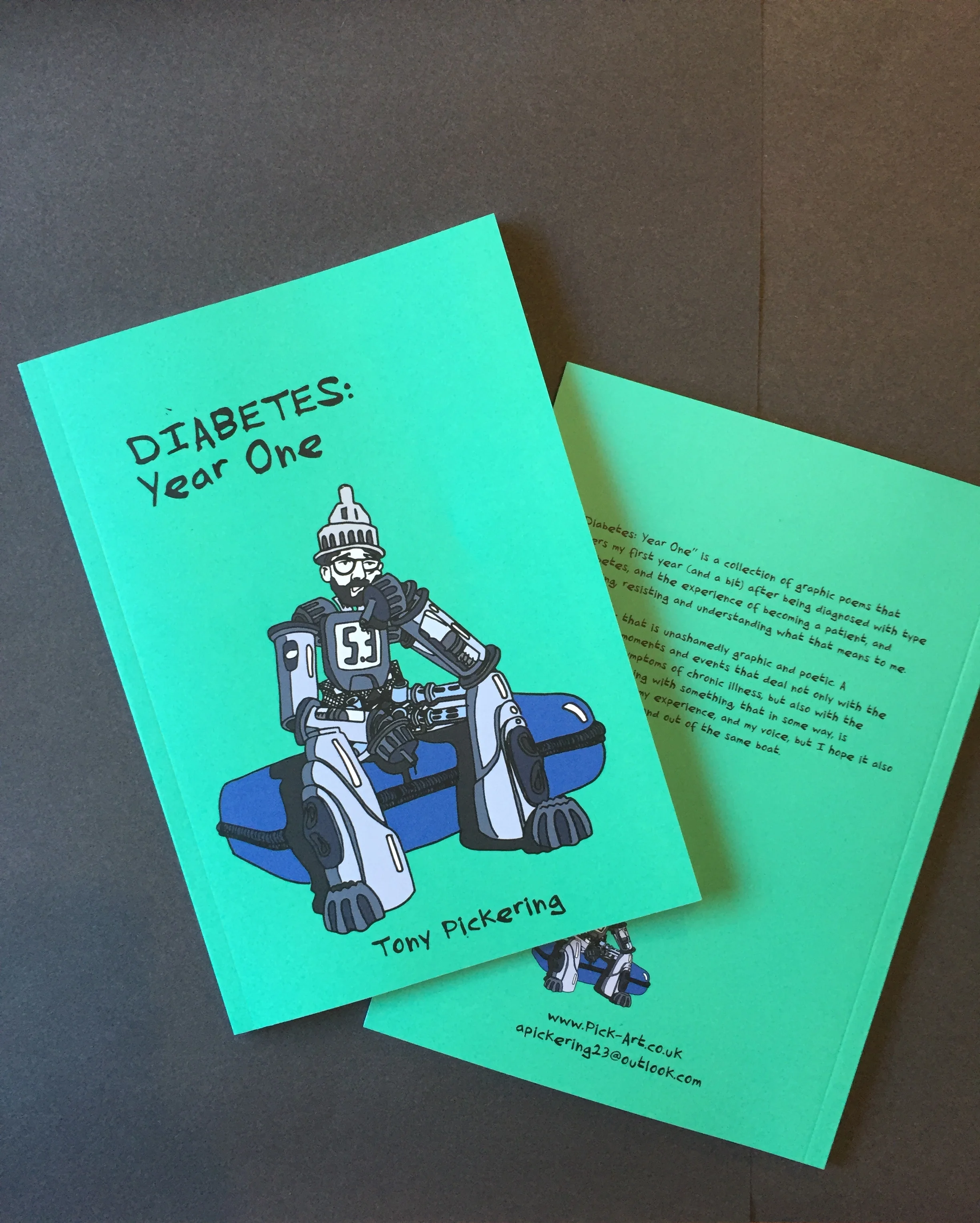
Diabetes: Year One. 2018, by y’know, me. 

Diabetes: Year One. 2018, by y’know, me. 

Diabetes: Year One took up two years to conceptualise, procrastinate and realise. It took diagnosis with a chronic illness, a lot of confusion, drugs trials and squeezing through academic study and research (see my SciArt blogs to see how it started); and now that it’s done I’m really proud of it! But there is much about it, about me and about my process and how it has developed other work I should reflect on (and I really need to get this blog going again) - so here goes. 

The comic - or “Comics” is a medium that takes different forms - words, pictures, sounds, design, stories, symbols and so on, and puts them side by side, splits them apart, then over and underlaps them and lets the reader put them together; but I didn’t know that when I started! I mean I had an inkling, I’ve read comics, graphic novels or whatever for years, but when I found myself saying I should do a graphic novel about type one diabetes I didn’t know where to begin. 

My first thoughts were a miasma of research and experience that kept floating out of reach. Words and images - fragments of prose that became poetry and doodles that began to outline illustrations. With this in my head I sat down in front of the most dangerous of foes, the blank page.

I hate this bit, there’s so much potential to get it wrong - even when you don’t know what it is you’re about to mess up, so really shouldn’t be able to mess it up, all I can think of is how I’ll mess it up! And this is both silly, and, more annoyingly, fucking frustrating! As a result I harness all my well stored anger management issues and invariably just try to draw or do something - expecting it to be bad, but hoping it just might have something. 
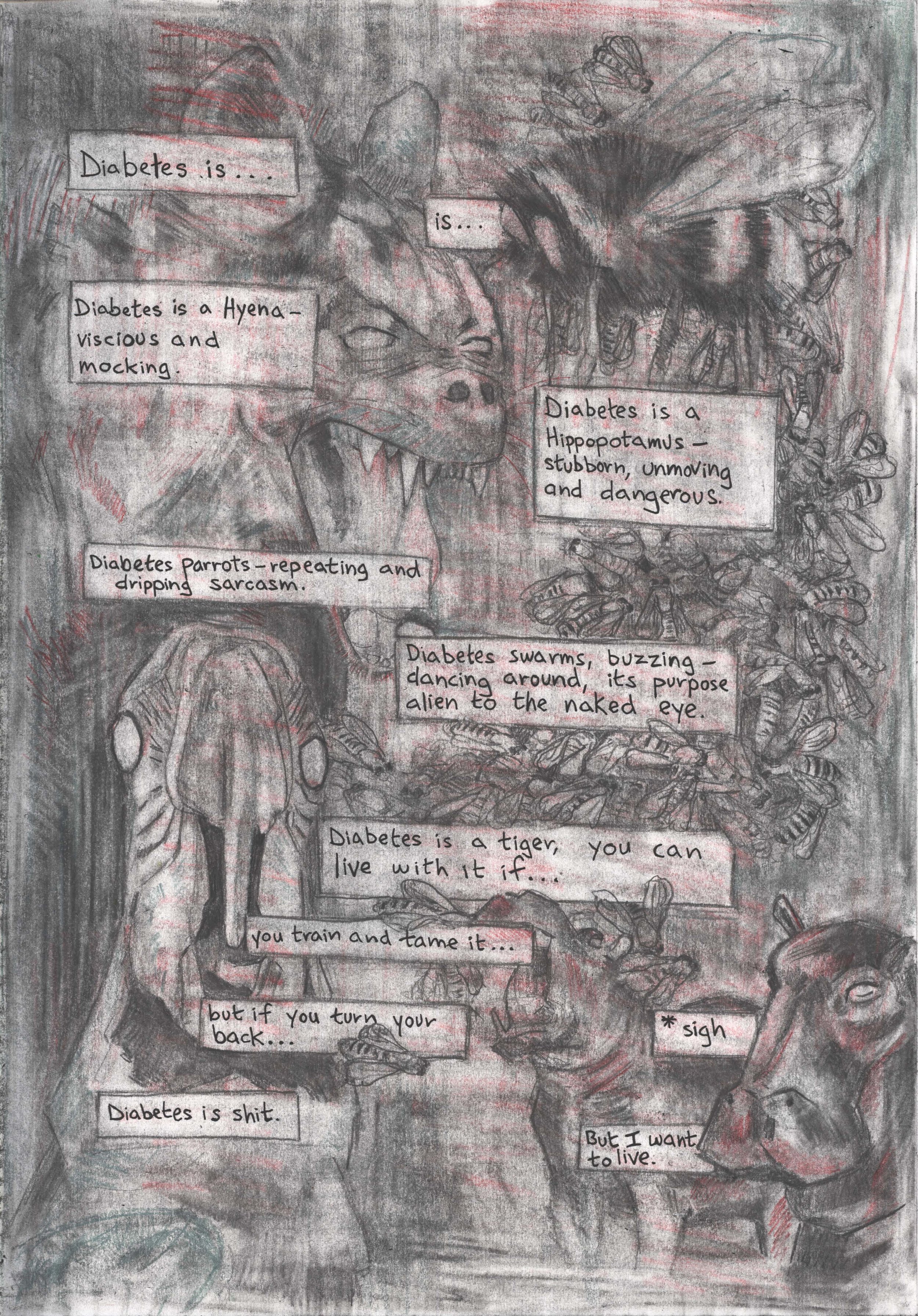
My first, unused page.  

My first, unused page.  

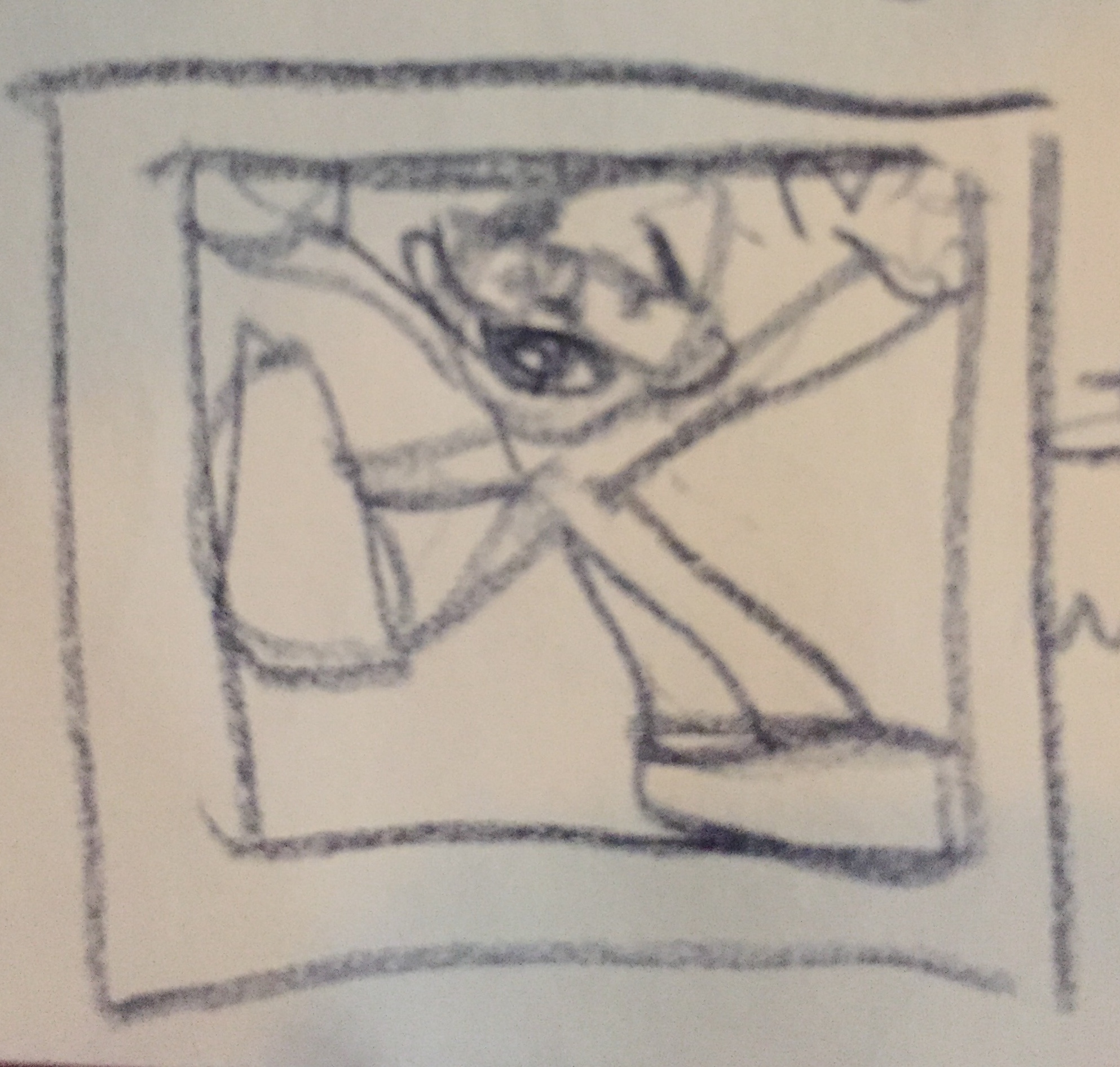
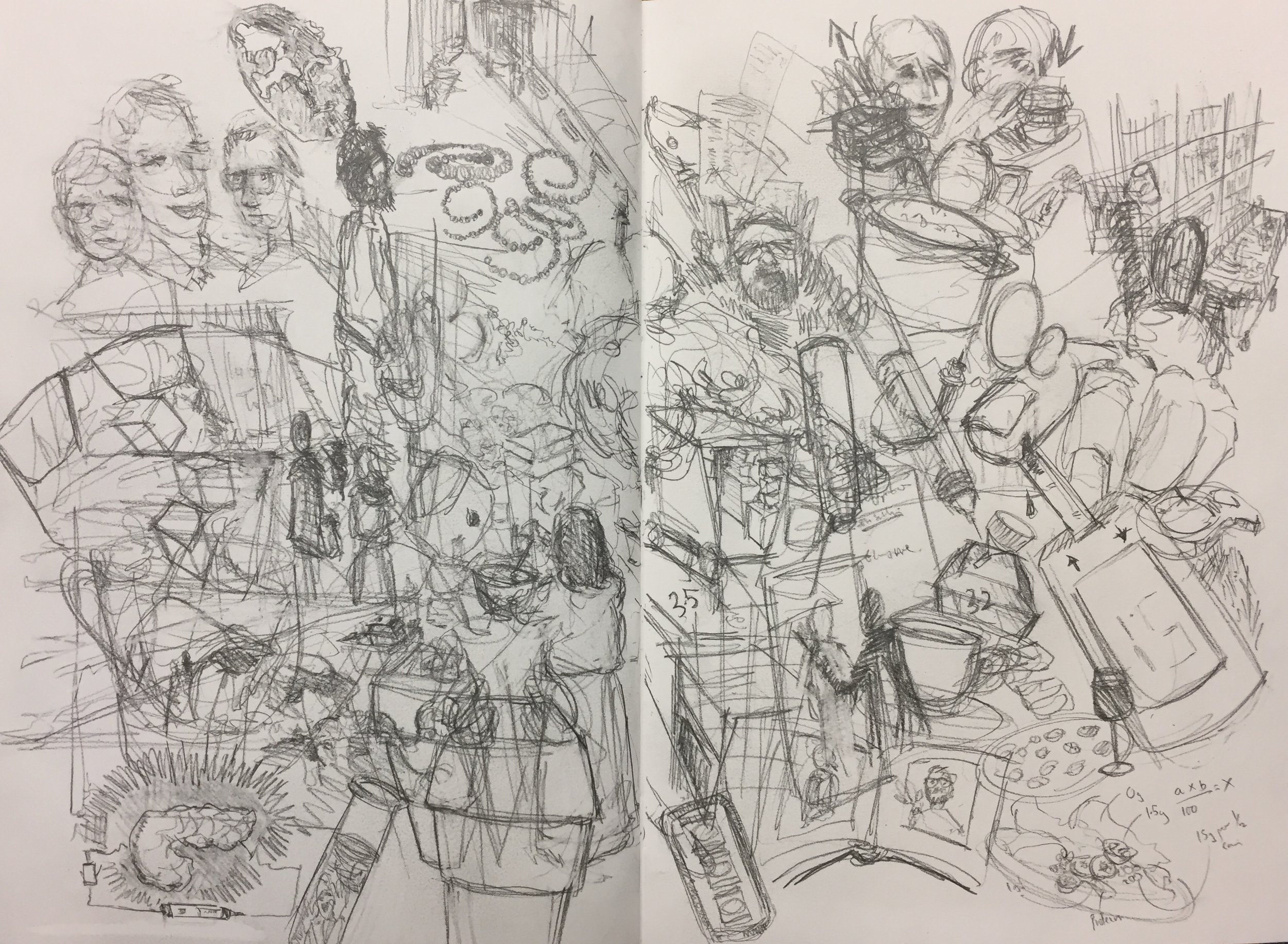
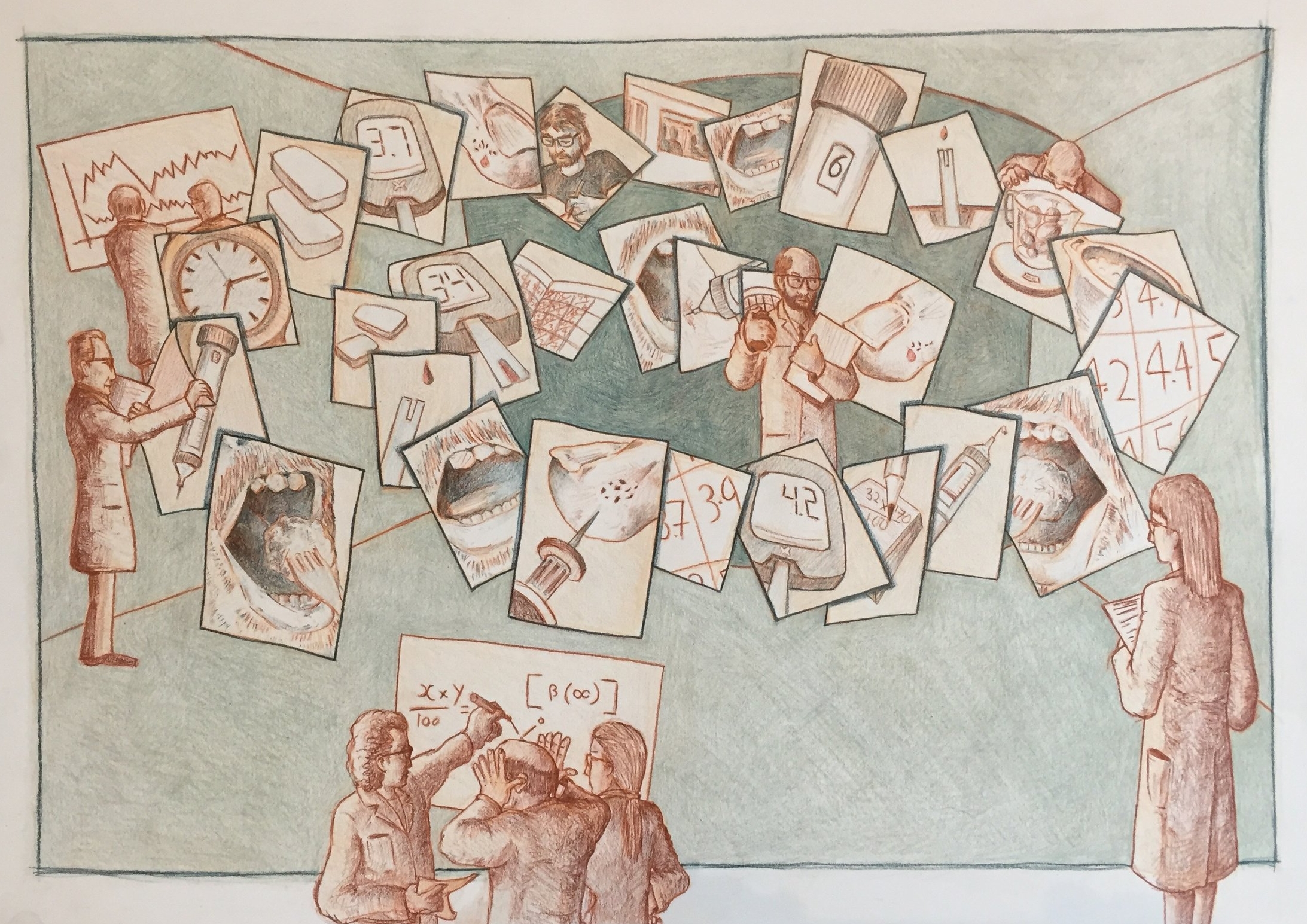
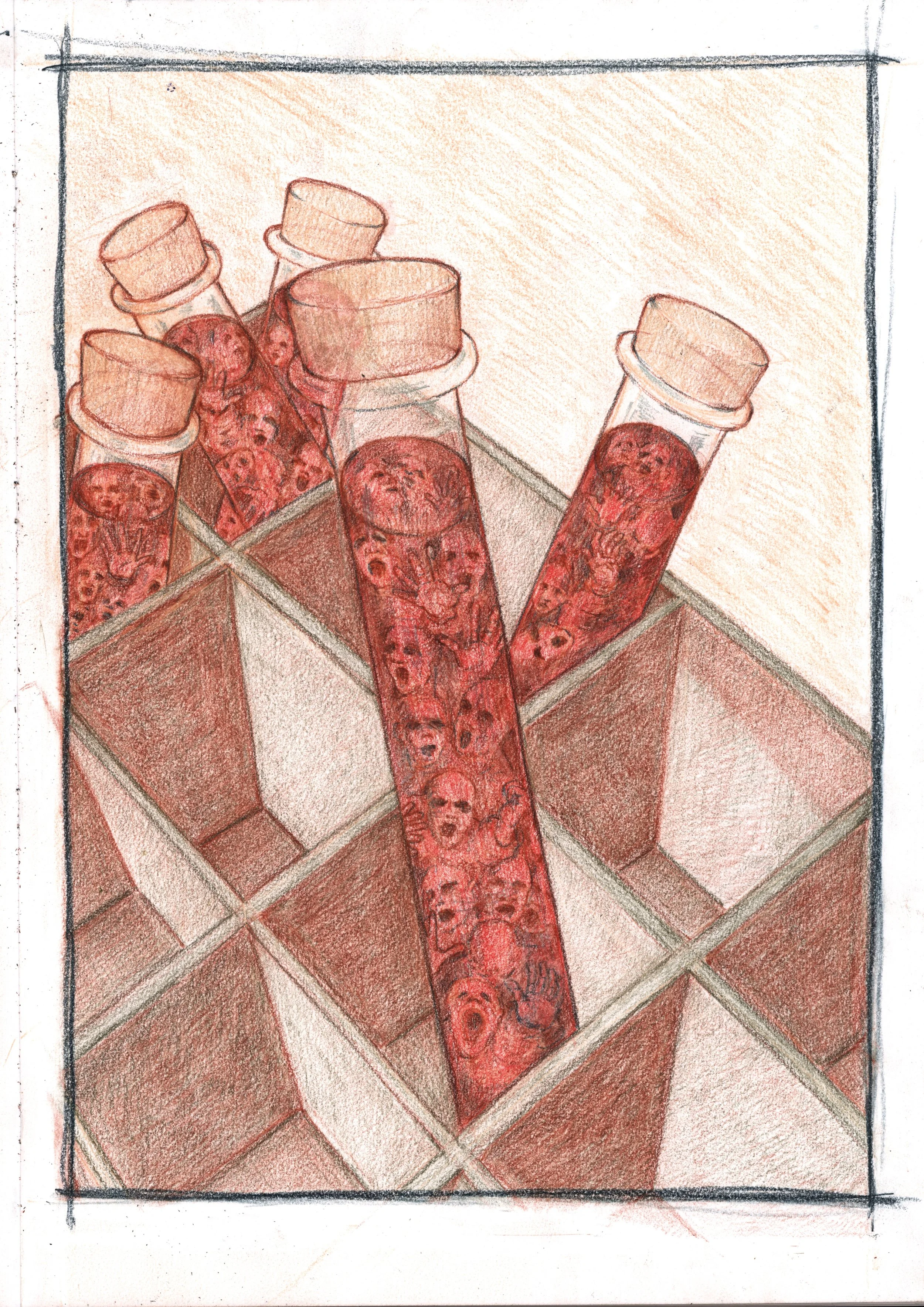
My first page was confused (see) -  when it was finished I wasn’t sure what I’d meant or what I’d said! But I had proved I could design, draw and write a page. I began to grasp hold of a process - writing alongside the drawing, a grid to organise the page (even if by the end I only used the grid to ignore it), and layering pencils to build up Images, or to excavate them with a rubber.

There was lots more I was to develop: at this  point I had fragments not a structure, I hadn’t learnt to love thumbnails or appreciate the gutter and the panel, I didn’t really know I was entering the world of graphic medicine, and I hadn’t realised how much this work of imagination would be a work of ongoing research. But these are for future blogs, for now, I had begun.
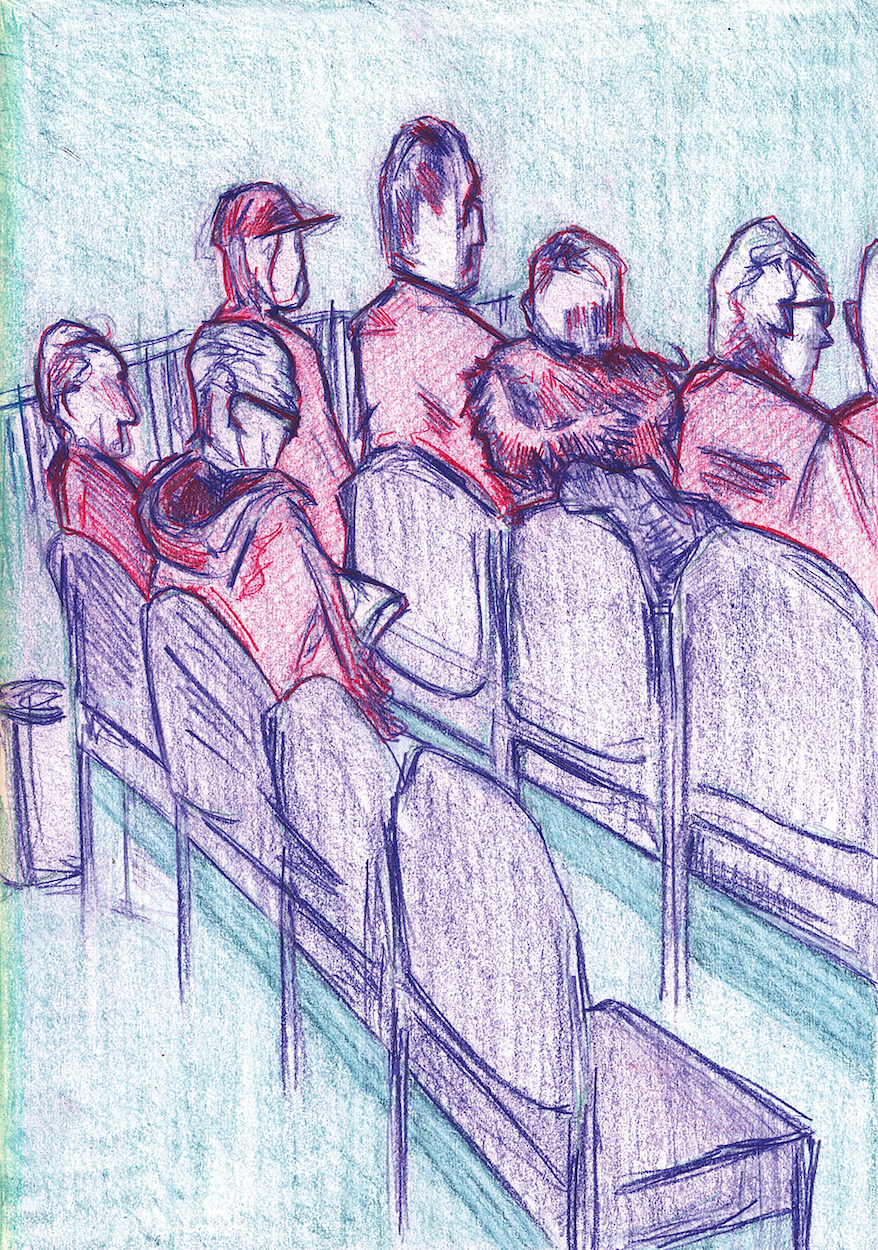
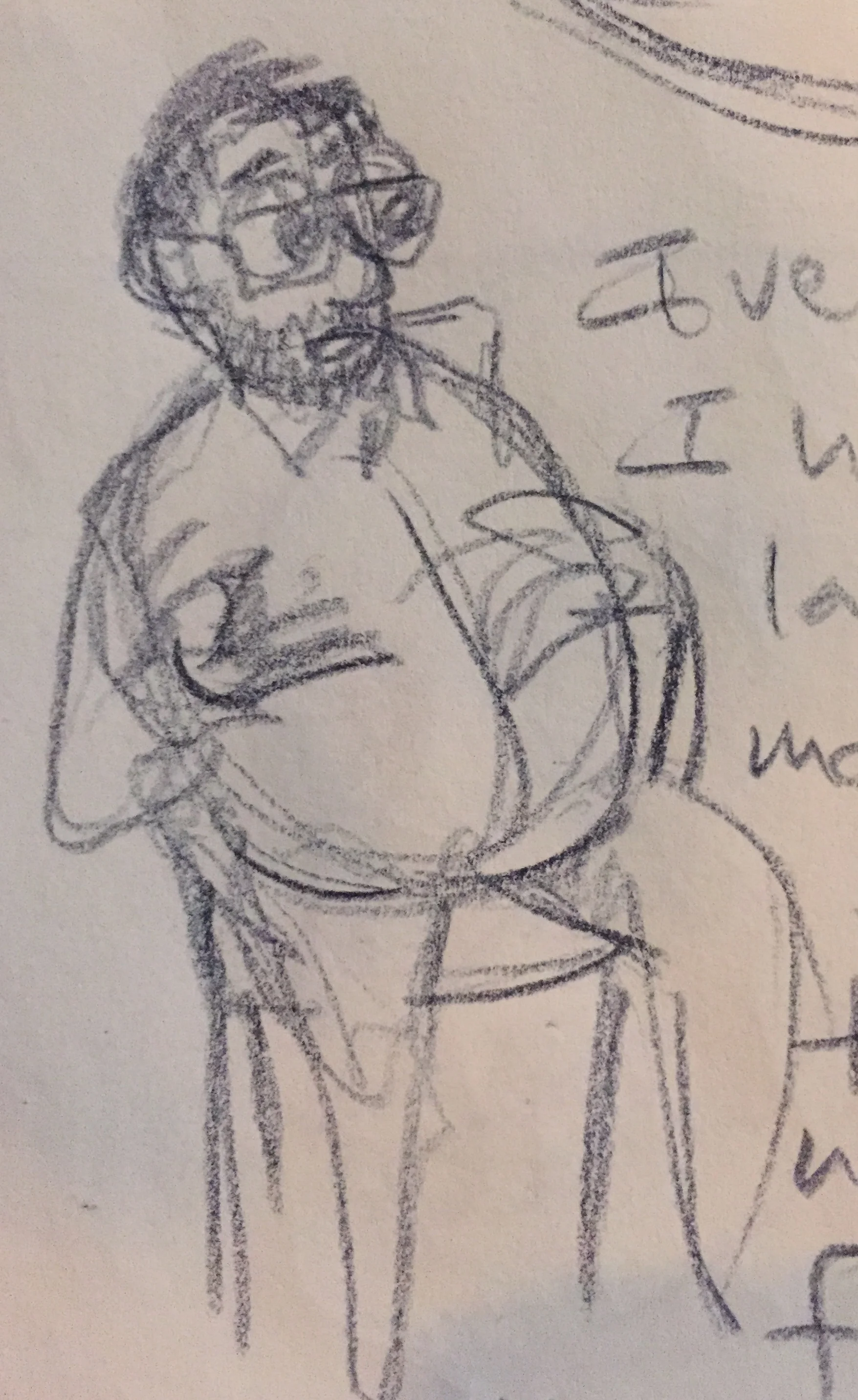
The waiting room.

There’s a cough.

A magazine rustles, followed by a sigh of impatience.

There is a faint smell of antiseptic.

I’ve never been scared of hospitals, just uncomfortable. The GPs, the drop-in, A&E, they’ve just never felt like places that belong to me… as if I’m there under false-pretences – an intruder, taking up time and space from those who had better reasons to be there. A fraud – I should go home, get some rest, sleep it off – most things go in time, right?... Right?

Then middle age hit – literally. In the two years since turning forty I moved from accompanying others to the waiting room, to them accompanying me: a foot infection, an eye infection, then, the pièce de résistance, type one diabetes. Gradually what was background has crept forward.

The posters, once visual static – bullet points of dos and don’ts, NHS logos, photos of reassurance and positive thinking, with phone numbers zig-zagging the space, are no longer safe spaces for the eye to linger. Now I find myself scanning for hidden meanings, cracks that they paper over, pathways that I can follow.

And so I tumble into a wonderland - where my certainty in how I am is questioned. A mirror world where I see myself distorted by the sight of others - people who come to know me as my body, my  disease and my treatment. Slowly who I am is changed - measured in terms of strips used and units taken; in terms of the rise and fall of my blood sugar; in terms of the correlation between my application of medicine and self-discipline. Here the habits and tendencies that define me as an adult - as the person I thought I was, are part of the problem - and the solution. Personality is part of pathology, and key to finding the way through.

I take a breath. There is a different quality of time - an otherworldliness. Here the concerns are different: the ticking of the clock counting down the seconds, the opening and shutting of the door, the steps on the floor - all build their own rhythm, have their own logic. This is the world of the body, of the internal, of the mystery and science of health and disease - and at the same time the clamouring voices of those who don’t know what’s wrong, and what they did. As if the atmosphere can be touched, and chewed. There is a thickness that builds where the impulse to help, and the need to help others collides, it carries the aromas of fear, guilt, exhaustion and hope.

Increasingly I find myself belonging. Ironically, as time passes, and I take more and more control over monitoring and medicating my illness, and so have less and less need to go to the waiting room, I now feel justified in crossing the threshold, in entering these, oh so patient, spaces.

IMG_5882.PNG

“Sunday at the Drop-in #1” colour pencils with digital augmentation.

Cross thinking.

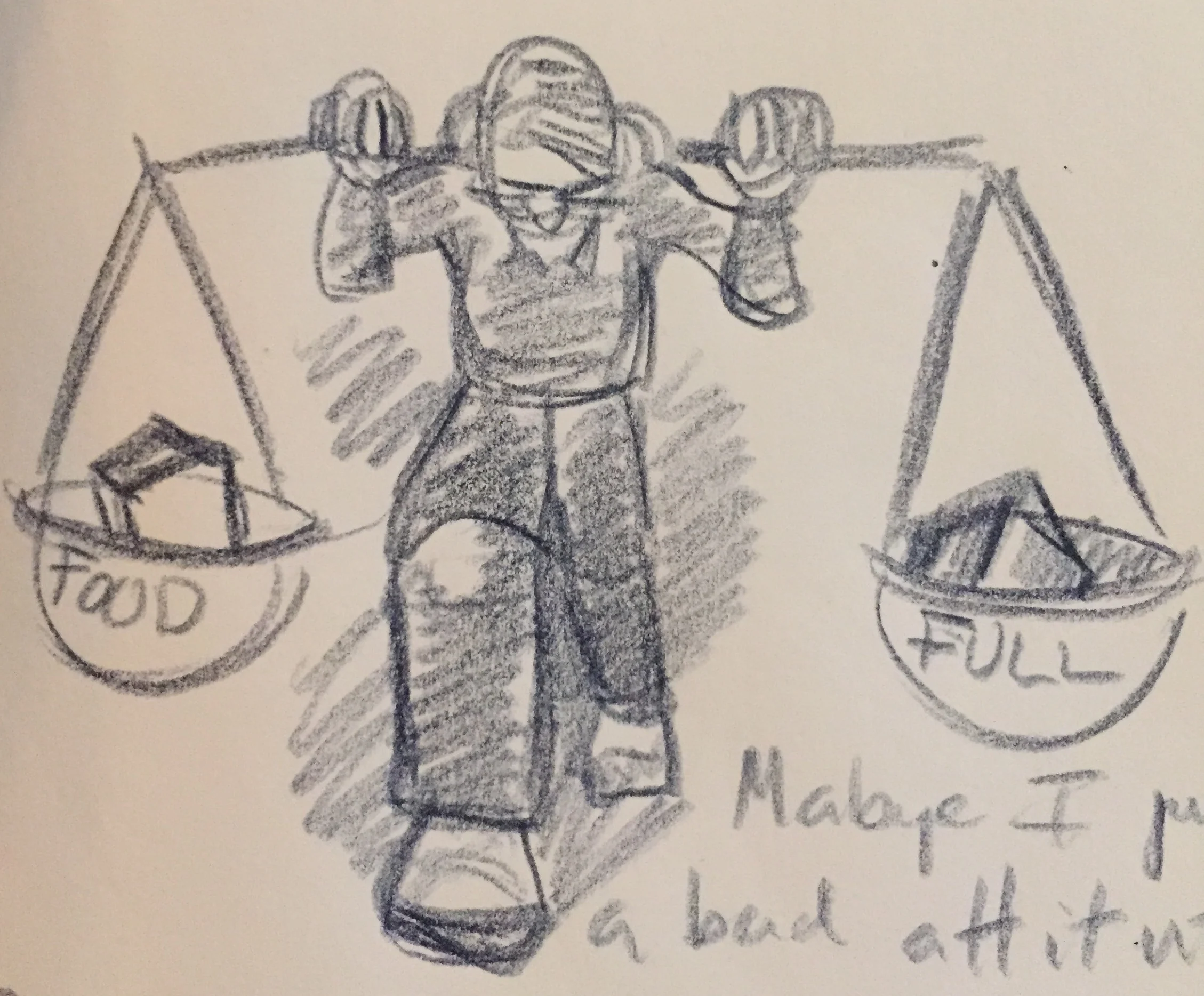
I’ve eaten early - cos’ I had stuff to do later tonight, which means I’ll need to eat dinner early too. Except about now I feel really full.​ This sounds pathetic - but it’s really preying on my mind. I expect more of myself - like I should just make a fucking decision!

FullSizeRender.jpg

​I wonder if I have a bad attitude to sacrifice? But then I’ve planned the day - I planned it last night - so that this should make sense! Should be easy! And I resent it being difficult.  

FullSizeRender.jpg

I find myself dithering at a cross-roads - literally. I stand on a pavement taking half-steps in different directions, cross thinking myself before I’ve made a full stride; unable to decide where I’m going, until, exasperated with my ineptitude I dart into the nearest cafe and sit, and hope... and, trying to stop my thoughts, I draw...

FullSizeRender.jpg

My thoughts settle. I did think about going carbless - which might be less filling, but two things - well three things mean that’s a bad idea. The best reason is that, as I’m going to be doing stuff - walking, standing, maybe talking, I need to make sure I have enough carbs to stop me dropping too low through the evening. Then there’s the fact I’d quite like to have a drink or two - which again means I should make sure I have ‘carbed up’ so the alcohol drop doesn’t affect me so much.

But the third reason is much more irrational... In truth, carbless - taking no insulin, scares me. I don’t believe my body has my best interests at heart, like its waiting for me to fall into its trap. A bit like I felt learning to ride a bike when the stabilisers are taken off! I’ve done it once or twice - but normally when other people are with me... y’know - just in case. 

And it worked, the drawing, the writing... things slow for a moment. I order a coffee, then a sandwich,  and a drink. I eat, I post and I’m off.

Aw nuts!

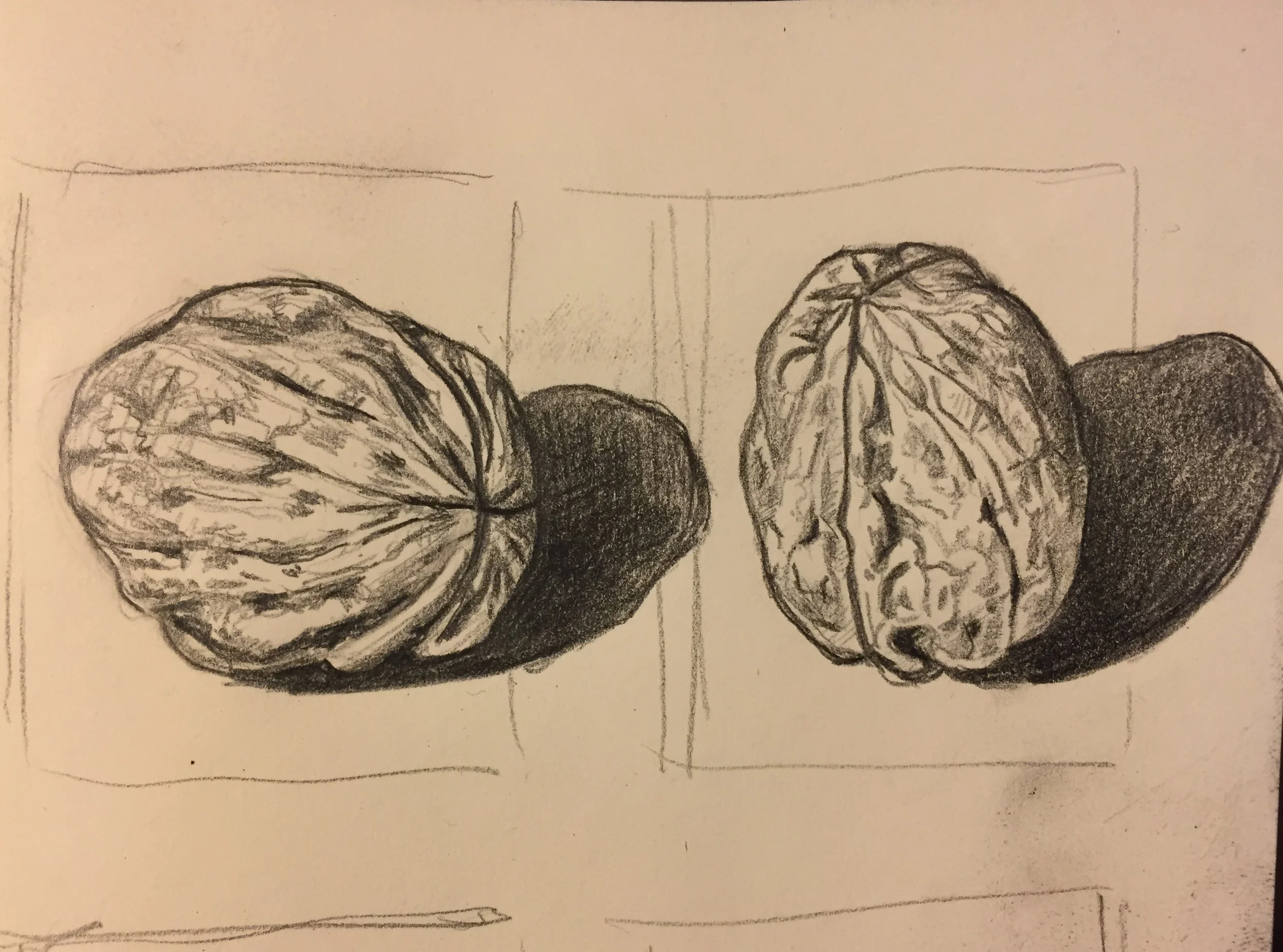
The light falls, and sinks into the depths of the shell. Tone builds and falls as the pencil scritch-scratches on the paper and slowly the wrinkles form, creating their own geography as the nut takes shape.

I’m sitting drawing walnuts, and my thoughts turn to why (well that and bad puns about “nuts”, “pencils” and “nooks and crannies” - I’ll let you joins the dots”)? There is something joyful and indulgent about taking the time to engage in the complexity of looking - whether in a still-life or landscape. You give yourself to the process: look, squint, soft marks, then more - scribbles to fill in contours, or to establish the geometry of the shapes; more looking, revising - moments of “Ah!” as the confusing opens up - clarity blossoming, along with a flourish of marks - quick decisive lines, then shade here, here and here!

I’m not mathematic, many will tell you that, but drawing - sketching, is a different sort of geometry - a way of unpicking the logic of what you see away from the deceit of numbers, who slyly swap places when you’re not looking. And for me now, living with type 1 diabetes I find the numbers are more present than ever. Phantoms that glide around the potential of each meal - complications that are always on the edge of sight, and snicker at my lack of grace under fire. 

Maybe this is the joy of sketching the obvious, the joy of detail - it quiets my mind, let’s me think my way, for a while.   

Or maybe I’m just nuts...

FullSizeRender.jpg

“Going Nuts” late night thumbnail sketching in pencil.

Food Mood

Food has always provoked strong feelings in me. I associate good times with food - past, present and future. I love the act of preparing food - the alchemy of flavour, and the excitement and contentment of mixing ingredients together - sometimes in quick movements, sometimes a slow bubble. Also I like to eat - to enjoy. Maybe it’s comfort food? - but now, and always I think, it's also control.

With type 1 Diabetes I can’t not think about food. The word think implies that this is always a rational thing - a strategy, a plan, but it doesn’t work that simply. It’s more a presence - a voice nagging away, but quietly - so I can’t hear the words clearly, a thought half grasped...

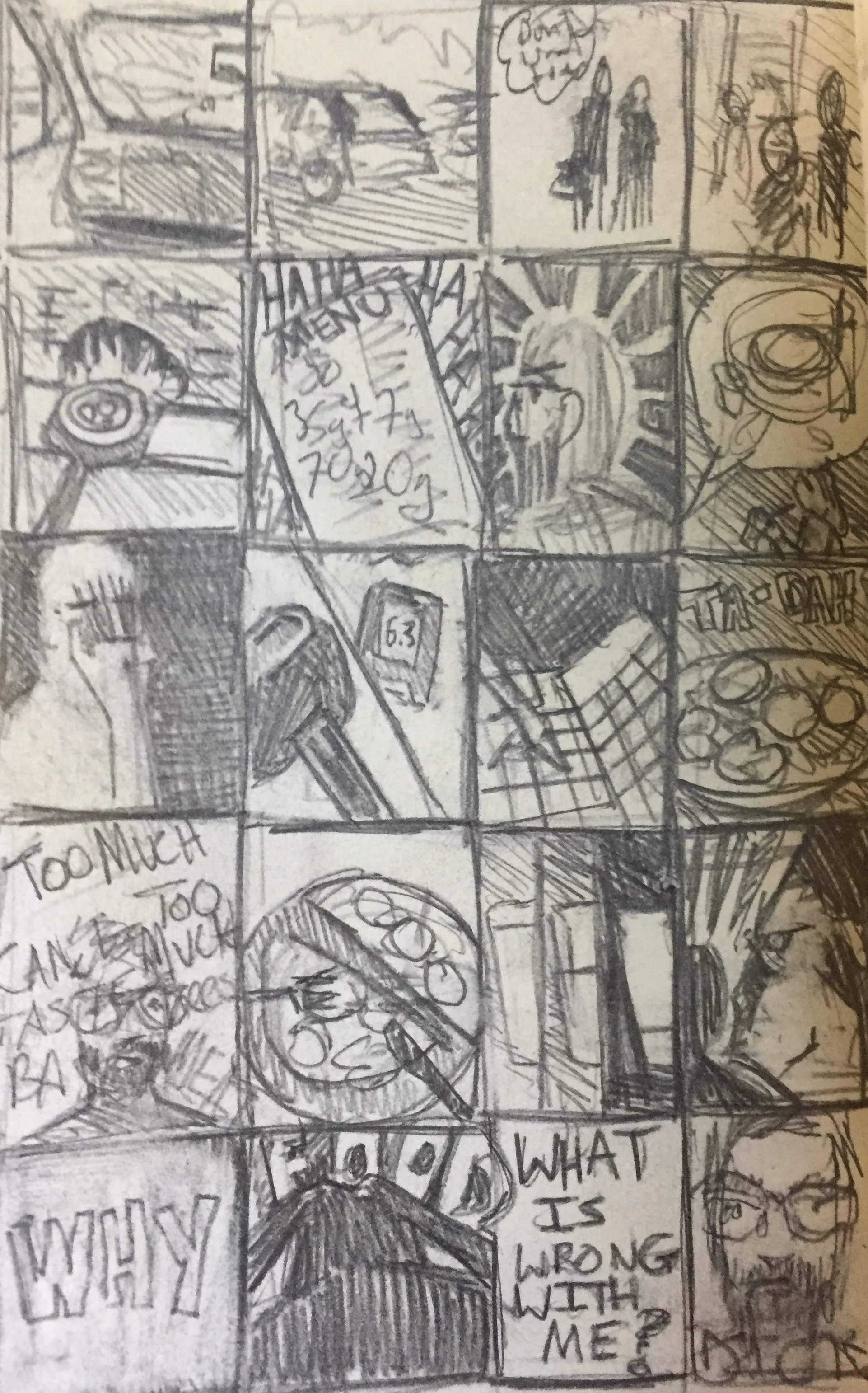
That day I didn’t want to eat. I felt I had to. Why didn’t I just choose fuel – a sandwich or something? 1 unit would have made me feel better – especially after breakfast!

I like food though, and I hate to eat because I have to. I thought a small pizza could be half way between a sandwich and a roast. But it was too big - more carbs than I wanted - than I’d planed for. So I have to leave a third of it. Why didn’t I know – why didn’t I guess? Of course the one I saw wasn’t the real size – it didn’t fit the sodding plate – why didn’t I see it!

And now the whole meal is about my mistake – my stupidity; and I’m embarrassed – I’m very publically wrong, and I hate it! My stomach contracts and this is what consumes me. So now I notice every flaw – the eating becomes a chore, a task – as now I’ve injected I can’t go back. I have to eat it, and each mouthful finds another issue – texture, taste, value – it all starts to swirl, and snarl.

I know I’m horrible to be around now, so I try to change tack. But it’s still there, and I can feel my eyes screwing up as I look around. I hate this! I hate me – why can’t I let it go!!

Fuck’s sake!

FullSizeRender.jpg

“Food Mood: roughs” 

Old Haunts

A crisp cold cuts through the air - it’s touch slices a cross-hatch of time. Opaque light drifts over the day’s colours - layering a whiteness that signals the move from autumn to winter. Contrast softens as the fingers of dusk caress the afternoon, and introspection takes hold.

I walk on familiar ground. Memories crystallising around me, though the mold no longer fits as tight as it did. There are buildings cut from the silhouette; signs and banners have changed - moved on, and I find my footsteps altered in their purpose. 

A meeting in Newcastle at the Medical school - delving into their research into Type 1 Diabetes, a quick look around old haunts, a catch-up with an old friend. Looking out from within the whirlwind I realise I am, at once, more certain about what I want - and more terrified that I won’t achieve it! A deep breathe, a whiskey, a shrug and I make my way over to Durham.

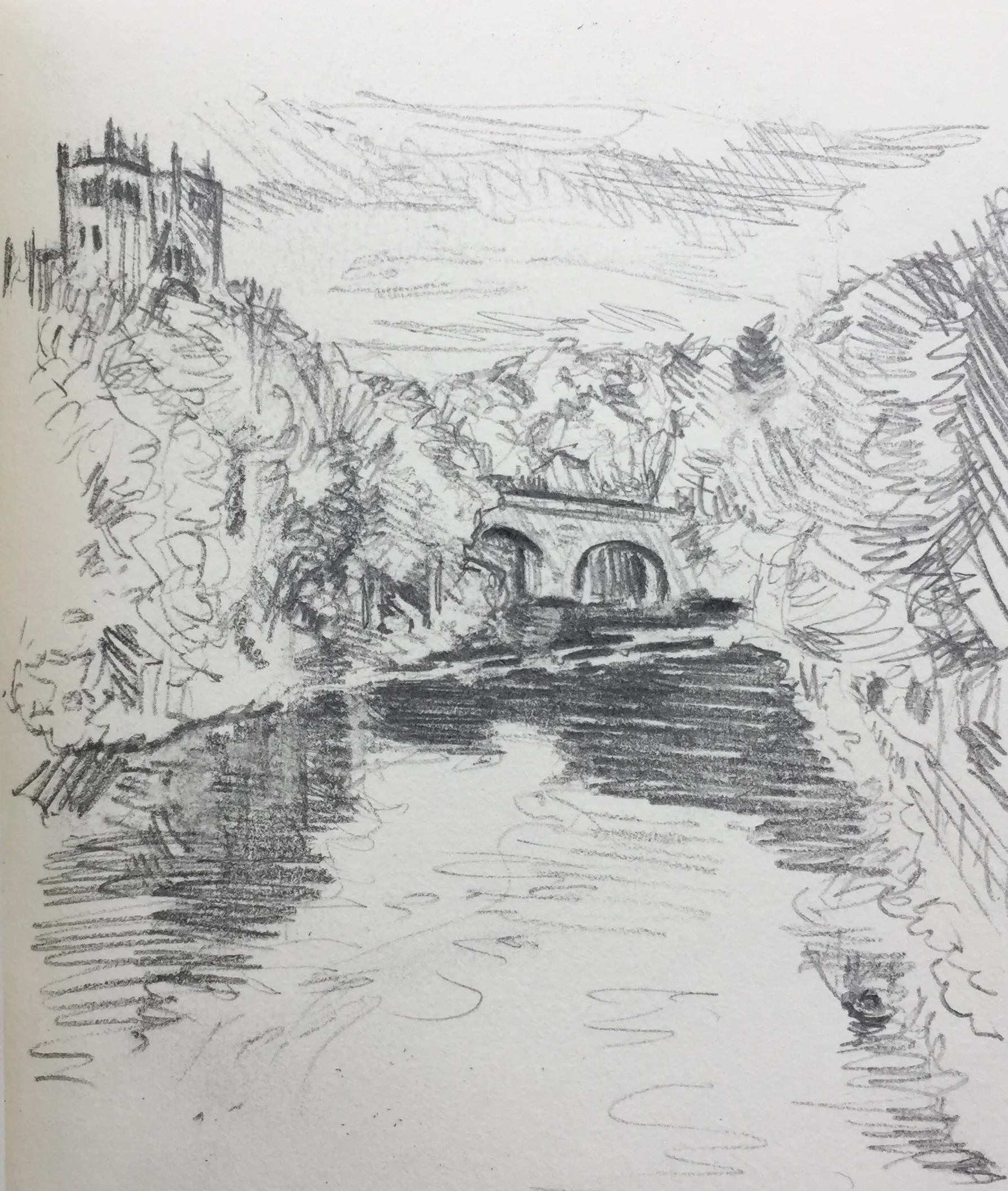
Returning to the Durham Lumiere has become a ritual for myself and Caroline. A crossroads between the medieval city and the technology of lighting and projection  that holds thoughts in time and allows for reflection and hope. And, as I find my thoughts speeding up, I take moments to stop and look - to sketch and write, to see and think; and squint to see a face I recognise staring back through marks scribbled and symbols tapped... Do I really look like that?

FullSizeRender.jpg

Riverview: Durham

Back again 🙄

As thoughts begin to swirl more thickly around my head I find myself writing another re-start post to my blog. I’ve done this a few times - re-started I mean, and I guess I need to ask why? 

My blog began without manifesto. A series of posts that were plucked from thoughts, sights, sounds and whatever came my way as I made my way through the day. I vaguely thought it might start to explain my approach to art - and maybe give me some insight into what I was doing!

In some ways this has proven to be the case - revealing a quixotic approach to subject matter and form; along with a tendency to doodle with words. It is the benefit of seeing my thoughts written - spaced out in front of me, layers of spaghetti stretched flat so that I can recognise them and me for what they (I) are (am), that has made me restart though.

It’s strange that I feel more confident in myself when I express my doubt to an unknown audience? Maybe it’s my inner narcissist? Maybe the discipline of putting words in front of others? Whatever - it’s my reason to begin again.  

Why words? I’m not sure. Drawing also has a similar effect - sketches, doodles - actual drawings; these are ways of thinking - tracing lines across mistakes to find a path. And I think there will be times when those drawings will make their way on here - especially comics and cartoons (though they’ll be tonnes on other social media if not, I’m sure!), but I’ve come to realise I exist in words and image (as well as y’know, flesh), and though these often cross over - that’s not always the case. 

Over the last year my blog was really only about one specific course - which turned out to be great, but while I enjoyed that, I think that I lost my voice for a bit - bad luck it seems to be coming back. These vignettes - the length of a thought and a raised eyebrow, feel as though they are about right for my...  attention span. 

I guess my posts will be sporadic at first, but there’s a lot to talk about at the moment, so I hope that picks as life generates more material - it’s good like that. 

Sci(Psy)Art: The fault lines of Art-Science. (a SciArt blog)

As deadlines loom, and doing becomes the necessary outcome of thinking, I want to reflect more on the science of SciArt: the connection between the disciplines, and the science of diabetes. (A quick disclaimer - from the outset this is the consideration of a lay-person, albeit one who is bound up in the experience as a student and a patient.)

The multiplicity of SciArt covers a vast space – from Stelarc implanting an ear on his arm (Stelarc, Stelarc.org. http://stelarc.org/?catID=20242 (1/2/17)), to Helen Storey’s Catalytic Clothing (Helen Story and Tony Ryan, Catalytic Clothing.org. http://www.catalytic-clothing.org (1/2/17)) - demonstrating how:

 “Artwork and art process has the power to encapsulate some of the most complex debates of our times and, through offering a visceral experience, can traverse intellectual distances at light speed.” (pg. xv, Miah, A ed, 2008: Human Futures: Art in an Age of Uncertainty, Liverpool, Liverpool University Press)

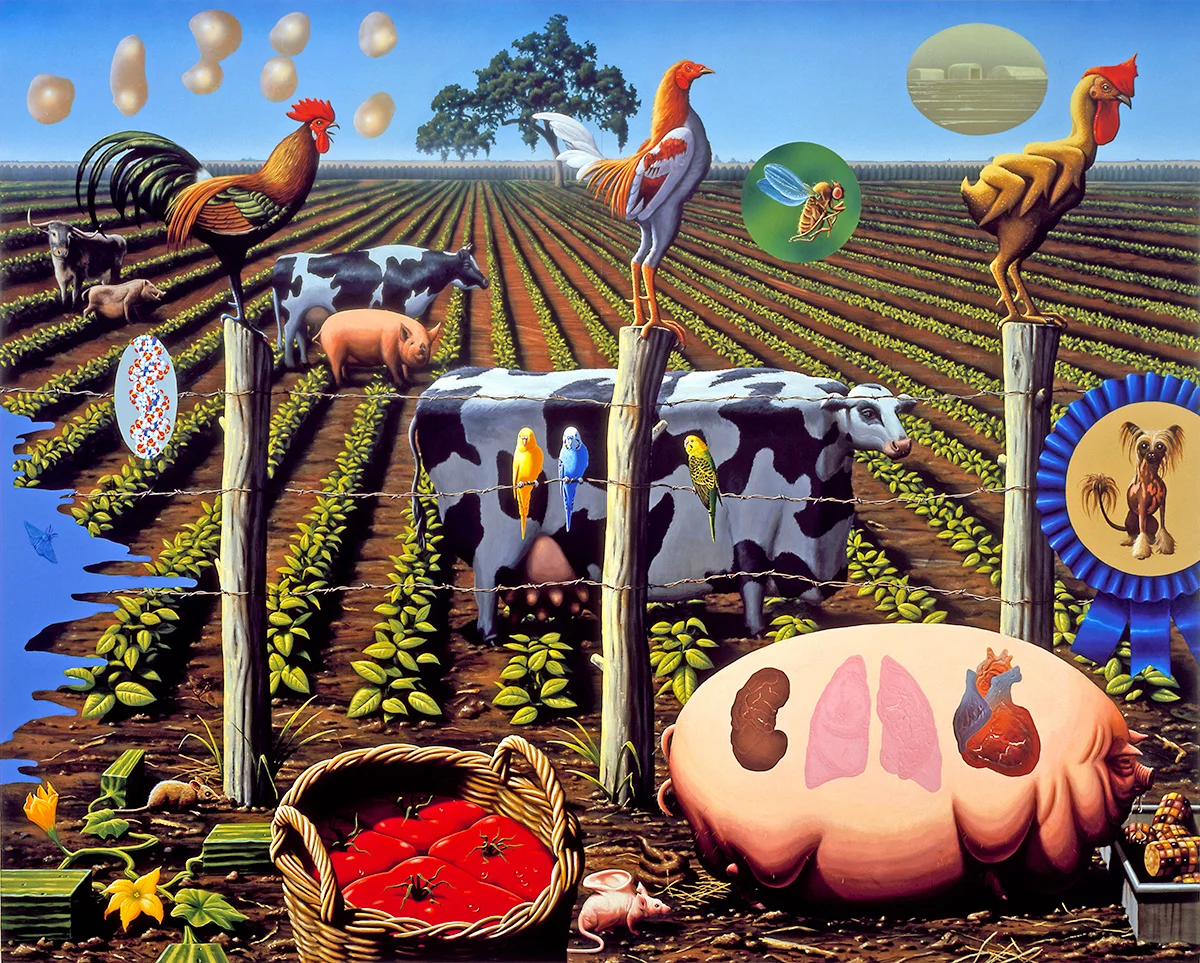
Miah here highlights how the synthesis of the two disciplines has enabled a discourse of ideas to enter into a wider consciousness – fulfilling the social need for understanding, but also a deeper sense of engagement. Going further than simply seeing a practical use for a discovery, but interrogating the nature and the direction of that discovery. In a sense, we can see Art as a crucial part of the policing of Science. A view that Stephen Wilson elaborates – suggesting that artists are involved with “questioning the narratives of progress” (pg.11, Wilson, S. 2010: Art Science Now: How scientific research and technological innovation are becoming key to 21st century aesthetics. London. Thames & Hudson).  This idea of questioning emphasises the nature of challenge in the relationship between the subjects, and points to a necessary tension in the relationship – a “critical dimension” (pg. 11 Ibid). Wilson goes further in suggesting that Science is seen as part of a ‘narrative’ – as a ‘world-view’ in itself that we – as a social-economic entity are complicit in if left unchecked.  An approach Wilson cites in The Farm by Alexis Rockman (fig.1), 

fig.1. Rockwell, A. 2000. The Farm. Alexis Rockman.net. http://alexisrockman.net/wonderful-world/ (1/2/17)

fig.1. Rockwell, A. 2000. The Farm. Alexis Rockman.net. http://alexisrockman.net/wonderful-world/ (1/2/17)

where we see the potential for environmental and genetic manipulation critiqued in relation to social and economic demands. This Wilson calls part of “a critique of the idealised version of science” (pg.12, Wilson. cited above)

Of course, this cannot work one-way, nor is it enough to suggest that Art is wholly critical of Science, Miah goes on:

“Artists have synthesized (sic) worlds into which the possibility of representation is infinite. They have found new forms of expression and have animated new architectures.” (pg. xv, Miah. cited above)

Reflecting on how the very forms of ‘Art’ have been challenged – pushing concepts of representation further – distorting the line between craft and technology, an act in which artists are complicit: “Artists also invent ways to visualise research results and make investigative process public” (pg.11 Wilson. cited above). It is this invention – this focus on form that pushes the artist into science, and makes science into art, this (dis)play of ideas formulated on a desire to explore, explain and discover meaning(s) that are hidden, or that resist our grasp. Art and Science do not exist in a vacuum, as Miah notes: “We cannot separate art from the cultural conditions of its production and, more widely, its role within the public sphere” (pg.xvi, Miah. cited above) – the same can be noted of Science – both arenas intersect within wider cultures, and if anything, the priority of SciArt is to ensure that intersection is not lost?

The intersection in my case is personal – infusing the medical science with my lived experience, finding a way to represent that experience, and engage meaningfully with a body of scientific discovery.

Diabetes itself is tricky (see here for a useful overview of the differences between types of Diabetes, and the site generally for loads of information Diabetes.co.uk, http://www.diabetes.co.uk/difference-between-type1-and-type2-diabetes.html (1/2/17)). I have type 1 diabetes - it’s an autoimmune disease, which means essentially my body is attacking itself.

 “Ultimately auto-aggressive T cells invade pancreatic islets focusing destructive force on the beta cells that produce insulin” (pg.83, Wagner, D. The Role of T Cells in Type 1 Diabetes  in Type 1 Diabetes - Pathogenesis, Genetics and Immunotherapy Downloaded from: http://www.intechopen.com/books/type-1-diabetespathogenesis-genetics-and-immunotherapy (30/12/16))

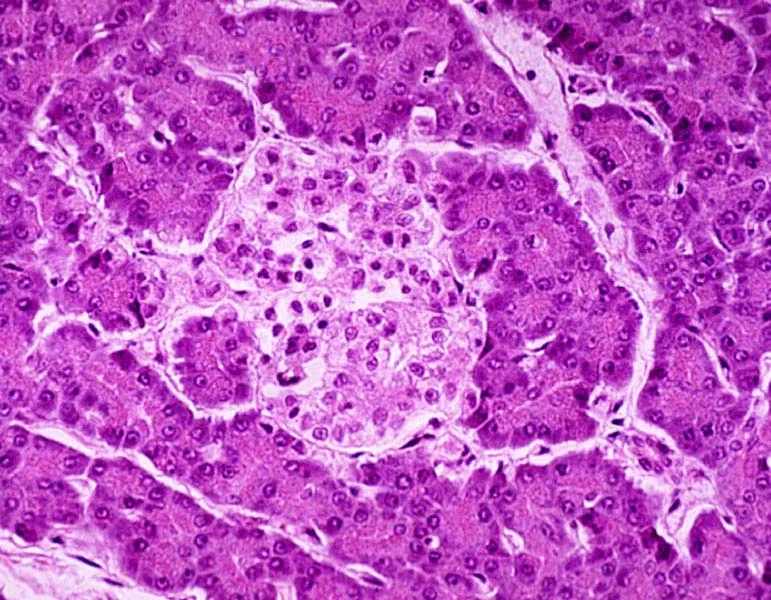
 So - my T-cells (the body's police force if you like), are attacking my ß-cells, which reside in the Islets of Langerhans (which should be a Scottish Island - or at least a fantasy kingdom):

fig.2. Islets of Langerhans: Not a Scottish island (Bing images, wps.aw.com/wps/media/objects/443/454188/Fig19012.jpg (1/2/17))[Marieb, E: Essentials of Human Anatomy and Physiology. Pearson http://wps.aw.com/bc_marieb_ehap_10/178/45725/11…

fig.2. Islets of Langerhans: Not a Scottish island (Bing images, wps.aw.com/wps/media/objects/443/454188/Fig19012.jpg (1/2/17))[Marieb, E: Essentials of Human Anatomy and Physiology. Pearson http://wps.aw.com/bc_marieb_ehap_10/178/45725/11705638.cw/index.html (1/2/17).]

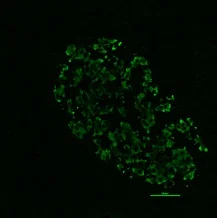
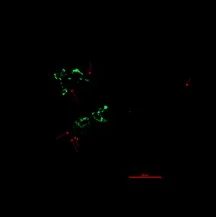
Or, for a better understanding compare these Immunofluorescence stained images of healthy islets (fig 3) against a diabetic islet (fig 4) 

fig 3. Healthy pancreatic islet - showing insulin production.

fig 3. Healthy pancreatic islet - showing insulin production.

fig 4. Pancreatic islet with type 1 diabetes - showing insulin production.  Provided by Dr Anneliese Flatt: clinical research centre Newcastle RVI.

fig 4. Pancreatic islet with type 1 diabetes - showing insulin production.  Provided by Dr Anneliese Flatt: clinical research centre Newcastle RVI.

·      Cells counted manually for all different types

[Overview

·      Immunofluorescence staining carried out in pancreas tissues for endocrine cell marker chromogranin A and pancreatic hormones viz. insulin, glucagon, somatstatin and pancreatic polypeptide A

·      15 type 1 diabetes tissues and 8 age-matched controls

·      50 islets per tissue imaged on the confocal microscope

·      Islets defined as a cluster of more than 10 chromogranin-positive cells]

Looking at the damage – or the battleground it’s clear that the ß-cells are losing. This stops insulin production (or at least effective insulin production) - meaning I get a build-up of glucose in my blood if I don’t regulate it with external insulin… or exercise - maybe diet too? It also affects the ⍺-cells - the ones that produce glucagon when the bodies blood sugar drops too low. 

But it turns out I do have some insulin left - my ß-cells are producing some, but its slow, and needs help - and it’s going to run out.

This means eventually I will be fully dependant on insulin. But studies have shown that the longer I can maintain ß-cell production of pro-insulin, and the better my glycaemic control, the better the health benefits.

“Therefore, all type 1 (and possibly many type 2) diabetic patients may benefit from any success in maintaining ß-cell (and thereby -cell) activity after onset of disease (21). From the data present here, the best current and practical method subsumes the best possible control for each diabetic patient. [pg.835]” (Steffes, M; Sibley; Jackson, M; Thomas, W: ß-Cell Function and the Develop of Diabetes-Related Complications in the Diabetes Control and Complications Trial. Diabetes Care, volume 26, number 3, March 2003) 

The focus of the trial I am enrolled on with T1DUK is involved with exploring the potential impact on diabetes from an immunology approach. Basically, there is a two-pronged attack - with one drug (Liraglutide)used to aid the insulin secretion process and make the insulin I have more effective; alongside this is an infusion of an immune dampening drug to hold off the bodies attack on those ß-cells (effectively this gets the body’s immune system drunk, giving my ß-cells a break) This is assuming that I’m not taking one - or both placebos…

As well as the research I’m involved in, there are varied approaches to diabetes, including:

  • Immunology
  • Carbohydrate research
  • The development & delivery of insulin
  • Diet & impact
  • Education (after-all each diabetic carries their own lab with them?)

So… where do I fit in? 

  • Patient - I am a diabetic type 1
  • Research subject - immunology drug trials, but also daily testing and evaluation of my bodily responses
  • Researcher & Diarist - daily blood tests and insulin dosages, personal blogs and journaling of experience, academic and visual research
  • Diet - understanding and trial of daily carbohydrate intake, alternatives and options - including self medication using insulin and sugar
  • Student - learning about the medical and practical impact of ‘new’ existence
  • Illustrator - collection and development of research, and visual interpretation of experience
  • Individual - personal experience
  • Artist - collection, synthesis, interpretation and expression of information and experience

On a daily basis this means injections and regulation of my food, and an increased awareness of physical activity. This doesn’t mean I can/can’t eat certain foods (though sugar is something I keep away from - unless I’m low, when I don't - see already we’re getting confused here), but that I need to know what I’m eating and the effects. Generally, it’s all about the carbs - Carbohydrate breaks down into glucose - and that’s where the issues begin. Too much sugar build up can result in long term effects - such as blindness and amputation; too little results in comas (not commas - as a Lit graduate, that I could live with). But glucose provides energy, and can be used through exercise too; also, different carbs burn at different rates, and other foods can affect the way in which the body uses the carbs. 

So now it’s about the planning, the maths, the chemistry, the biology, the medicine, the situation and the data. Regular tests let me know what’s going on inside me - and let me calculate what I need to inject - although I have to take into consideration what I’ve been doing, what I’m about to do, what time of day (‘cos the body isn’t necessarily consistent - ratios of insulin to carbohydrate change at the day, and the life, continue) on the basis of an analysis of the food I’m planning to eat. So, maths, apps, research, understanding and a bit of gut feeling all consolidate around each meal… and bedtime… and y’know, everything… 

Surely there’s some art in there somewhere? 

Poetic licence. (a SciArt blog)

In our poetry workshop Sam Illingworth covered a couple of poetic forms - the Nonet and the Haiku, and made some wider points about poetry and science, but also poetry and practice. The key points I took from the workshop were about the role of poetry in communication, and the importance of form in communicating the content of the poem. During the workshop Sam discussed his practice, and gave us the opportunity to both write and critique poetry – harking back to a previous session on the scientific method – and the importance of testing a hypothesis.

Sam discussed his project to turn the abstracts of science papers into poems – considering the importance of these in communicating the message of the research. This stems from an interest in the power of poetry as a communication device, but also from the idea that in creating poetry the scientific discovery can enter into society – and societal discourse more usefully (and arguably completely). That is to say that by engaging in an act of creation that forces reflection and ‘humanising’ of results, there is a more powerful connection between the distance of research, and the impact on ‘lived experience’.

In considering poetry as an aid to communication there is an interesting disconnect for me. As traditionally, in the literary canon poetry is often considered one of the more arcane or difficult branches of study; associated with layers of complexity and density of meaning – a fault perhaps of literary approaches to the forms as much as of the form in itself. Sam’s poetry – in its many forms, is performance poetry – he publishes written versions alongside recorded readings in his blog page, and the tradition of spoken word poetry is one that has for many years been outside the canon, but has come to the forefront over the last 50 years – moving from the beat poets of the 50s and 60s, through to influences on and from hip-hop, and the contemporary spoken word movement. (A good selection can be found in Poulin, A & Waters. 2001. M. Contemporary American Poetry. Boston, Houghton Mifflin Company.)

At its heart, though, poetry is about economy of expression – saying the most in the most appropriate way. That is not to say that all poetry needs to be short – but the formal constraints can be an excellent way to process thought and ideas. Sam suggested that he likes to link the form of a poem to it's topic - as seen in his poem Going North for the Winter, where the decreasing form of the Nonet (a nine line poem, where the syllables decrease from 9 to 1 as the poem progresses) reflects the intention of the poem, which is:

"... inspired by research done at the University of Wisconsin-Madison, which found that climate change is forcing the habitat of the snowshoe hare further north. With reduced snow cover meaning that it must shift its habitat in order to avoid lynx, coyotes and other predators." (Dr Sam Illingworth, @samillingworth, www.samillingworth.com).

This correlates to my own experience - especially in the thinking of Marxist literary and cultural theory, where the relation of form and content has been considered in terms of the relationship between base and superstructure in the work of Terry Eagleton (see Eagleton, T, 1982: Literary Theory an Introduction, Oxford, Blackwell for a useful beginning); and considered in a wider sense in relation to the cultural manifestation of Late Capitialism by Fredric Jameson, who considers that to understand postmodern culture we must read it as "allegory" - an allegory that is primarily spatial (pg51. Jameson, F. 1991. Postmodernism or the Cultural Logic of Late Capitalism. London, Verso.)  

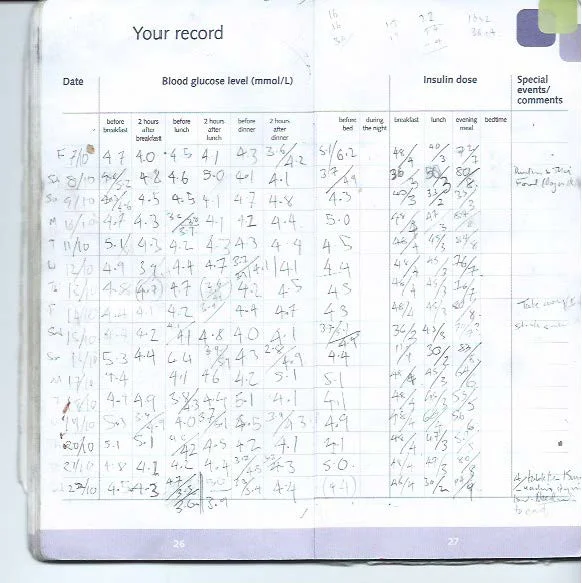
fig 1. A page of my daily diabetes diary (DDD, or D3?). On the left I test before meals and two hours after, and then before bedtime to see how the insulin has affected me. On the right I record the number of carbs in a meal, alongside the unit…

fig 1. A page of my daily diabetes diary (DDD, or D3?). On the left I test before meals and two hours after, and then before bedtime to see how the insulin has affected me. On the right I record the number of carbs in a meal, alongside the units of insulin - this helps me record/work-out the a carb/insulin ratio (which fluctuates throughout the day, and changes over time). At the far right I record key events, or meals that help me refer back, or adapt subsequent doses.

My own dalliance in poetry has helped form the direction of my practice for SciArt. Initially I chose the idea of journaling my experience of being diagnosed with type 1 Diabetes, and my experience on a subsequent drug trial and illustrating this. I have found ‘journaling’ to be an unhelpful expression – especially as I don’t have a typical daily diary (Although I do record my blood levels, and carb to insulin ratios regularly throughout the day (fig 1)- which has a visual potential, but apart from references in images I haven't yet been able to develop further).

Moreover, 'journal' suggests a more structured consideration of the situation – one that doesn’t correspond with the way in which I feel it impacts on me. For while a key aspect of diabetes is the need to manage your life, the sense of a calm, and rational approach associated with the word “manage” is not how the experience feels.

My solution has been to consider the journal in the form of the ‘free-verse’ of ‘beat poetry’. Whilst a definite form or structure to the work of the ‘beat poets’ is difficult to lay down, there are certain features that enable expression of ideas: the format is jazz inspired – looking for hooks and links, but being free-form, and encouraging improvisation; a syncopation of the rhythm – encouraged by line breaks; and a ‘playfulness’ with the form and spelling of words and use of rhyme. For me the syncopation of the form reflects the tension between the scientific rigor of ‘managing’ diabetes and the emotional exhaustion and frustration of the condition (there have been links made between diabetes and mental health issues Beyond Type 1, https://beyondtype1.org/lifestyles/mental-health/, 11:25, 30/1/17).

As covered in my last blog, the process of writing poetry has been developed by a process of drawing as interpretation – mind-mapping thoughts, and drawing responses in an overlapping process that both reveals images to inspire poetry, and in turn those poems produce images to develop. This dialectic of poetry and art works around my understanding of my diabetes both through lived experience, but also through my research into both the disease in general, but also immunology in more depth. In my last blog the poem "Life as a Test Tube" I focused in on the experience in relation to the process and the science of Type 1 Diabetes, whilst developing the images, and contemplating this blog I started to piece together snap-shots, building as sense of the narrative thrust, still using the free-verse/beat form/aesthetic, but adding as sense of dramatic rhetoric (and the title is very much working...):


Diabetic beginning.


I start with a

                  constant

                         pounding

Present thirst,

                  and it        

          won’t

                  go.


So I drink - craving

                                    sugar,

                  fizz,

                                    relief.

                                                      And Pee

                  and pee

                                    and pee (and itch).


                                    Thunder over the mountains,

                  quick sketches – snapshot

                                                      and I snap,

until

                  Stop! Stop?


[GP] – poke, prick, piss, weigh

                                                      diastolic over systolic equals A&E.

Blood -    

                  Taken, shaken, spun and wrung

                                                      numbers float to the top.

Diabetic

                  Oh…

                                    Oh…

                  Does this mean? Does this mean? Not sure…

Questions

                  Answers

                  Oh…

                                    Oh…

                                                                        Testing further

                                    more blood, laying on my back – a sprawling cephalopod

                                                      reaching across limbs and heart

                                                                        waxing legs and chest…

                                                                                                            bleep…bleep…

                                                      (Oh shit)

A talk

                  A swirling of thoughts, flying debris of knowledge spinning from nowhere

Appointments –

                  Come back when? Then?

                  Oh…

                                    Oh…

                  A breath – back in the room…

‘s okay,

                  ‘s okay – ‘cos now I know,

                                                      now I know            

                                                                        and knowledge is… is… nice?

Blood – again

                  blood

                                    blood

type 1/type 2/type 2/type1… type 1

                  Oh..

                                    Oh…

Manage it

                  (Manage – a word that has inside

 a way of life to

                                                      survive,

                                    and thrive, but

                                                      for me holds nothing but the thought,

                                                                        that this philosophy is

                                                                                          an

                                                                                                            anathema to me –

                  strategies with blue-sky thinking,

data-driven,

                  system-based

                                    as though all inspiration can

                                                                        be quantified – and imagination denied.),

manage it –

                  needles, strips, lancets, testing kit, basel, bolus, glargine, insulin, ketoid, ketosis (ketoacidosis)                                                                      hyperglycaemic,

                                                                                          hypoglycaemic –

                                                      hypo,

                                                                        hypo

manage it –

                  diet, carbs not sugar – unless too low, insulin adjustment, split doses,

                                                      counting, calculating,

                                    good carbs, low carbs, no carbs

                                                                                          sugar when,

alcohol when,

                                    and don’t forget to divide by…

                                    exercise,

                                                      activity,

                                                                        stress…

                                                                                          and everyone is different…

                                    “Carbs and Cals”(without the cals) – book and app;

reading labels in the supermarket – phone checking,

narrowing down

                                    low, lower, lowest –

                                                      conjugating taste into numbers – experience to data.

                  Rebellion – I will eat!

                  Challenge accepted – spices, herbs, pulses –

weighing, weighing – times, then divide

                                    (One pot – one equation)

                                                      walking, thinking, testing.

Pin prick, finger prick – you’re a….

                                    check - test, record,

                                                      write it down,

                                    analyse,

                                                      sort – think it through, work

                                                                        it out – hypothesise,

apply – inject – suck it up,

                  make a note,

                                    save for later,

look back on,

                  compare with…

                                    see how trends develop

                                                      trial and error

                                                                        error and trial.


Find a routine, find a rhythm,

                                                      find a way to fit it in.


Life as a test tube (a SciArt blog)

I’ve got a few SciArt blogs to write. I know this because I sat down and made a list. It’s a good list – thorough - it has sub-sections and clauses and everything. And I will get around to them… probably.

 I’ve been at an impasse recently; Journaling – chronicling my diabetes started to feel muddled. How much of the project is testimony, how much is science, how much is about my emotions, and how much is simply charting the day? My confusion meant I didn’t feel like I was making much progress, so I began to feel a bit… well, helpless.

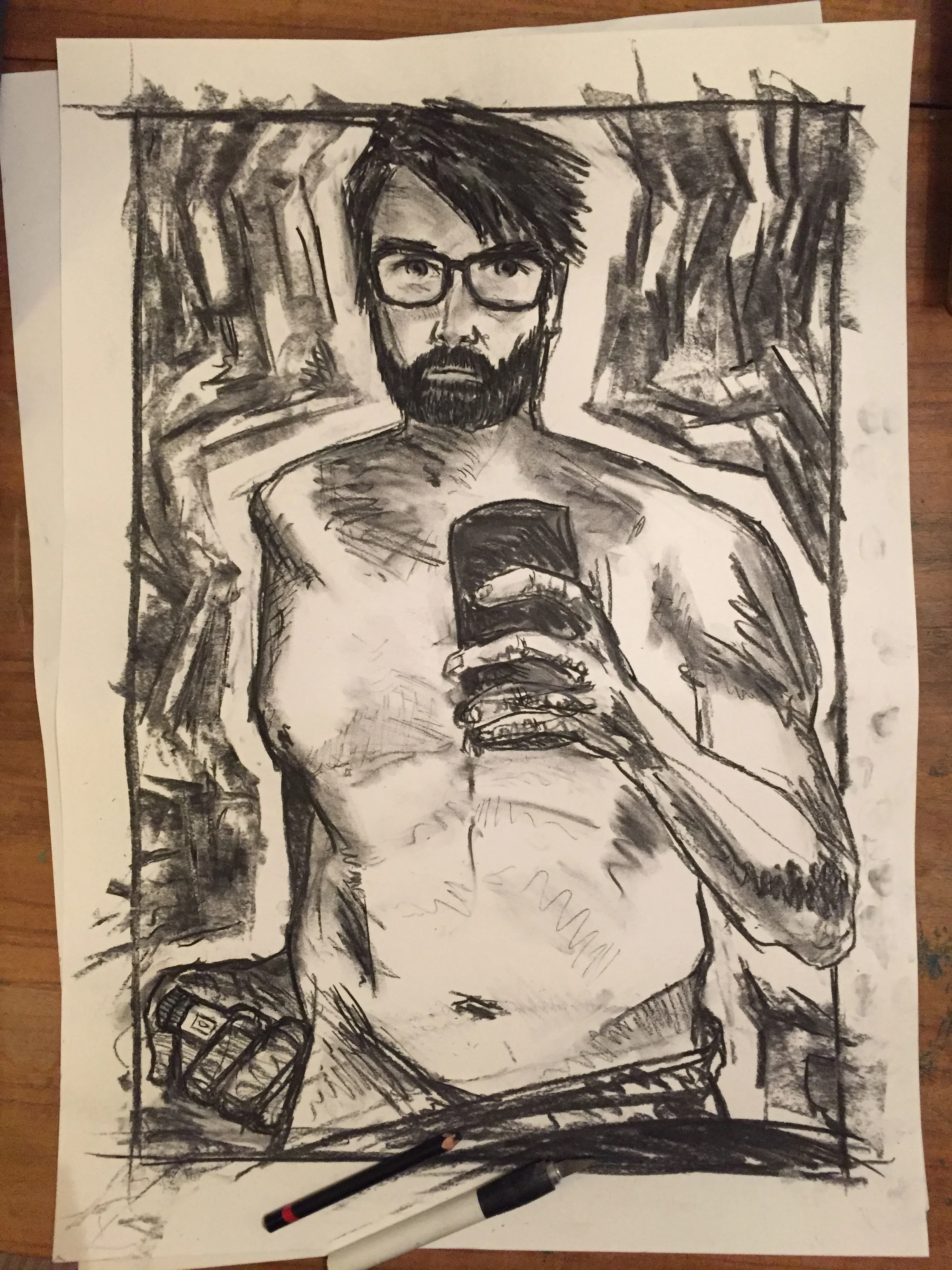
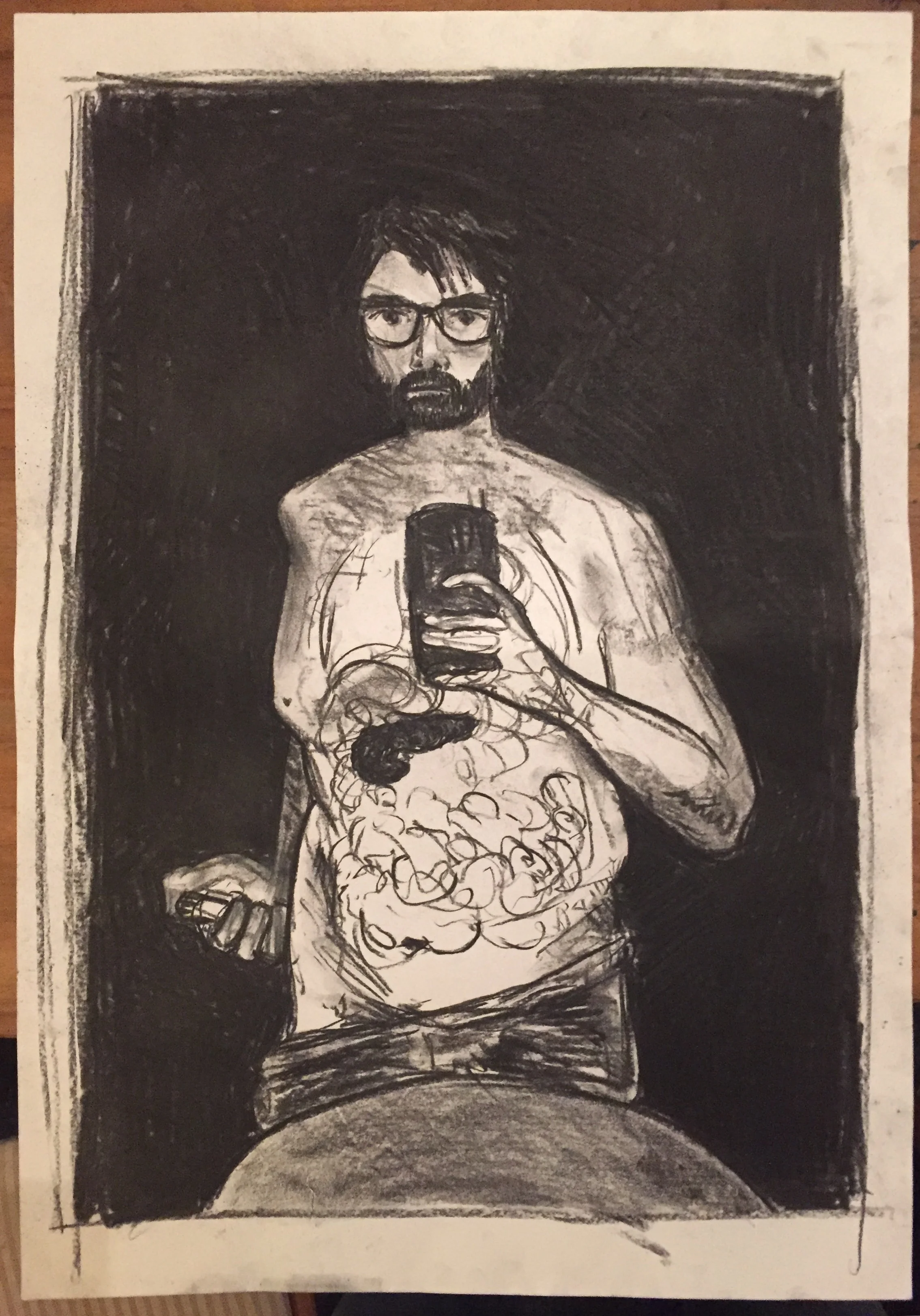
Pickering, A. 2017: Selfie with injection pen. Charcoal on A2 paper. 

Pickering, A. 2017: Selfie with injection pen. Charcoal on A2 paper. 

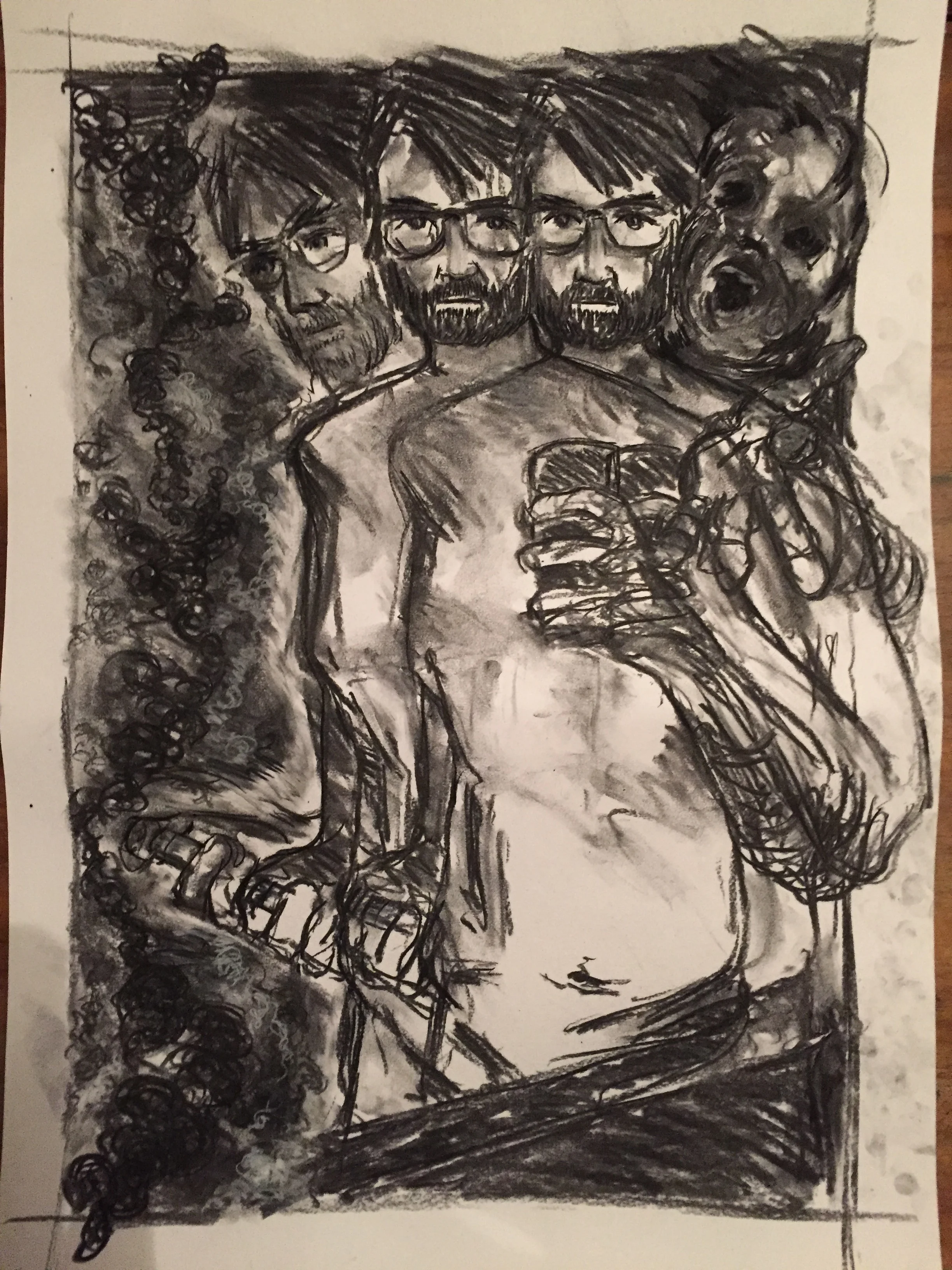
Pickering, A. 2017: Autoimmune selfie. Charcoal on A2 paper.

Pickering, A. 2017: Autoimmune selfie. Charcoal on A2 paper.

Pickering, A. 2017: Selfie with injection pen and pancreas. Charcoal on A2 paper.

Pickering, A. 2017: Selfie with injection pen and pancreas. Charcoal on A2 paper.

To get going I started to work up some smaller images on a larger scale – starting with variations on a self-portrait. I don’t like showing self-portraits – I never feel you can win – if it’s good – what does that say about you? And if it’s not – well that’s pretty apparent quickly. But in this case it was a useful point to start – after all the journal will consider my view-point, and question myself as character and narrator (I mean, how reliable am I?). Working in charcoal on a large scale I could work quickly, smudge, rearrange, and (especially useful) work in layers of darkness. The images bring out an intensity, and build to a sense of a struggle with myself. The final self-portrait attempts to make explicit the internal life in the context of the outer life, which I hope to explore further. 

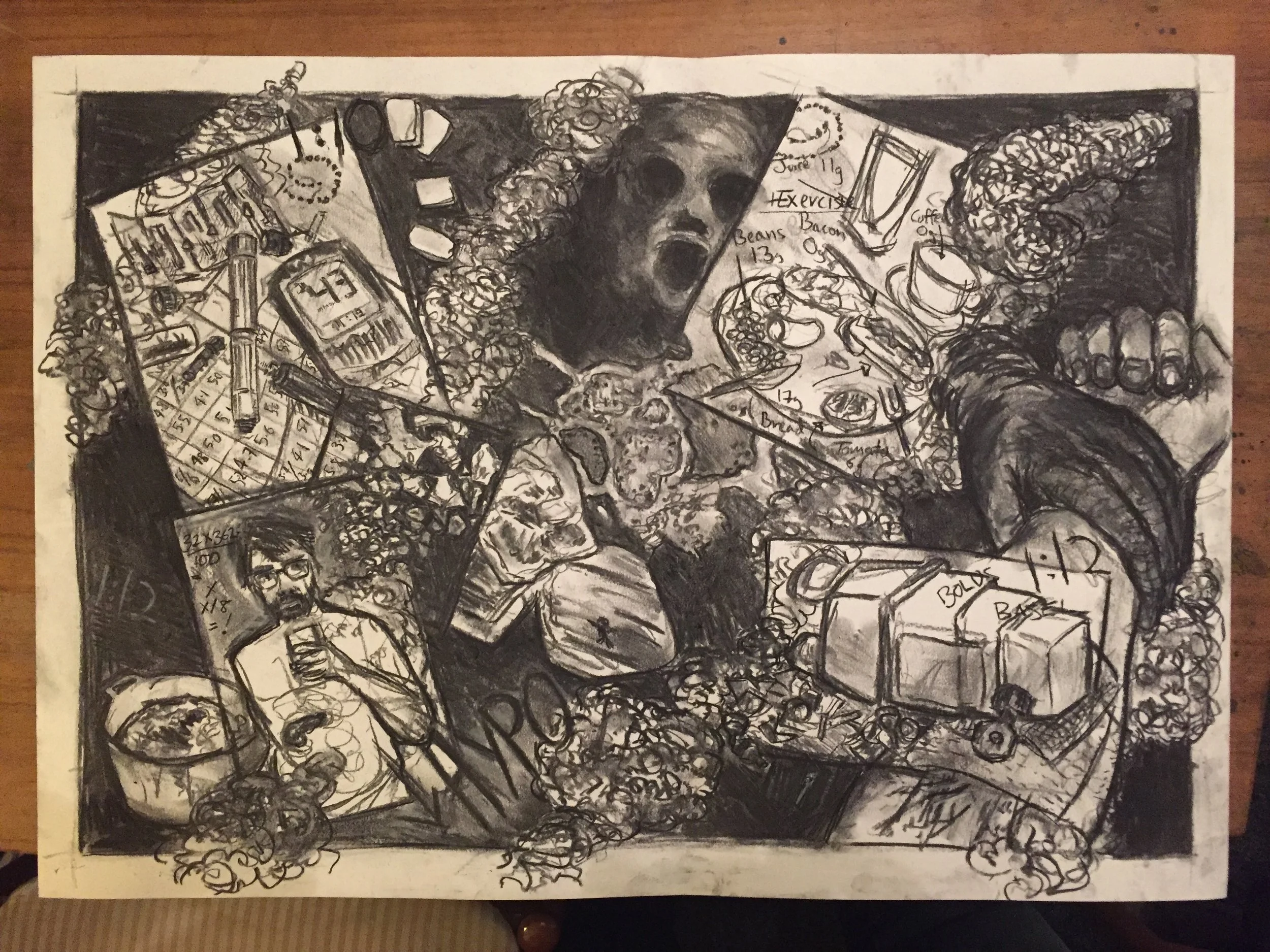
These images lead to “Inside-out”, an attempt to articulate the scientific discovery, and the tension of living with type 1 diabetes.

Pickering, A. 2017: Inside Out. Charcoal on A2 paper.

Pickering, A. 2017: Inside Out. Charcoal on A2 paper.

For this I drew on the research into immunology which is the basis for the drugs trial I am on - including images of ß-cells and the Islets of Langerhans as well as the detritus and routine of everyday Diabetes. (Steffes, M; Sibley, S;Jackson, M; Thomas, W: ß-Cell Function and the Develop of Diabetes-Related Complications in the Diabetes Control and Complications Trial. Diabetes Care, volume 26, number 3, March 2003. Diabetes Research Institute Foundation https://www.diabetesresearch.org/islet-cells). I found that as well as visual images the frustration of the experience manifested itself - through the scrawl of my writing - forced into aggressive stroke through the charcoal itself, and in the opposing figure - the obscured, yet present 'self' that occupies the same body that I inhabit.

Chromogranin Stain Type 1 Diabetes Islet: "What is most interesting is to look at stains highlighting chromogranin (red) and insulin (green) - significantly less hormone producing and insulin secreting (beta) cells in type 1 diabetes islet…

Chromogranin Stain Type 1 Diabetes Islet: "What is most interesting is to look at stains highlighting chromogranin (red) and insulin (green) - significantly less hormone producing and insulin secreting (beta) cells in type 1 diabetes islet." (Dr Anneliese Flatt)

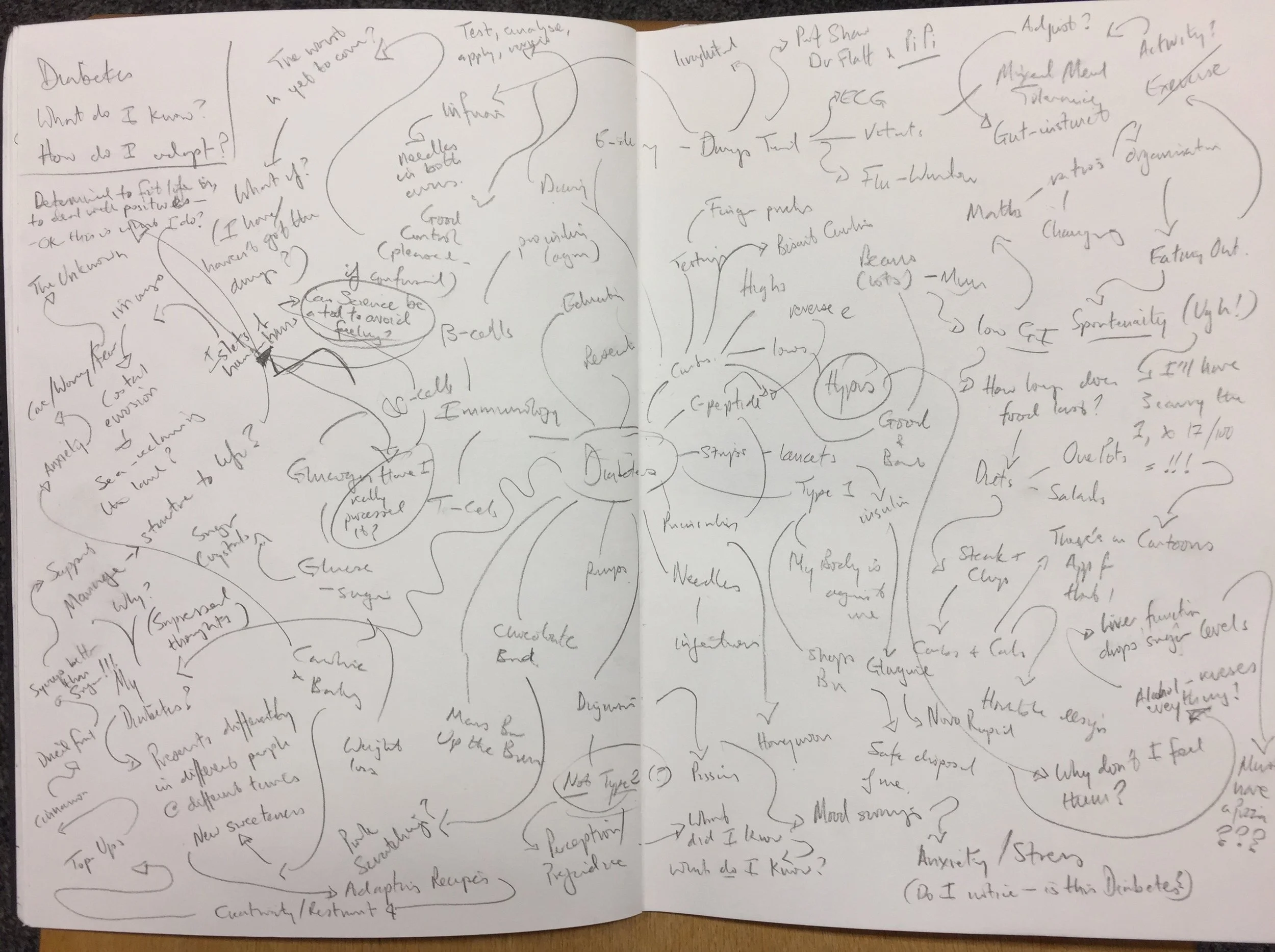
I feel that I’m beginning to find visual language to communicate the fault-line between the discovery and the dealing.  Collating these images with my science reading – and incorporating information provided through my collaboration with the Medical staff through my drugs trial - who provided insight into the T1DUK consortium (http://www.type1diabetesresearch.org.uk), and images of stained islets, showing the impact and working of type 1 diabetes, I developed a mind map to begin to isolate themes, ideas and images. The map was then developed through drawing as interpretation – which in turn produced a response in the form of a poem.
"Diabetes map" (pages from my sketchbook)

"Diabetes map" (pages from my sketchbook)

The map quickly becomes un-structured in the sense that ideas begun on one strand are then carried on in connection with another, developing the sense that the medical science and the life lived are not, and cannot be, isolated from each other.

"Interpretive drawing: images of thought" (pages from my sketchbook)

"Interpretive drawing: images of thought" (pages from my sketchbook)

My drawing overlaps, indicating both my sense of preoccupation and frustration, alongside the way in which the space for diabetes is not separated from life – I experience my disease in the context of what I do – and shape what I do around the presence of my diabetes – something indicated by the central placing of the pancreas. The drawing reveals the potential for further images – from the puerile [me having a piss], to the graphic [pancreas and insulin as a technical drawing for a circuit] to the expressionist [my emotions trapped in a test-tube – exploring the way science can be used to syphon off the pain of emotional engagement] and the geometric [proinsulin molecules as pattern].

 A key idea that came through from the map and the drawing, was that of living as a constant process of experiment. Not being able to trust the body, or communicate effectively with it. Instead you need to regulate your biology – you must hypothesise based on knowledge/data (testing), review the results, apply the hypothesis, and test again later. To know if this process works you need to record the results for review at regular periods – and in my case submit the results for expert review. This came out through the poem.

The poem is free-verse – drawing on the jazz inspired form to indicate the frustration that comes from the regular improvisation around the rules that life forces on these little experiments. Some of the the images were developed through this process appear below. In contrast to the free form of the poem, they are clinical in style - even where movement and chaos is referred to, a reference to the opposition between intention, and the disorder of existence. Within the images lies the way in which the structure of this process can provide security - through a narrative of control and progress, whilst at the same time masking the insecurity of the vagaries of blood sugar, and it's medical impact.


Life as a test tube


Test, analyse, apply, revise

                  Structure – struc-ture

                                            Tick-tock,

                  5.1, 5.3, 4.6, 3.2 – uh-oh

                                    - sugar, test

Pickering, A. 2017: Test, Analyse, Apply, Revise. Drawing pencils on A2 paper.

Pickering, A. 2017: Test, Analyse, Apply, Revise. Drawing pencils on A2 paper.

                                    - carbs, test

           Tick-tock – step, step,

                  walk and talk, coffee

                                            read, talk

                  And walk, walk,

carry,

                  double-back, read,

                                    Test, calculate,

                                                      Insert, record;

                        walking

                                    thinking, drinking, coffee - review

4.6, 4.2 – biscuit, walking,

                  drawing, 

                                    carrying

                                                      3.8 – shit, Hold everything! Pause

Test, analyse, apply, revise.


Pickering, A. 2017: Life as a Test Tube. Drawing pencils on A3 paper.

Pickering, A. 2017: Life as a Test Tube. Drawing pencils on A3 paper.

Life as a test tube,

      human experiment – the science ring-fences

              experience

                                in graphs of

joy[?] – success – 

                                    Happiness

                                            is above the curve.

                                    The everyday.

                  Every moment – the feeding, the judging and the fixing                  

                                                                        (How low can you go? ) – (Can you feel it?) 

                                                                                                                     Why can’t I feel it?

Everyday frustration [thrust-ration: seconds of impetus].

                                    Food, food, glorious… fuel – a foodie on a deadline,

I love the taste of gasoline in the morning – tastes of…  

                                    Equations, ratios, probability –

                  take this – change that, remember the other:


Where X=the random probability of the food matching the whim of the body in a chance scenario. 


Moments. 

        War-cells

                  ß, ⍺, T – why can’t they all just get along?

Me, myself – and I – I who stab myself in the back,

                  I who call out

                                    I who watch – and when I need me most, blink.

                                                      Single minded – slow throbbing – I can’t, won’t… stop, stop-it!

                  Stop-it.

                                    Eat, Eat? Eat! – not that! FFS –

good control, under control, regulated, regimented,

                  Except,    

                  Except:

-        We missed that turn on the left

-        Have you brought the sandwiches?"

-        Shit – what time is it?

-        Where do you want to?

-        Just a quick meeting to…

          Stab,

                  Bleed,

                            Test,         

                                       Note,        

                                                      Review    

                                                                        And hope.