Work in progress...

It’s been hectic so far this week, so a very quick, and late post this week, and not much commentary I’m afraid, but i didn’t want to miss a post… so *coughs*, here it is.
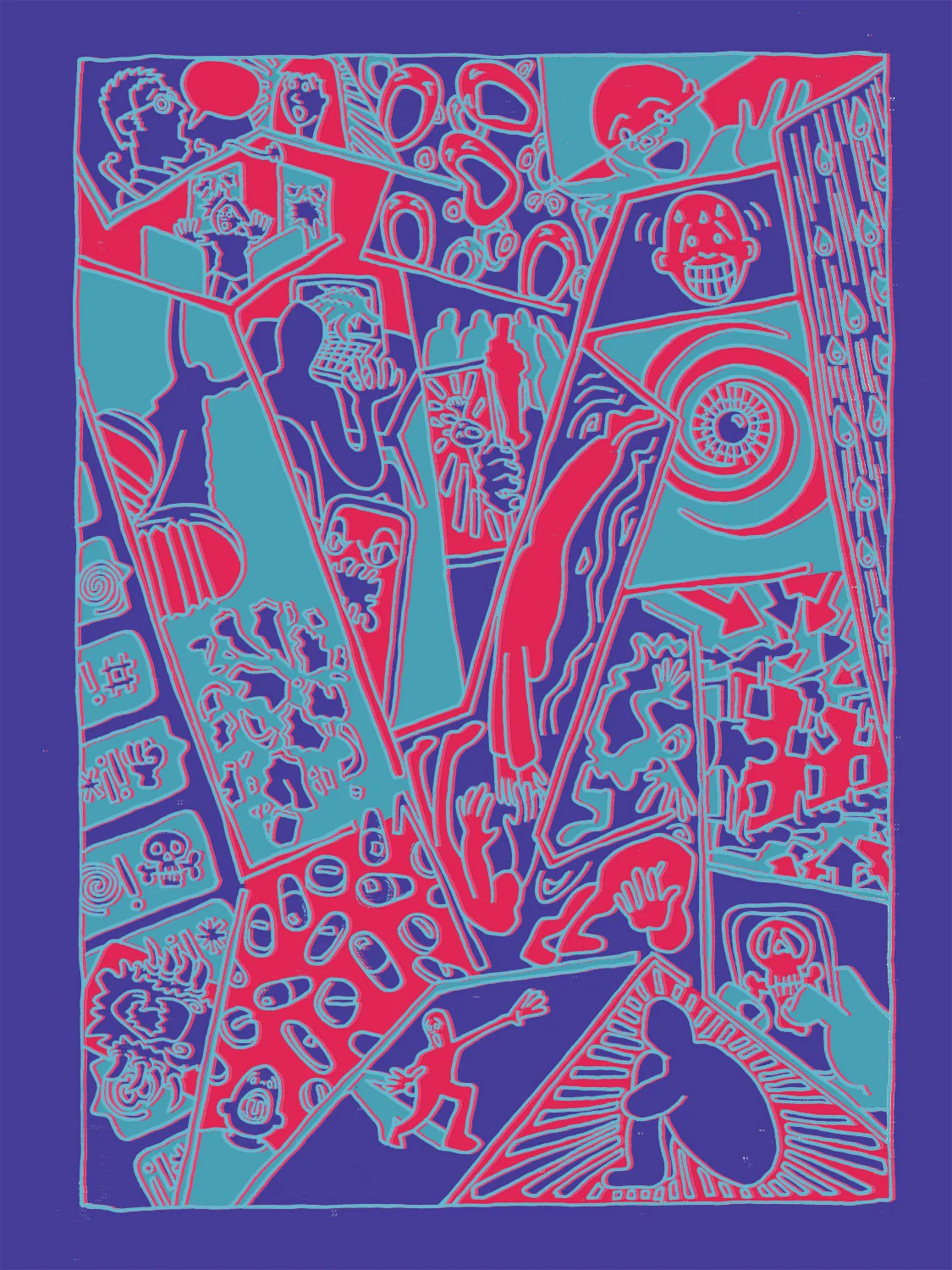
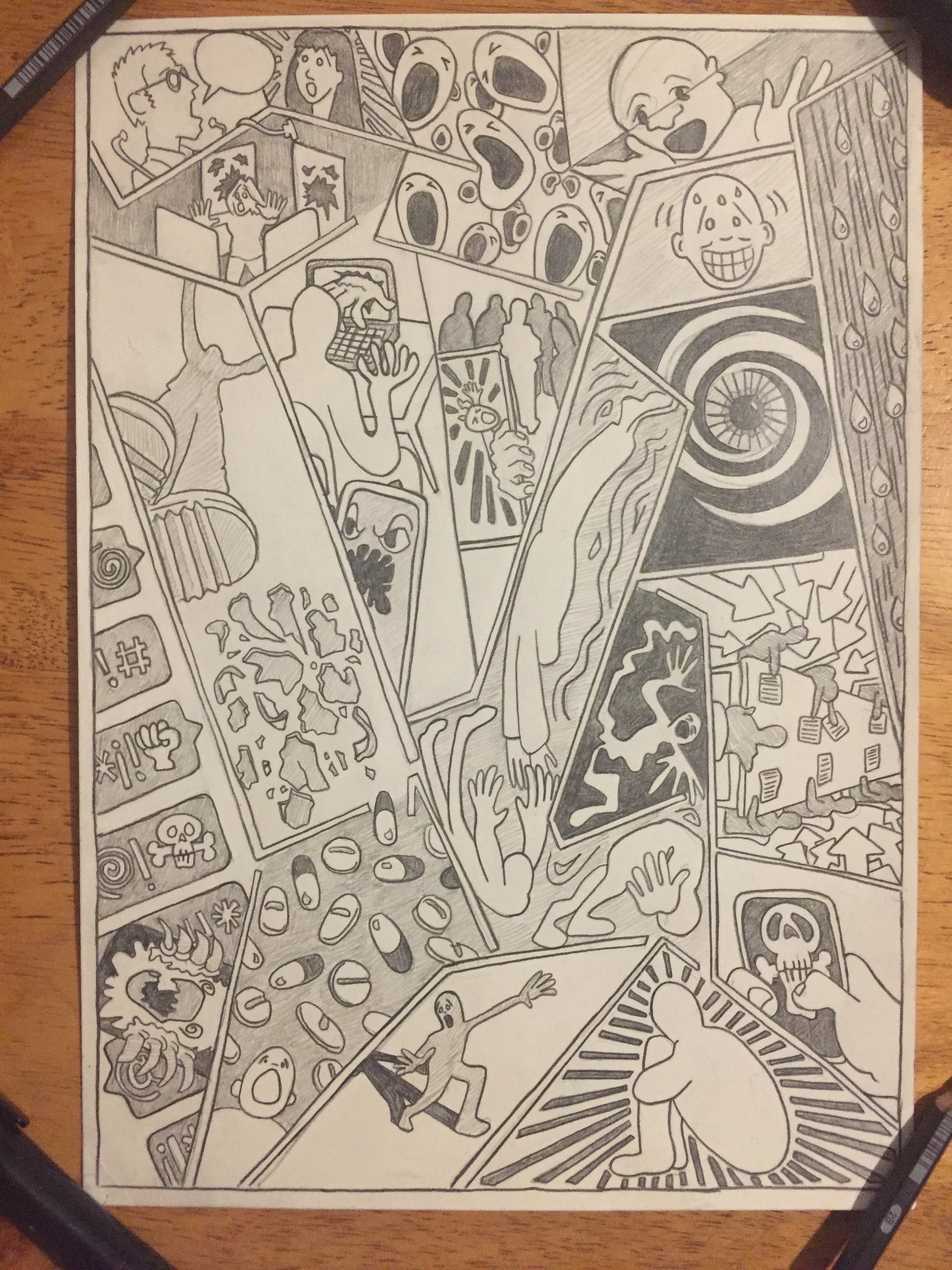
fig.1 “Mental Health/Escher” WIP

fig.1 “Mental Health/Escher” WIP

Grabbing some moments for my work has seen me messing around with the disorientation of 3D to explore my mental health/Escher sequence that I’ve been developing [fig.1]. This needs some clean up, and refinement - the balance isn’t right yet, but it’s now got me thinking that I might produce this as a series of print versions - and that 3D has definite possibilities. My normal process involves working quickly on instinct - partly to bypass overthinking, but, with this image, there’s scope for exploration and investigation, which I want to enjoy.

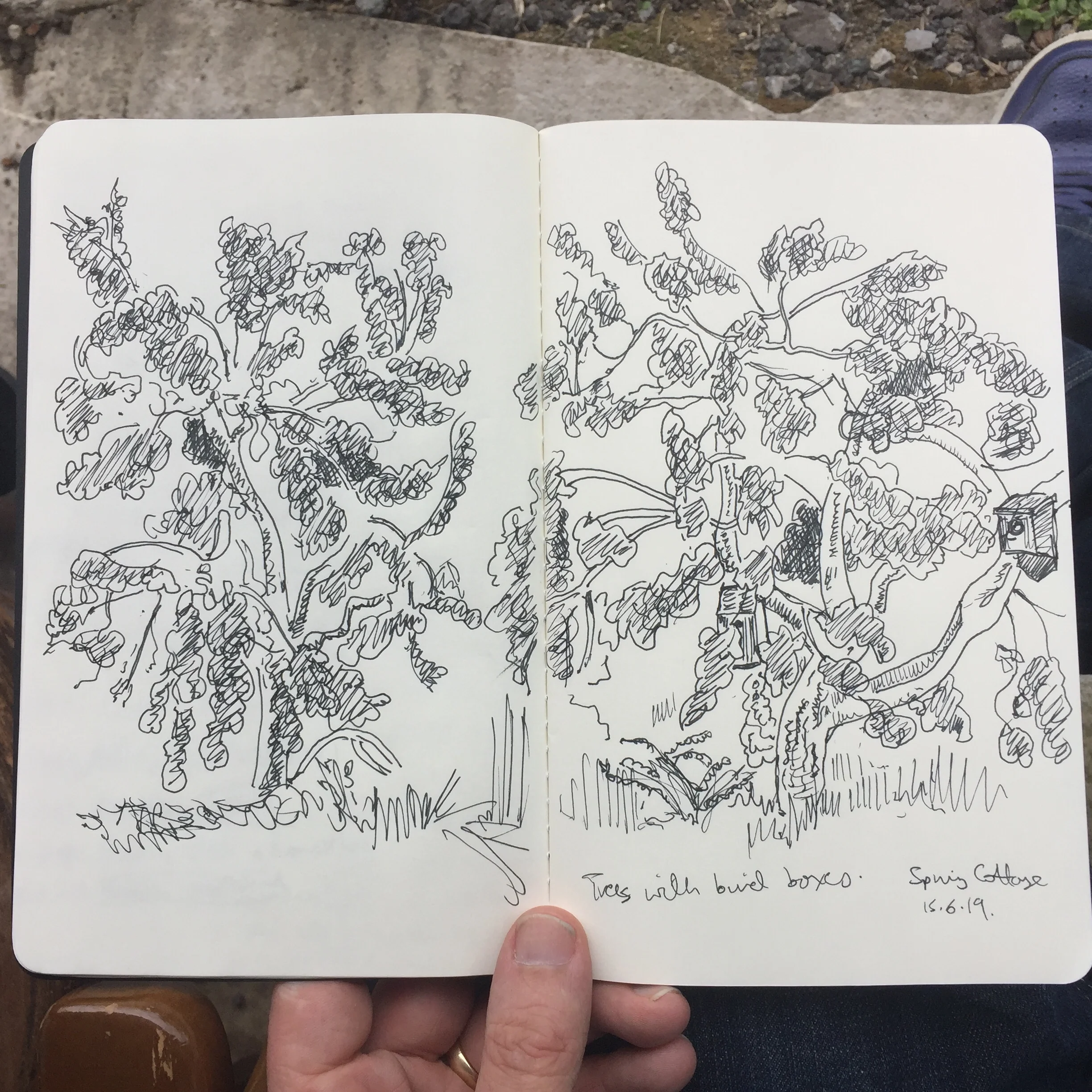
Otherwise I had a chance to visit my Dad in his care home. Because of his dementia sketching has become a part of our communication with each other, filling in the blanks in memory and conversation [fig.2]. He enjoys watching me sketch as much as the finished product. This time we were able to spend some time watching adult Blue Tits bringing food to their young. I didn’t catch the birds, but the trees and the boxes led to a sprawling and expressive sketch that seems to exist between my more controlled drawings and my scribbly sketches from life…
IMG_8099.jpg

The posts for the next few weeks might also be image based, but I suspect it will all lead to reflection in time ;)… Right, that’s my snap-shot of my thought/work process this week - now, have to dash.
Disrupting the norm.

So it’s been one of those weeks – where work and jobs and family stuff has been manic. And, alas, not all of this has been creative! Naturally, as I write this it’s a glorious morning, which is both uplifting – B12, vitamin D, dopamine, all that stuff; but also makes getting my head down more difficult – fortunately I have this blog, so I give myself permission to spend some time reflecting… *ahem. 

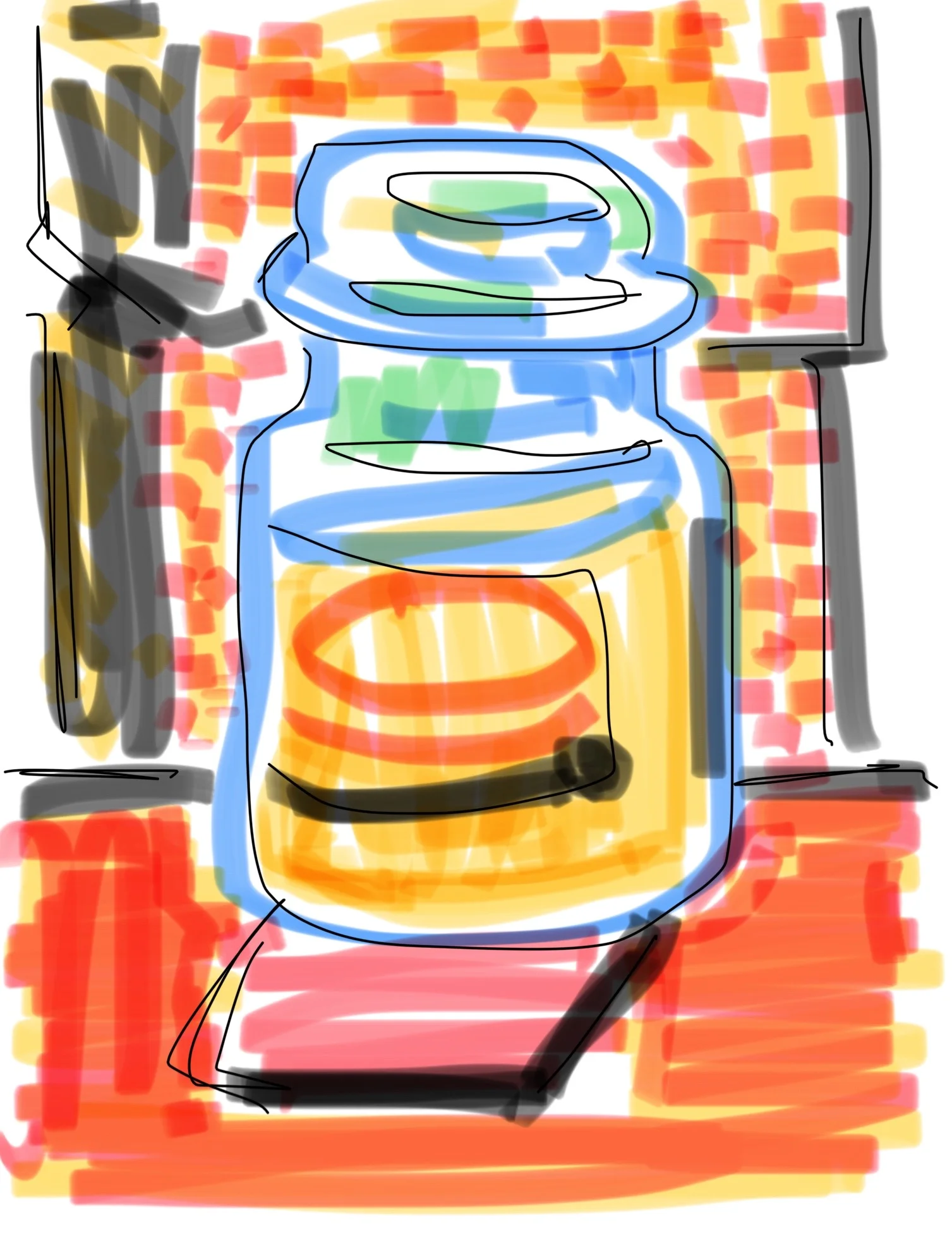
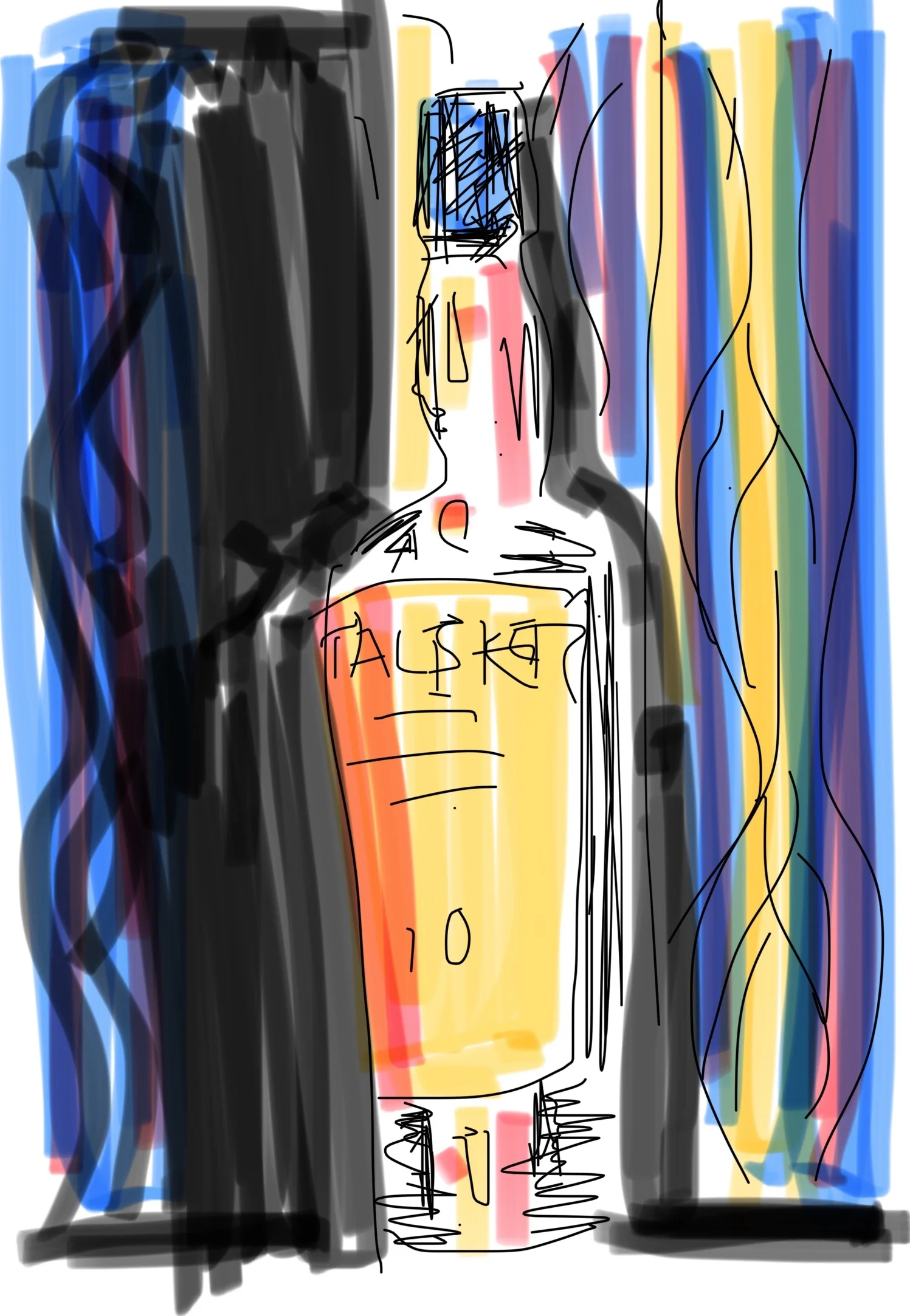
fig.1: Talisker 10 still life

fig.1: Talisker 10 still life

While all the stuff has been going on I’ve been chipping away at my Escher/mental health piece, and I aim to deliver a post on its completion next week; but having less time means I’ve had to try and find ways to fit in my practice where I can. 

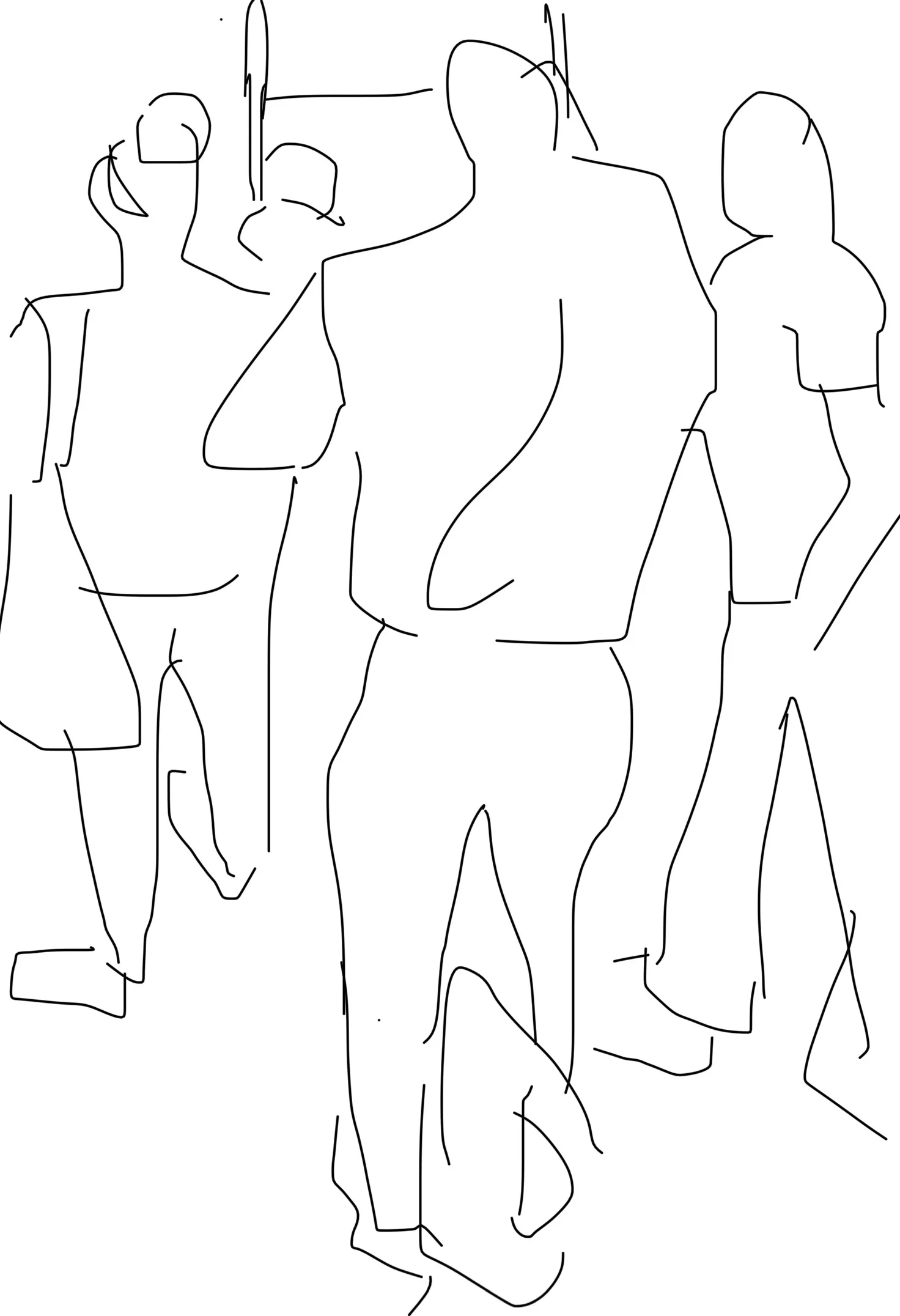
fig.2: Commuters

fig.2: Commuters

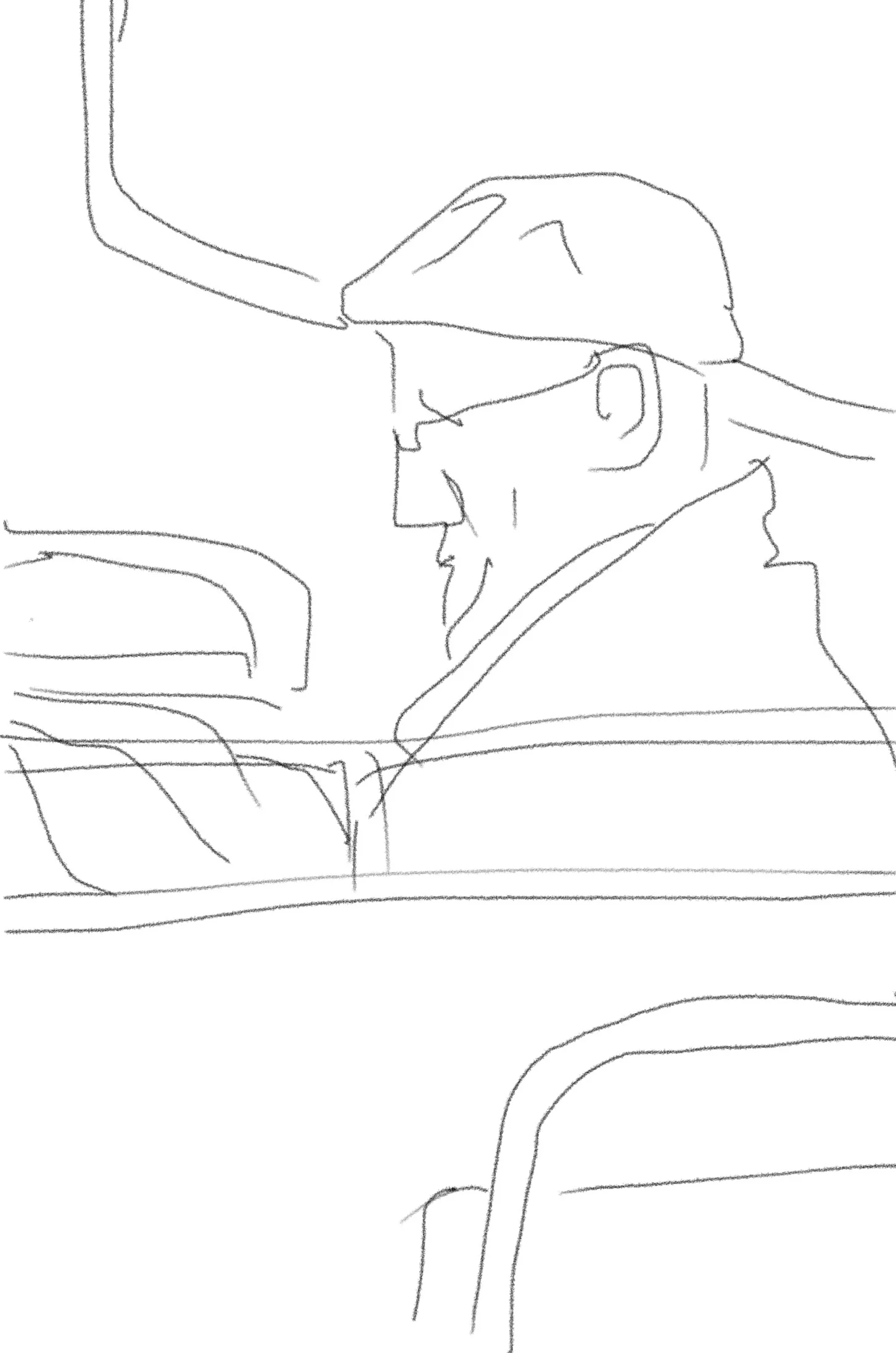
So, faced with crowded trains, access to only a phone, and the positive impact of disrupting your practice, I’ve been messing about with my phone, my finger, and the capacity to draw using the Notes app [fig 1-4] (My phone’s memory is stuffed, adding in other better apps is not really an option till I upgrade). This is not quite Hockney and his i-pad, but y’know, thought I’d give it a go.

fig 3: Candle Jar still life

fig 3: Candle Jar still life

It’s made me think. The results have been interesting – challenging me to consider composition, economy of line, new ways of using colour, and accepting a looser approach – my finger is just not as precise as a pen would be! The colour in notes is through highlighters – so you can blend-ish, but it’s tricky – kind of a mix between a marker and watercolour. The upshot is it makes me think about colour as absence, blocks and pattern, and I use black for tonal variations – I usually keep black away from colours!

fig.4: Commuter - man on train

fig.4: Commuter - man on train

Drawing like this opens up new approaches to figures – considering how they take up space, and present attitude; and for the still-lives, how the objects relate to their surrounds in what is a pretty bland room. I can’t cut through the image or erase mistakes in the same way, so often the choice is between accepting a mistake or starting again; a constraint that makes you look that much harder. The results are rougher of course, but there is an energy as a result, and I wonder…

I come to these qualities with fresh eyes, because the medium is not familiar. I will continue, and get the jobs done, I will complete the Escher piece – I’m still very excited by it! But I will also try to build on these experiments – considering these images and how the approach will work for me.

A testing time.

A new week begins, oblivious to the shooting stars of work, things to do, quick jobs and a myriad of deadlines that arise, approach and depart. In amongst all this I’m working on my Escher piece on mental health [fig.1]. 

fig.1 Development drawing

fig.1 Development drawing

 Last post I discussed the initial sketch and the generation of the concept – now it is time for shaping it. The idea moves from a sketch to a more detailed drawing, a chance to re-interrogate the ideas, to see if they still work, and to test the logic of each panel. The first step is to translate the shape of the drawing – my sketch book is long and thin, so tends to squish ideas. A new drawing gives me the opportunity to explore more width, to see which panels need more space, and which benefit from the elongation to work. 

 The quality of line and shape is more carefully described on a larger scale – navigating swirling movement and lines of perspective. In adding in or removing moments of detail quirks are made permanent and weight and impetus is given to scenes – monsters realised, psychology intensified. Panels are tweaked, and in places, where I can no longer see my thinking (or disagree with it), completely changed. 

 Through this process I find myself becoming obsessed with the movement of the pencil. From the initial flicks and swirls of the compositional marks, through to the pressure of the final sweep. There is a tension between the need to embed my intention in the line – for clarity, and the need to remain relaxed enough to describe the languid sweeps and curls; a tension between the need for confidence in the making of the mark, and the fear of slipping. As a result, in my drawing I think there is both a façade of bravado, and an ability to embrace – and sometimes revel in, mistakes, wobbles – elements that disrupt concepts and intentions. 

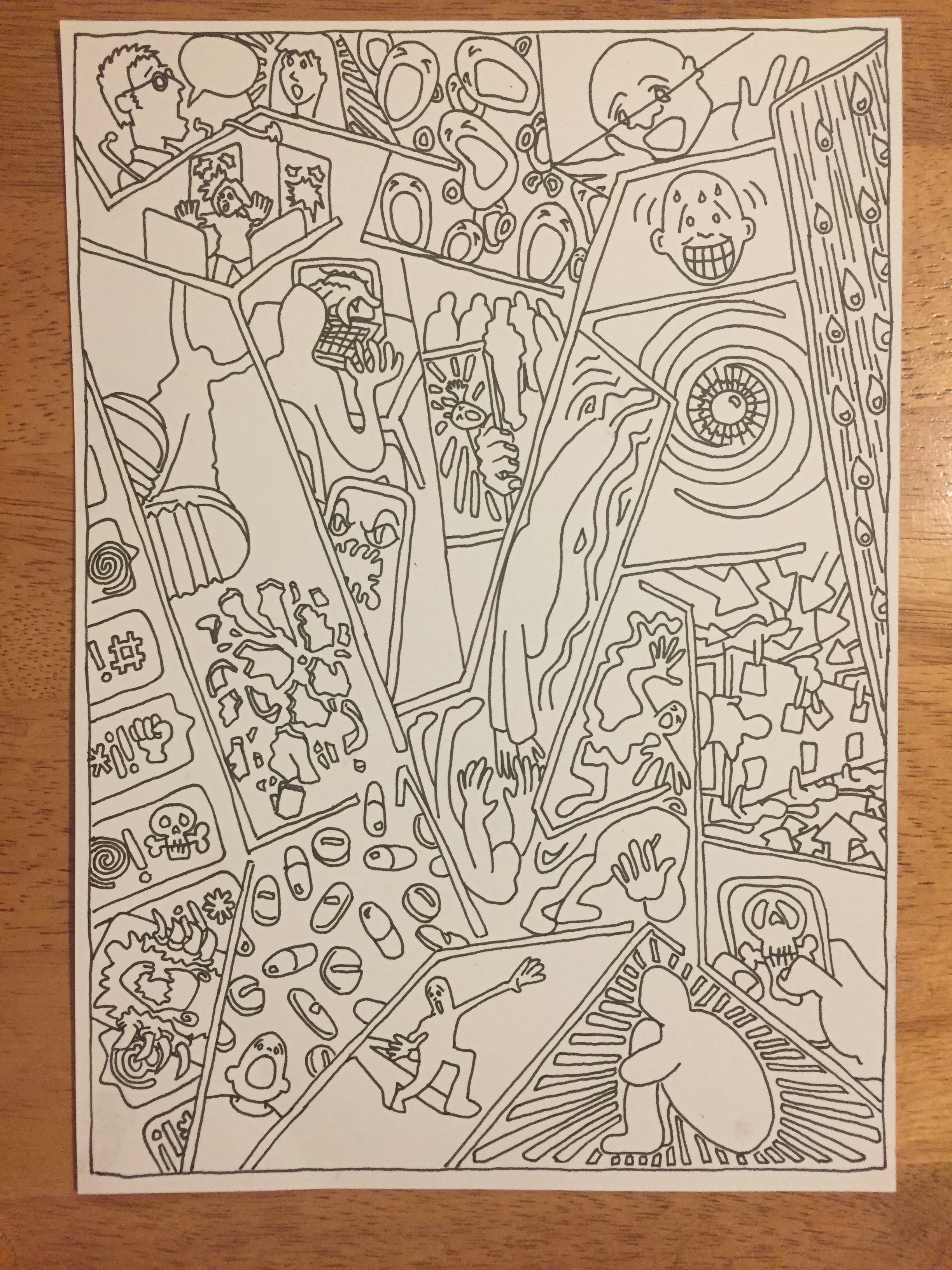
fig.2 Line ink

fig.2 Line ink

 The final aspect of the drawing is to suggest areas of tone and contrast. I do this even though the next step is to ink in the line [fig.2], knowing that when I scan in the ink drawing I will colour using this tonal plate to guide the colour palate. Adding tone gives me the opportunity to consider how the picture plane will be broken up, and how the eye will move across the panels, and so how the eye will read, or be guided to read the sequence. In this case the, although the sequence will not read in a linear manner, the reader will begin in the western comics tradition – providing the opportunity to use depth and a moving horizon to distract and disorientate, and to sculpt a new way of experiencing the narrative. 

 Which, given the topic of mental health, and how it is perceived and experienced , is kind of why I started this in the first place.

Mental gymnastics.

Shrieks of seagulls, and the rumbling of the tide greets me as I wake this morning.

Outside the sea is calm, rippling to the horizon, broken by the jutting seawalls and the odd boat bobbing into view. Clouds sweep across the panorama – skipping through shades of grey to meet the clear sky in the distance.

A quick seaside break over the bank holiday brings these new sights and sounds as a stimulus to recharge and rethink, and I am reminded how travel provides the chance for me to reflect on my work, but more importantly gives me the impetus to imagine ideas.

fig.1 mental health

fig.1 mental health

fig.2 Shaftesbury Theatre

fig.2 Shaftesbury Theatre

fig.3 Denmark Street

fig.3 Denmark Street

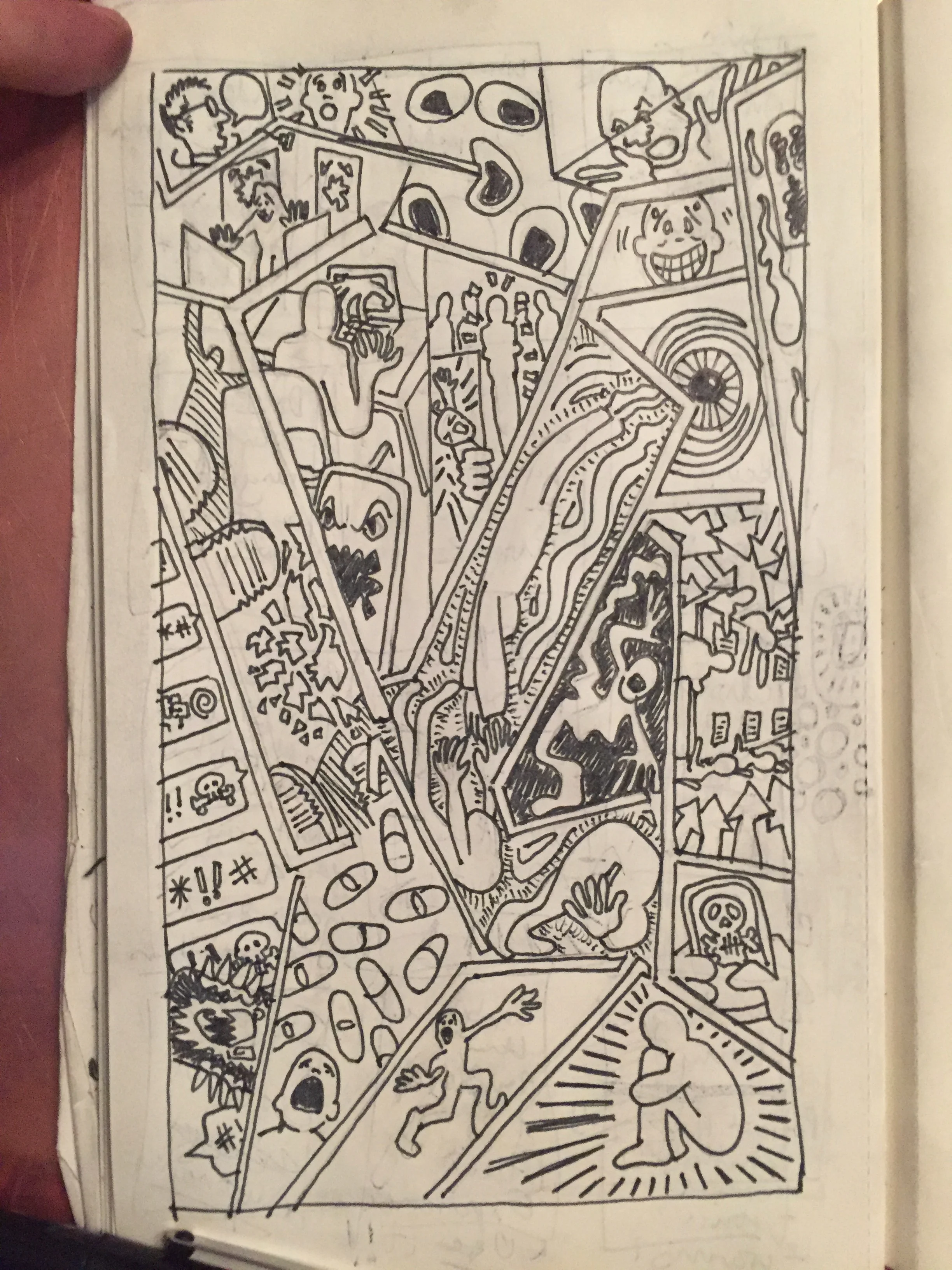
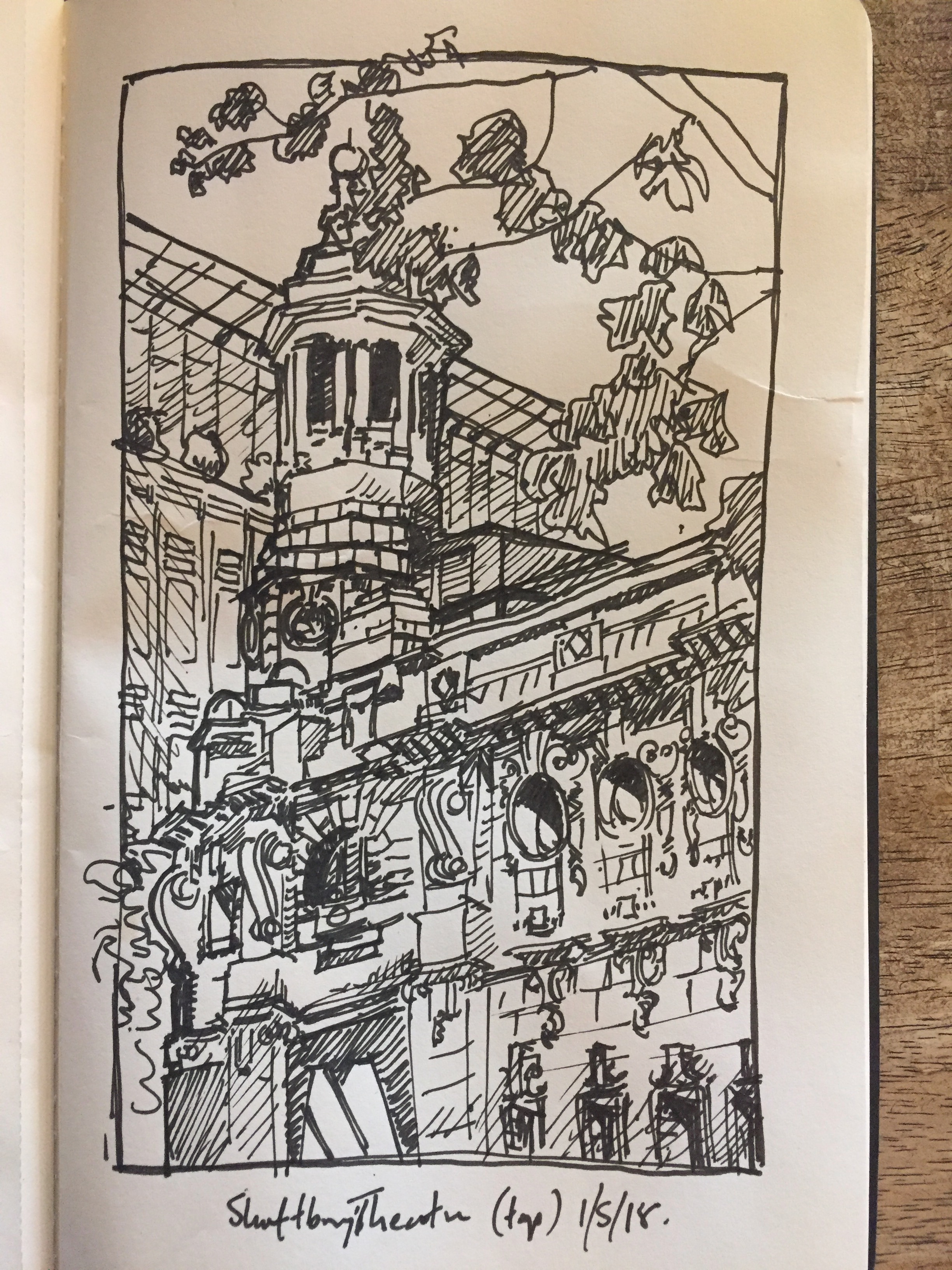
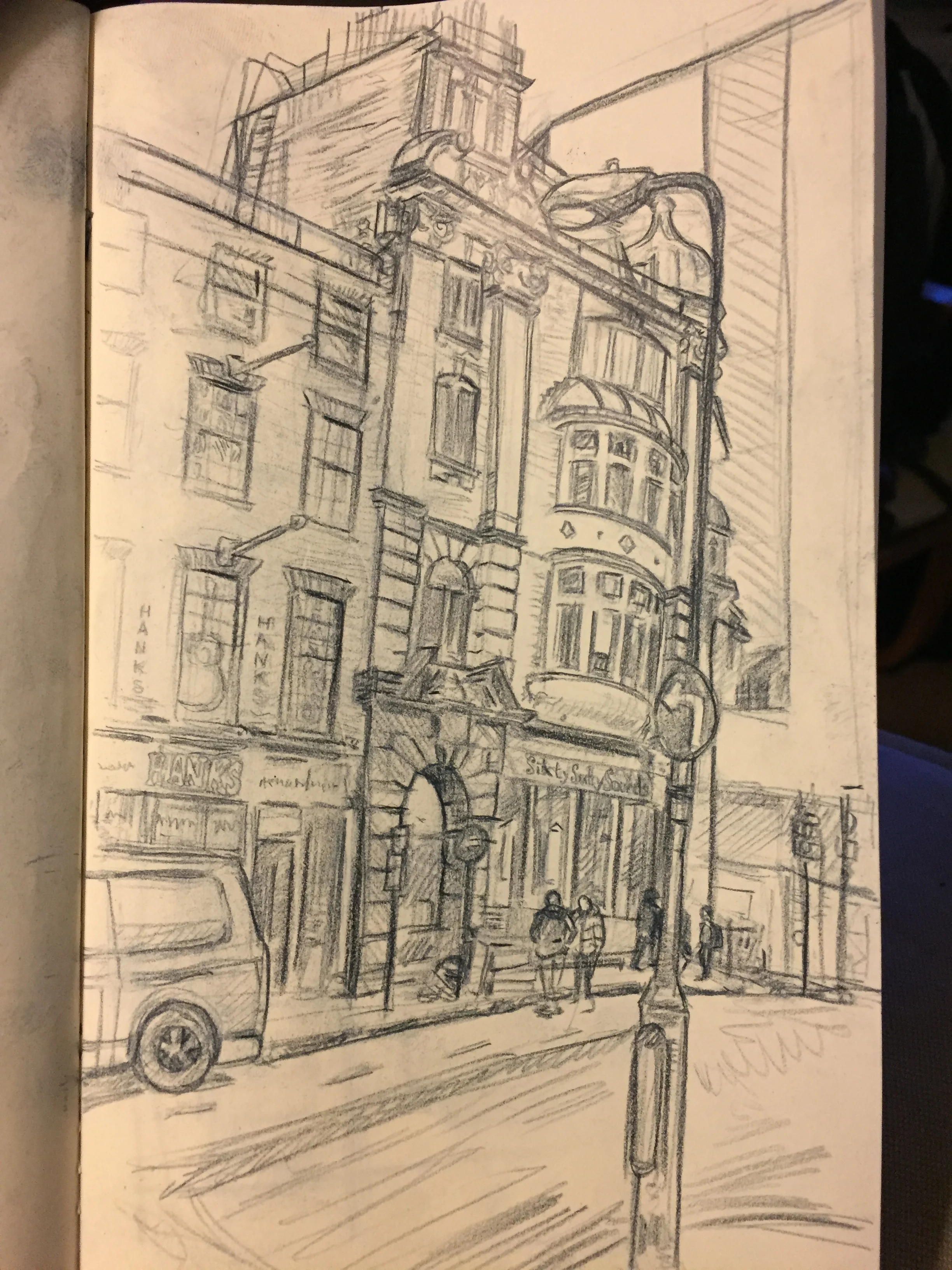
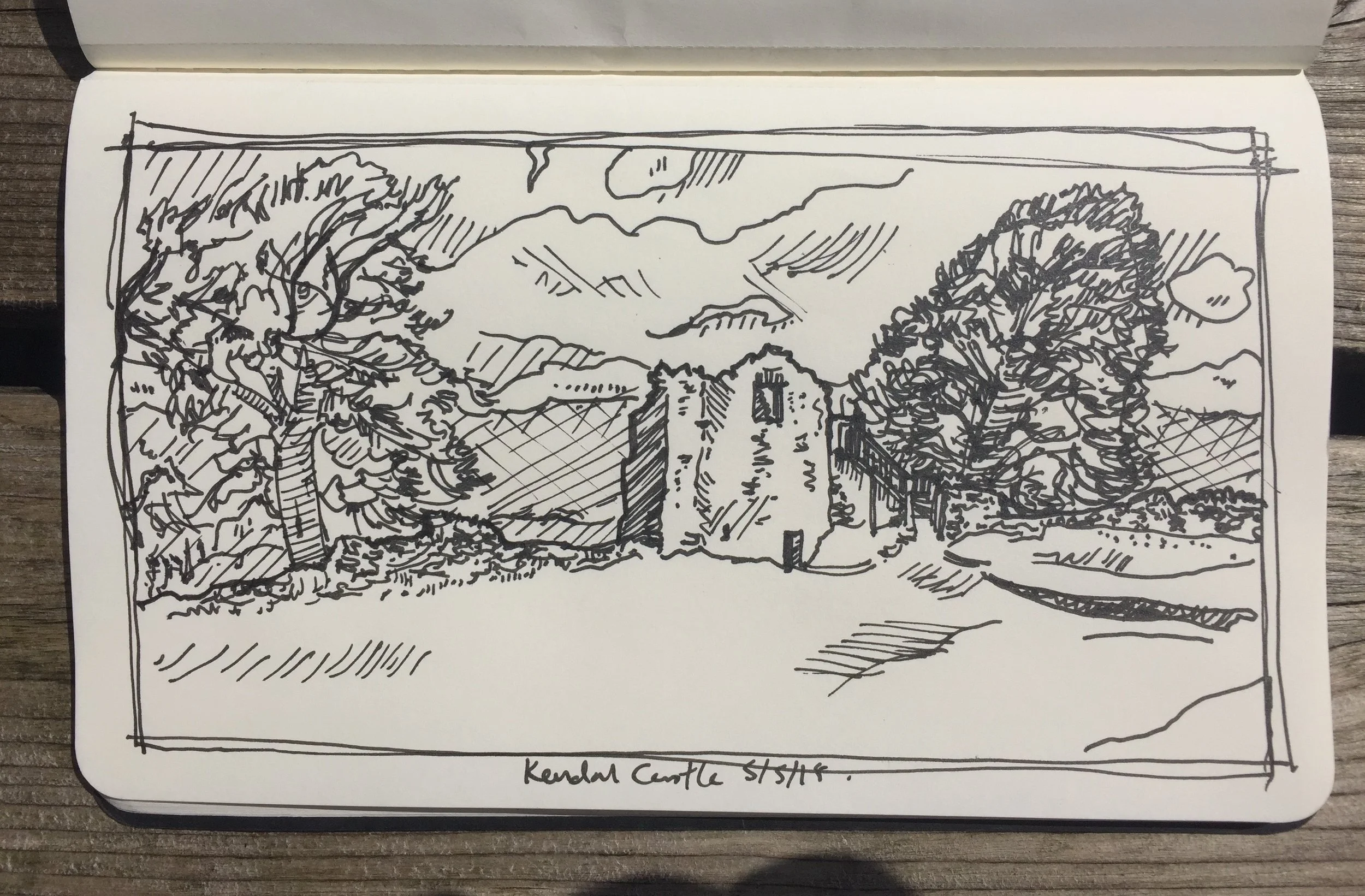
 I want to think about a piece in progress for this blog [fig.1], one that began on a trip, in a quiet moment between travelling from and to, whist going to speak about Diabetes: Year One as a way of enabling patients through art. I like to arrive early if I can – to give myself time to wonder around a different space, often to sketch places to try and understand them better [fig.2,3 & 4].

fig.4 Kendal Castle

fig.4 Kendal Castle

These quiet moments are often the best time to lose yourself in an idea that’s been at the periphery of thought for a while.

This sketch takes the idea of M.C. Escher’s Stairs and uses its play of perspective as a structure for a panel layout. The shifting plains demand a disruption to narrative which has intrigued me for a while; an approach that attempts to describe the layers and shifts of thinking that exist around mental health - and as it was mental health week when I was sketching, the topic seemed apt.

In terms of process this is the beginning - the sketch needs work, I will have to tweak line, and clarify certain panels, challenge some of my decisions and reflect on how to be, colour and shadow will interact - if at all. But at this stage it is about identifying the structure, creating the handholds of narrrative and just dealing with the maths of perspective and the imagination of scene. This to me is the grunt work, a process of drawing and re-drawing to fit the image in my mind - testing my imagination as object and establishing the relationships of logic or aesthetics as ideas start to meld.

Having just finished a project it’s nice to work on a personal piece - a mini project, where there is no one to blame but myself for the constriaints I have placed. It’s nice to get back to my own masoschism for a while.

Past-Masters

fig.1: Iron Age p.3

fig.1: Iron Age p.3

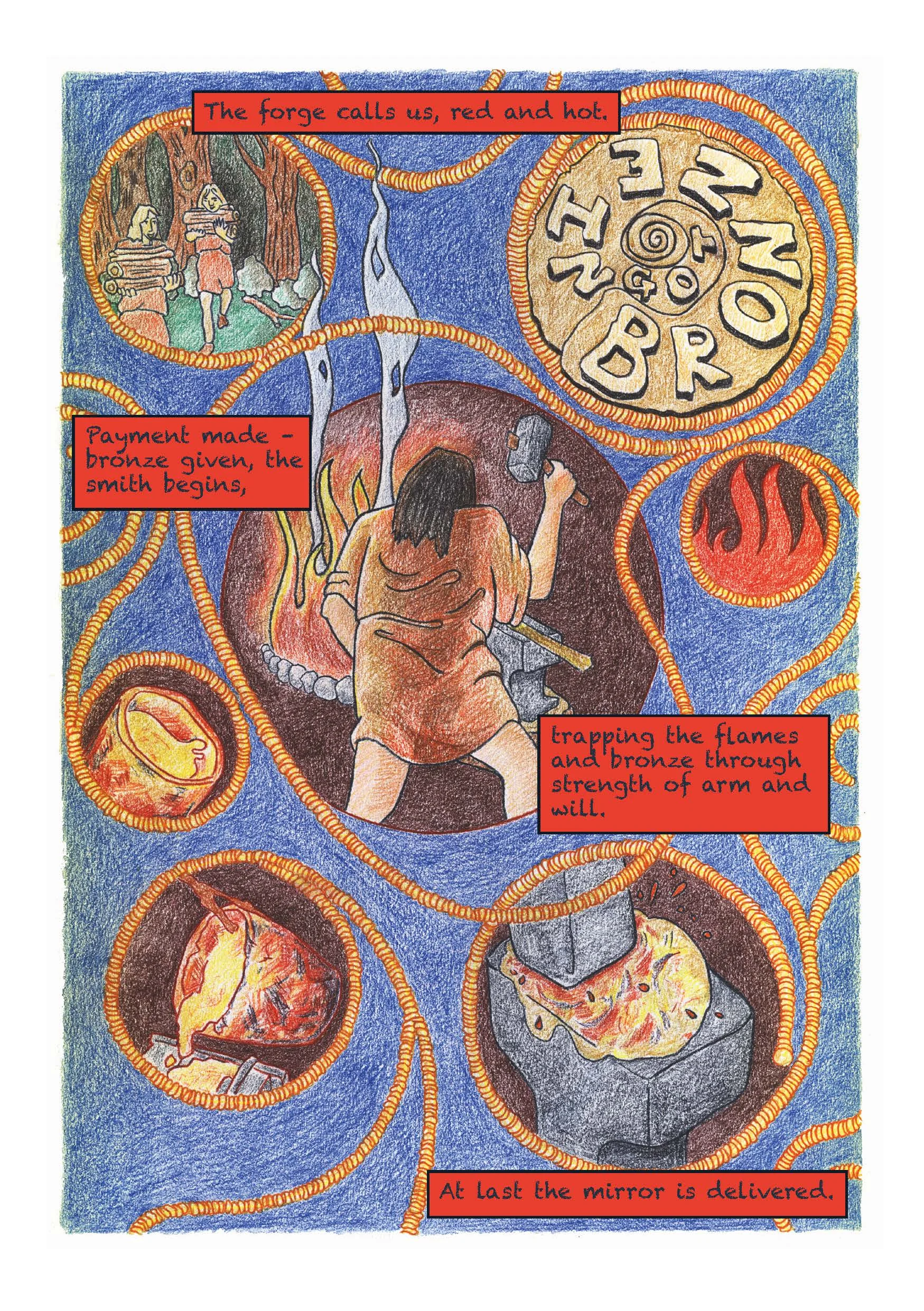
Another week rolls around, and, for me, this week is about bringing long running projects to a close. This week I’m all about pencils – lead and colour, as I finish a series called Pre-History to Primary Schools for the Archaeology department at The University of Manchester (Specifically: Dr Nick Overton, Dr John Piprani and Dr Hannah Cobb) [fig.1]. These comics have sought to translate and imagine the department’s research, so that it can capture the imagination and contextualise the technology and anthropology of Pre-History.

The project has been collaborative, with the department gathering research, and establishing the key technological or societal factors for each era, then developing scenarios around which to display the finds, digs and things that provide the basis for our thinking about these societies; before turning it over to me to create a narrative script and to illustrate the comics. It is part of my role to balance information in narrative text, with information shown through the flow of images. Alongside the information booklet, and the comics, objects are provided to create a package that is interactive in different ways – designed to inform and represent research, but also to engage imaginations to ask more questions, and to become curious.

fig.2: Neolithic p.4

fig.2: Neolithic p.4

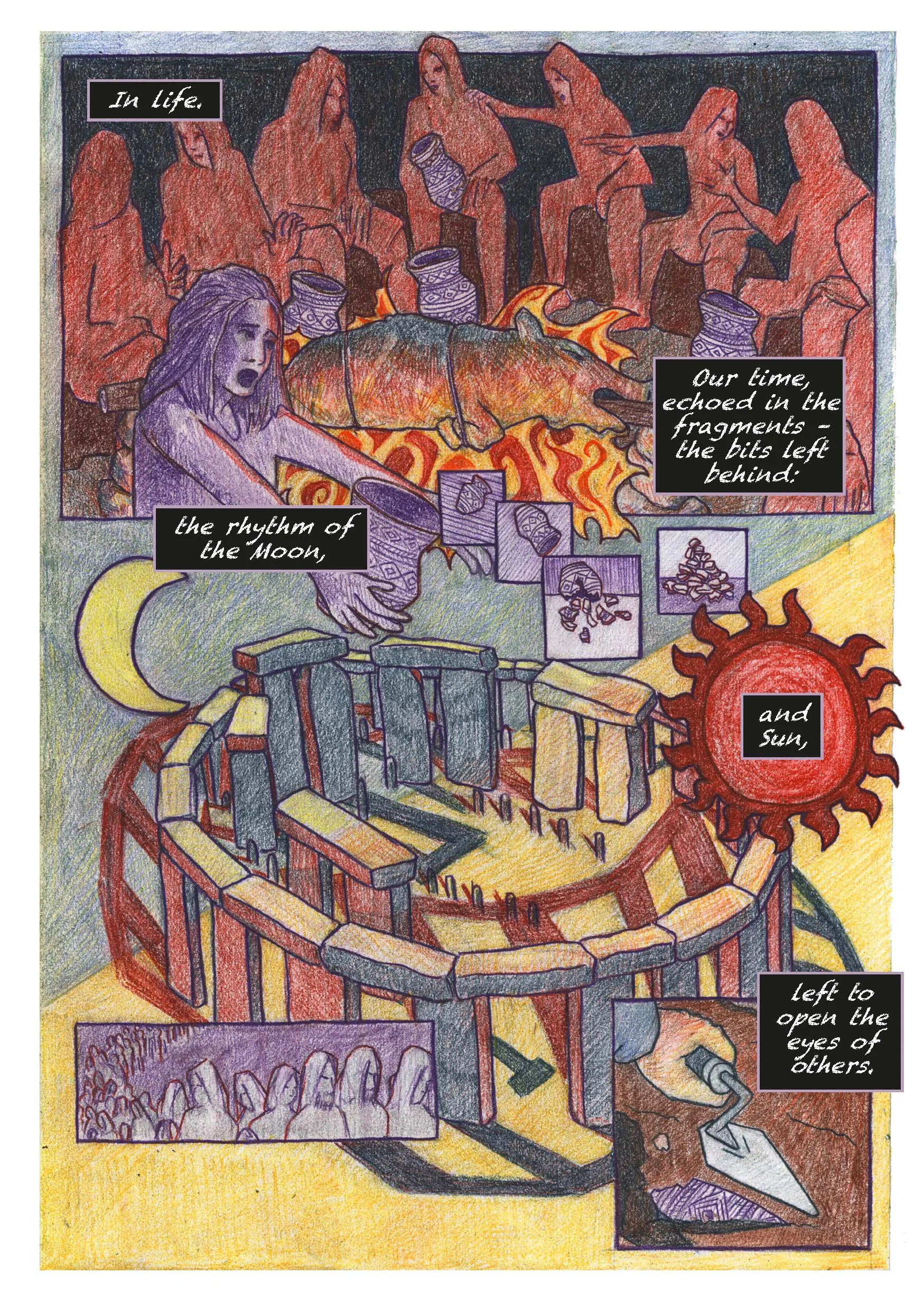
 For me the challenge has been a deliberate decision to tell these stories of a society influenced by the agency of things. The narrative point of view is very much part of this society – but not necessarily human… or animal. This point of view has informed the design of panel and gutter to provide a sideways approach to the story that unfolds. Finding a visual language for this research has been ongoing – but from the start has been driven by a sense of lyricism, and a quirky perspective that is both part of society, and outside [fig.2]. Much of the collaboration has been to negotiate my instinct towards elaboration with the need to represent the accuracy of the latest thinking – to visualise the skeletons in the flesh. The result is that the strips are grounded in naturalism but seek to consider the idea of the agency of thing, flora and fauna through moments outside the specific, and a use of colour that seeks to wink at our modern empirical view of the world. 

fig.3: Mesolithic p.1

fig.3: Mesolithic p.1

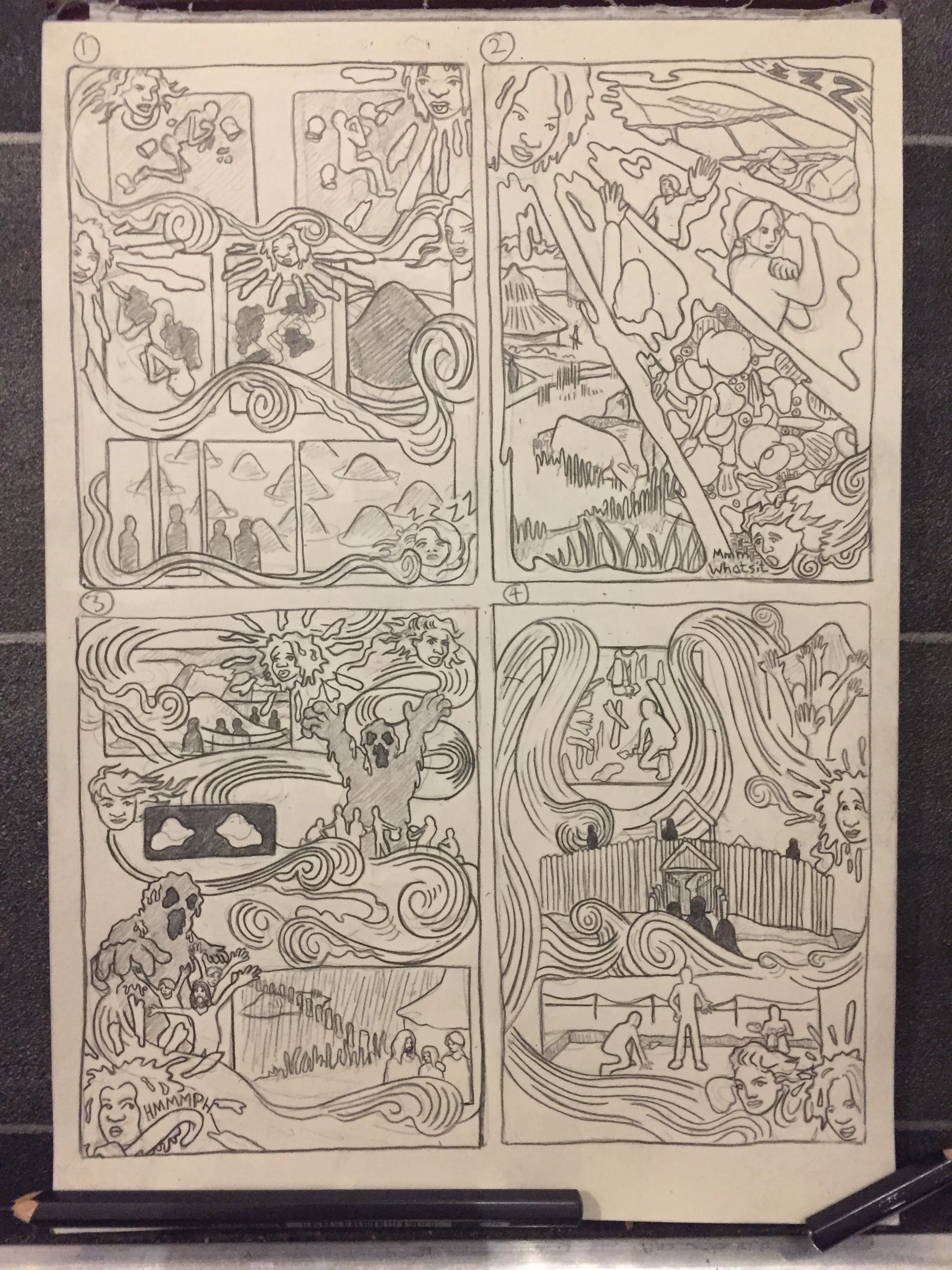
 As the project has developed I have evolved my process – always beginning with thumbnails, but increasingly moving to a pencil, then colour model – rather than working over the pencil drawings. With each era the images have mixed research into finds and objects, the presence of defined landscapes, hints of film allusion, with the graphic potential of comics grammar. These developments have allowed more discussion of changes, and less fear about suggesting ideas (as changes are easier), which means that the discussion becomes creative and better solutions are found. Discussions around the theme of death [fig3], the representation of gender and race, about dispelling the norms of contemporary society, and balancing the thing and the story. And, as this next week begins, it is my move in the discussion, to create my pencil templates that realise the changes suggested to the thumbnails [fig.4]… but also find a way to communicate the narrative drive ;)

fig.4: Bronze Age: initial thumbnails

fig.4: Bronze Age: initial thumbnails

Internal, external, enabling me?

So the sun’s out, shorts have been gathered up from the depth of my wardrobe, and warnings about possible skinny leg sightings posted in the neighbourhood.

With new weather comes new perspectives - I mean generally, not all the time, but… often. It’s a slightly different post this week - really I’m going to let the images do the talking. I’m planning at talk entitled "Enabling Patients Through Art” at a conference called Patient, Heal Thyself (see more at www.euhic.com (ugh, link won’t embed, so copy n paste), and promo artwork [fig.1]), which will reflect on some of the concerns I’ve blogged about regarding my work and it’s relationship with type 1 Diabetes. The promo itself explodes some of my thinking about the role of the patient in relationship to healthcare provision, and to the experience of becoming first a patient, and then a person living with diabetes.

Fig.1: Patient Heal Thyself

Fig.1: Patient Heal Thyself

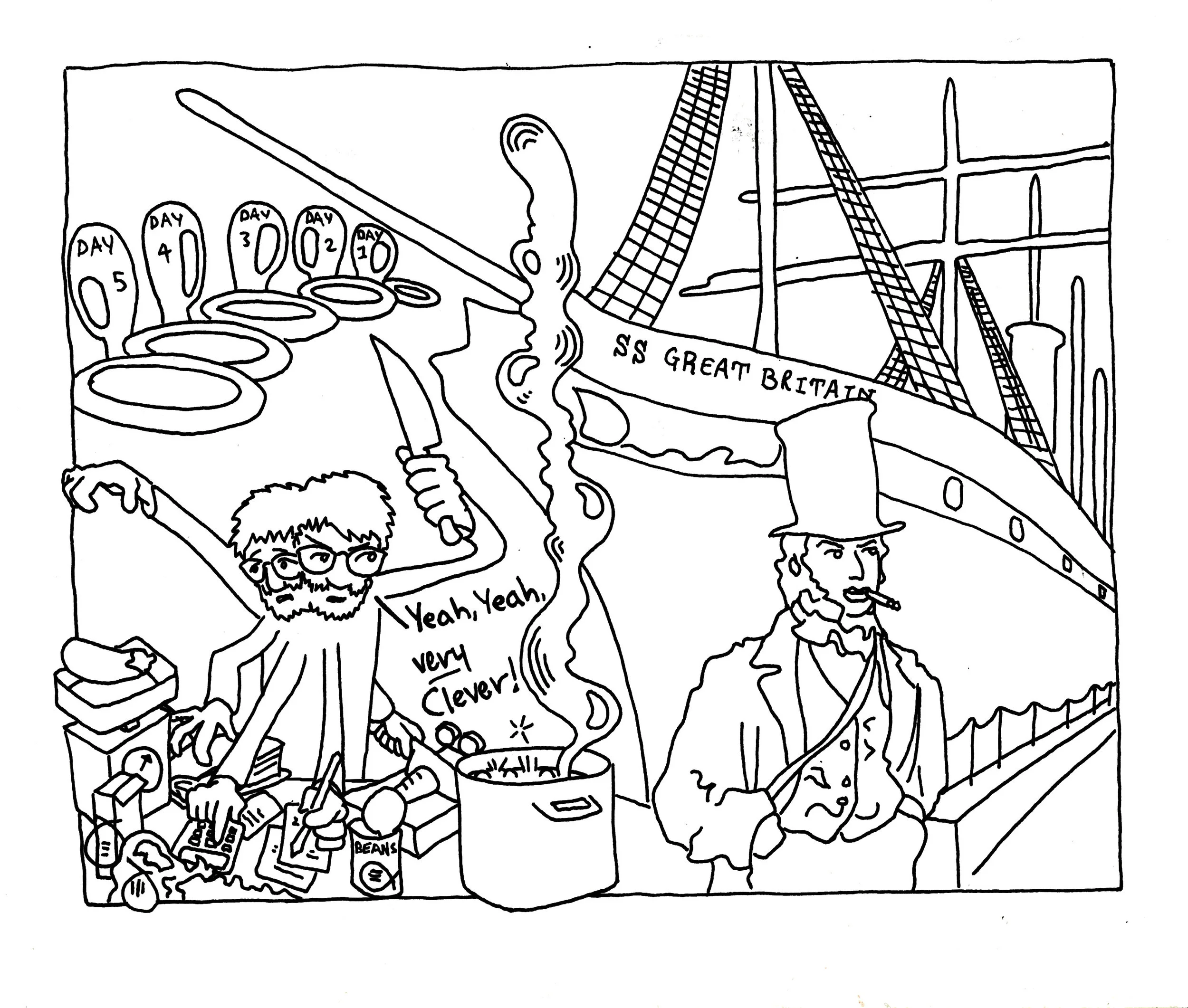
And, naturally ,whilst planning out a talk, and thinking about the blog for this week - I decided to draw a cartoon reflecting on some recent experience (unsurprisingly food based, though more surprisingly picking a fight with Isambard Kingdom Brunel - go figure!). In doing so I find I reveal my thinking to myself, and in this case it enables me to step back, to give myself some perspective, and even to find humour in the realisation of my own melodrama [fig.2].

fig.2: ‘You think that was tough!’

fig.2: ‘You think that was tough!’

Whether this is enabling, or coping, and what the difference is between the two; and why comics, and cartoons seem to be such a useful conduit for this thinking is something I want to explore, and *ahem, need to get on with...

[Exit pursue by a bear, erm, work]

Reflect and refresh.

It’s Friday, and you know the Week should be winding down; but new deadlines have managed to creep ominously forward, whilst others you thought you’d disposed are rearing their heads with ‘just one more thing’. You find yourself looking at the weekend trying to work out where you can fit in a bit of work to try and sneak back some of the time that is currently slipping through your hands. Your mind is popping with the logistics of zig-zagging family and work, and your energy is focused on finding the time - but not on what it is you have to do.

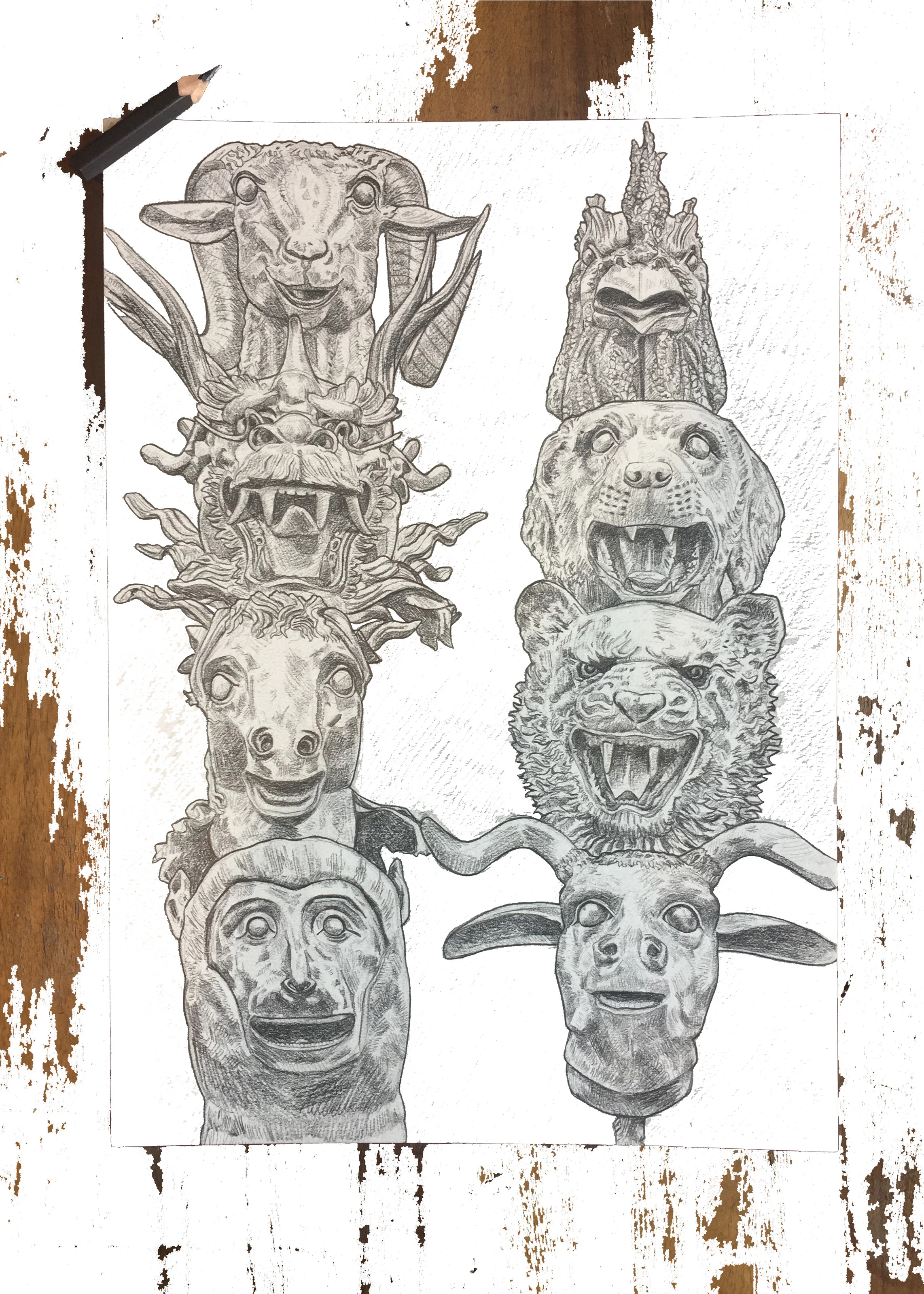
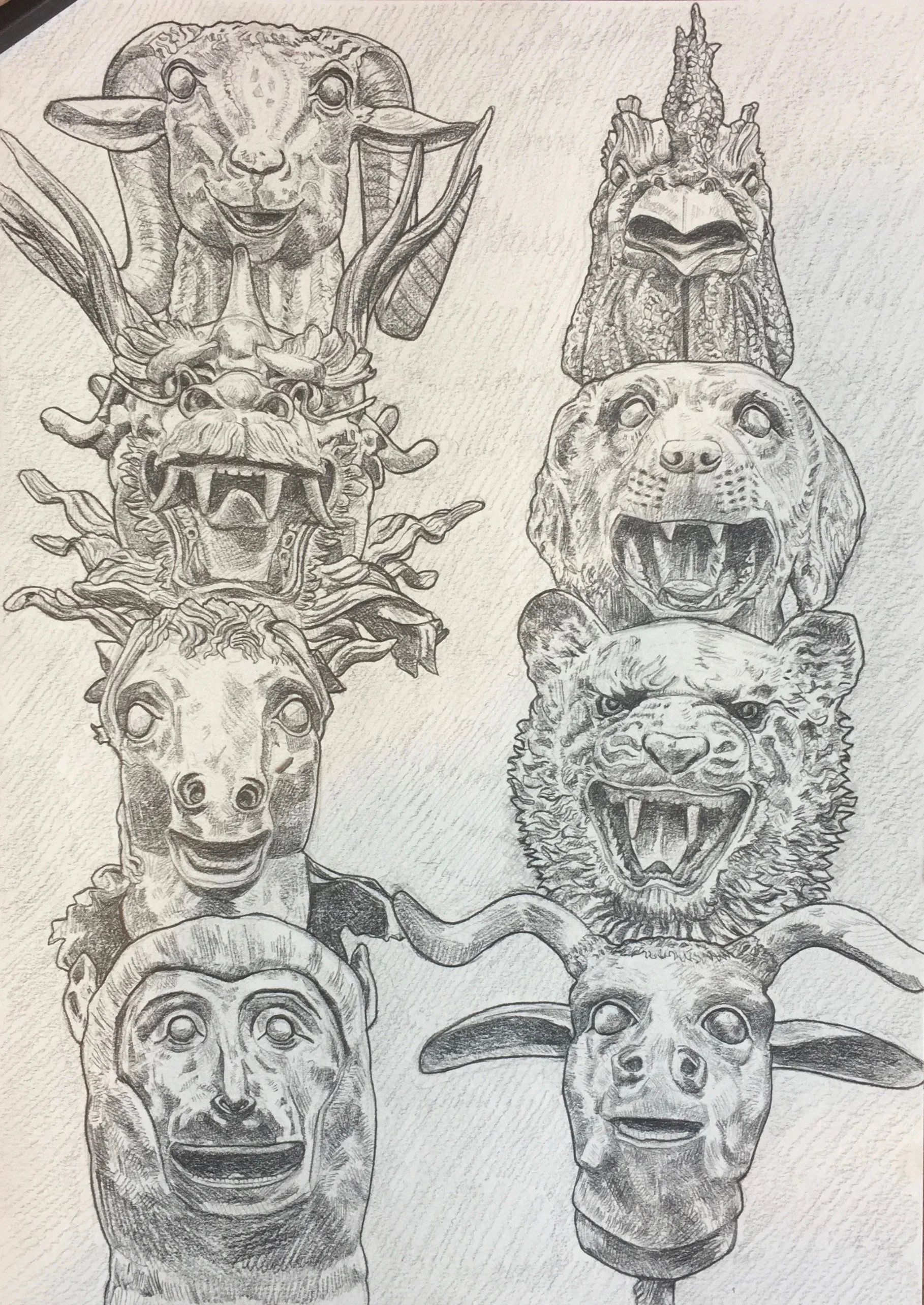
So, as I felt a familiar twitch of the eye and the bitter taste of adrenaline, I was lucky that I’d already agreed to spend a day getting drunk, and another going to the Yorkshire Sculpture Park this weekend. Having no choice meant that I had to refresh rather than stress. A day to let go, and another to revive my eye, and my mind (and a bonus day to obsess) enabled me to reflect on the projects, to explore more fruitful ideas and choices. Specifically sculpture often inspires me to sketch in detail, and in this case it was a drawing inspired by some of Ai WeiWei’s Sculpture of the Chinese Zodiac, which I’ve subsequently played with digitally [fig.1 and 2], and want to think about a bit here.

Fig.1 ‘Chinese Zodiac: Studies (digital edit)’ Original Sculptures by Ai Wei Wei at Yorkshire Sculpture Park

Fig.1 ‘Chinese Zodiac: Studies (digital edit)’ Original Sculptures by Ai Wei Wei at Yorkshire Sculpture Park

Fig.2 ‘Chinese Zodiac: Studies’ Original Sculptures by Ai Wei Wei at Yorkshire Sculpture Park

Fig.2 ‘Chinese Zodiac: Studies’ Original Sculptures by Ai Wei Wei at Yorkshire Sculpture Park

I am fascinated by the drama of gesture, shade and dimension, but can only really process all this by working it through in tone and shade. Drawing involves making judgements about distance and placement. Doing this reminds me about the rules and potential of composition, and also, as I inevitably find that I have made a mark that is errant, of the hubris of picking up a pencil. Realising your fallibility is useful, as is the realisation that sometimes the mistake is more interesting that the ideal. The process asks me to reflect on my choices, to defend my decisions, but in a situation of my own making, where I can feel free to fail.

Drawing also requires bravery - the sketch is recognisable, the objective achieved, should you stop, or do you have something else in mind, do you risk destruction to persevere? The further in to the sketch to progress, the more hinges on this decision - have I wasted a day? At this point the certainty of my hand can be tested. There is always the temptation to continue - the question have I done enough, can I make it better - will it be worth it? My way of drawing, in this case, requires building up layer on layer, in other words constantly resisting the same marks to add depth and contrast, but a method that can lead to overworking, and needs a determination to leave areas, whilst working on others. As a left hander I tend to work bottom left upwards to lessen smudging, so to finish, and realise the now the bottom left now needs refreshing can be agonising.

For me there is something relaxing about depicting detail - I am not a philosophical realist in Art or Design, it is more that searching for depth and nuance in detail has zen aspect - it demands an ‘active looking’ that is both exhausting, and a release. I often find I complete a complex drawing with a new appreciation, and understanding of simplicity - of the meaning of a single line, or of the juxtaposition of colours or objects. Drawing sculpture provides ridges and creases, but also the play of light and shadow, all of which combine to create an illusionary quality to a physical existence - something you only realise when you try to follow the line of a dogs mouth, or the perspective of a dragons cheek!

The process of the drawing is not the end though, once finished it is an object - both in itself, and digitised to communicate online. So I continued to mess about - enjoying the play of light on graphite to pick up on pinks and blue-greys, and the distressing effect of deletion. I’m not sure this is finished yet, but a digital context can be an exciting way to refresh a traditional image, though of course it can be a way to extend the dilemma of when to stop beyond the pale.

Speaking of which *coughs… .

Visualising the abstract.

The weekend storm has faded, and the sun soothes in through the window. My newly potted basil seems to approve, and I entertain the notion that this time I won’t kill it (I believe I have anti-green fingers).

I begin the Monday shuffle, sorting drawings, references, pens and pencils; plugging in laptops, tablets and lightbox, and complete my daily to-do list. I like to-do lists - they help to regulate, to make sure I am free to improvise - to be agile without forgetting the  basics (in my case carb counting and insulin 🤷🏻‍♂️). 

fig.1: Germs: Wash Your Hands (St Giles Medical) [Wip]

fig.1: Germs: Wash Your Hands (St Giles Medical) [Wip]

My work since Diabetes: Year One  has been based around imagining ideas; visualising concrete and abstract research and concepts in different disciplines: from medicine [fig.1] and archeology [fig.3], to environmental science [fig.4] and history [fig.5]. I approach all this as a lay expert, as a patient, as the curious and as a communicator. My job is to ask questions, of the topic, and myself. To question the details and the obvious, to confront my own assumptions, but also to add my voice to the conversation. 

fig.2: Thumbnails and Drawings. [Wip]

fig.2: Thumbnails and Drawings. [Wip]

There are loads of ways to begin to interrogate ideas, but my work is filled with the language of comics - character, movement, gesture, framing and lettering, so I tend to think best through thumbnail sketches in response to the research, and the thinking - where the coffee and staring into the distance comes in. But these are the notions, the quick thoughts; the thinking proper comes in making these sketches into drawings: correcting lines, finessing facial expressions, adding tonal layers, judging the composition and solving unseen problems [fig.2]. 

fig.4: “Factory”: Carbon City Zero (Manchester Metropolitan University) [Wip]

fig.4: “Factory”: Carbon City Zero (Manchester Metropolitan University) [Wip]

In some cases, these are specific images - such as figures 1 and 4, where a concept is isolated in an image, where considerations of audience and intent are wrapped around the detail of research, or the ambiguity of a concept. In these examples l have made decisions about standardising lines through illustrator [fig.1], or keeping the scan and wobble of my own hand [fig.4]; finding the right colour tone to speak to audiences, and how to balance my conflict between enjoying complex detail, and clarity of communication. The images display my personality in the characterisation and world building that emerge in adapting my aesthetic to a brief. Blending the relatable with slapstick and dark humour; colliding elements like the contrast and depth of shadow, with the tonal play and dissonance of colour; all these elements allow my imagination to play with the ideas, facts and theories that are put before it.

fig.3: Pre-History to Primary Schools: Iron Age page 3. (Manchester University). [Wip]

fig.3: Pre-History to Primary Schools: Iron Age page 3. (Manchester University). [Wip]

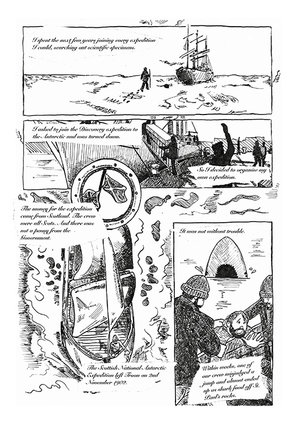
In other examples the research is theorised and embedded into narrative that tests or strips back the meaning to different readers and viewers [fig: 3 & 5]. Here I use different mediums to find different textures that, along with colour decisions, are important to guide and energise the narrative. The scraping of pen and ink against the resistance of the page creates a tension, but also forces a quickness of mark making that is both free, but also perilous [fig.5]. Whereas the laying of coloured pencil requires the images to build and build, creating a tension with the pace and action of the story [fig.3].

As comics, these examples bring in elements I’ve discussed before, such as pacing and rhythm through paneling, and the nature of the lines and marks. In these narratives there is the concern to depict the events and the story, but there is also the visualisation of texture, which is akin to the sub-text of the story, a deeper level of communication beyond ‘just the facts’.

fig.5: Voyage of the Scotia (Magic Torch Comics; Author Paul Bristow)

fig.5: Voyage of the Scotia (Magic Torch Comics; Author Paul Bristow)

All these decisions reflect my own struggle to understand the topic on my own terms, to insert myself as an outsider into the narrative, and in doing so to communicate to others.

These projects reflect different styles and mediums, but I feel now there is an aesthetic I can begin to touch, a blend of the surreal, the naturalistic, graphic design and cartoon; an aesthetic that is developing from facing new ideas, new areas of knowledge. An aesthetic that has grown from being forced to know type 1 Diabetes, and perhaps myself a little better.

Time-shifting

I’m running late this week - tossed and thrown by the eccentricity of the Easter weekend and the effort to return to normality. In this spirit this post is about why I wanted to include drawing history as part of Diabetes: Year One. 

The section covers three pages [fig: 1-3], but takes us from the Egyptians to the present. The pages are a mix of morphing through discoveries and misconceptions, and one-pages to arrest the continuum and consider firstly the impact of insulin, and then the potential for the future.

fig. 1: Diabetes: Year One, page 47

fig. 1: Diabetes: Year One, page 47

History is not infallible (I know I’m married to a history teacher), but it helps to provide a context, a way of re-rooting after the shock of disease. The first page [fig.1] may rush through history, but on its way it acknowledges both the horror and the humour: the impact of neuropathy, the grotesque images of melting flesh that accompanied early understandings; and the dark humour of the term “pissing evil” as diabetes was known for a time (Oh, FYI my phone is still shocked, insisting it should be ‘pudding evil’, for which I have no words #languagematters). On the way the page notes the medical milestones and stumbling blocks, before the importance of the pancreas came to be understood (and yes, it is a pancreas!). But this historical helter-skelter is also part of me coming to understand the science and the medicine - finding the human touches in the experience of Diabetes, and coming to see it in terms of more than myself, understanding the social presence of disease.

fig. 1: Diabetes: Year One, page 48

fig. 1: Diabetes: Year One, page 48

As I’ve mentioned drawing is discovery, and in celebrating the invention and inventors of insulin, which is literally keeping me alive, I found the image of the playing card [fig.2]. The image is an Ace - a card that dances with duality as it is both high and low. There is tension in any reflected image, and though they are joined through the pattern of testing strip foil in their waistcoats, I emphasise Banting and Best's own acrimony through the red outline; but also touch on the issue of being beholden to a drug for life, and in turn the issue of access in private healthcare systems, which fortunately is not something I have to deal with, but something I am very aware of:

“… the present struggles to contain the conflict of past & future. To measure and judge rationales and vested interests.”

Through drawing the past I again find myself reflecting on the place of disease in society, and as a result on my own place. Leading me to…

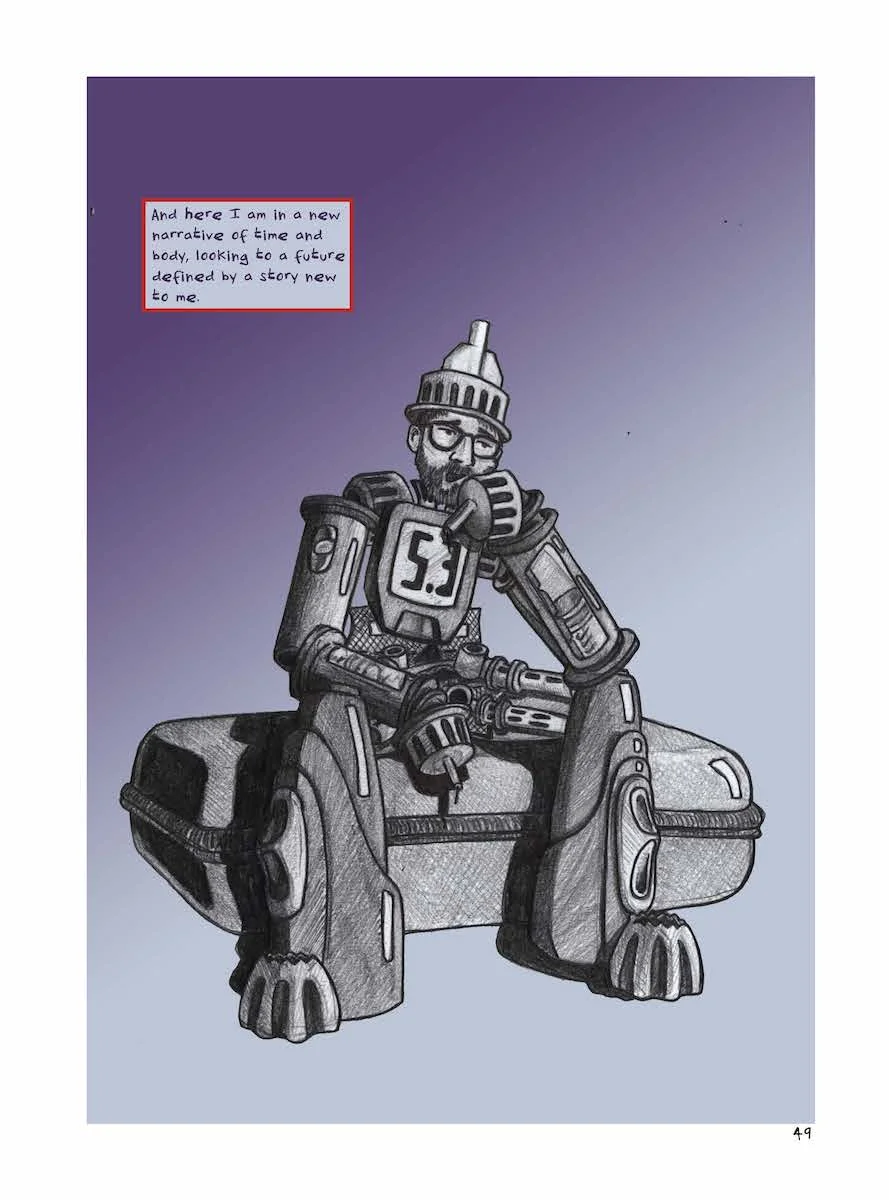
fig. 1: Diabetes: Year One, page 49

fig. 1: Diabetes: Year One, page 49

… The Diaborg [fig.3]. I’ve considered what this image meant to me in terms of my relations to the body in other posts, so for this post I’ll just note a couple of things. Mainly that the pose is an Homage to the Rodin’s the Thinker (though with added bathos and cluelessness), and that the image is uses my pencil drawing that inspired the final cover image. In other words - the image is about figuring it out, and the role drawing and art has in doing that.

Elements of the Diaborg point to the future, and represent the present, but it serves as a reflection on the past, and on how the past shapes our ability to define ourselves for the future. To ignore the past would take away the grounding of any discovery; so while this section is relatively short, I knew I had to include it, to picture myself in my “new narrative”, to pin down the overwhelming.

Process Piece.

Monday rolls around again, with the dull thud of a head hitting itself against a wall. I find myself, out of the house for inspiration, two espressos down, staring at a blank page. Worse, I’m trying to ignore the page to my left, where the attempt I rushed off to try and get an idea started is smirking back at me; basking in the fact that it offends me both as an approach to a new project, and as a reflection of my technical ability. One result of this, is that this will be a (relatively) short post. 

This stage of the process is frustrating. I thought I had a handle on the way forward, but it doesn’t feel right, so I need to start again. As I write, I’m trying to decide between rescuing elements I think may have something to add and decreeing a new set of constraints to build something new.

I know I’ll start again with thumbnails. The process of collating all my ideas only really happens when I start to draw out little disasters and I can see little moments of joy, horror or slapstick jumping out. This might be a finished scene, or the sweep of a line, or an expression on a face, or an inkling of perspective, but for me it will start with these drawings: small, cramped, unfinished, generally full of energy and overly complex. But from here I’ll start to take away, to refine, or to edit my ideas, looking for clarification. One of the reasons I like thumbnails is the way I can use frames to compartmentalise ideas or fragments that would become lost in a larger scene.

This compartmentalisation came from creating Diabetes: Year One, which for all the methods and themes I’ve explored, is ultimately about me trying to understand the relationship between illness and the emotional tumult of living. My creative process has always ridden the knife edge between hyper-self-awareness, and the need to get on and do; a process that needs to research and reflect, but one that needs to confront an impending deadline. This interaction between analysing and acting is how I approached type 1 Diabetes – for me to know is to draw, and to draw is to understand. In other words, it’s all very well doing the reading, and checking the numbers and all that, but I only realise what’s going in, when I see it coming out (This feels a bit scatological for a Monday morning, but I’ve spent the weekend with 9 year olds).

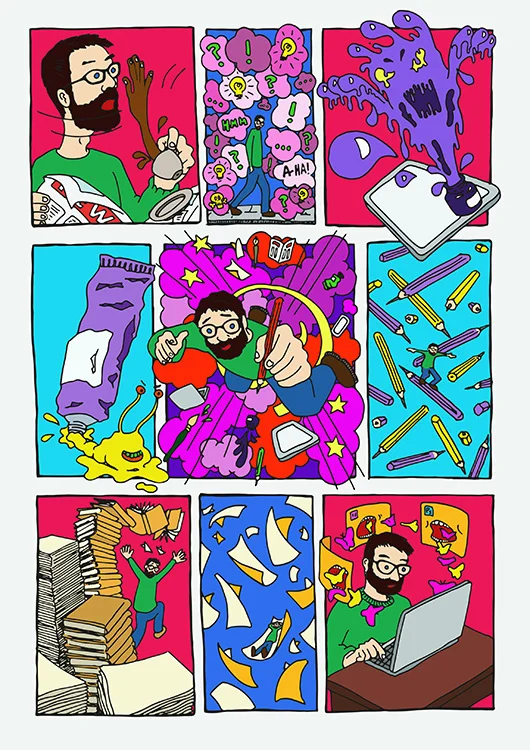
After the thumbnails the options broaden out, but in some way I’ll cover the basics – composition, style and colour. How I do it will vary. I drew this calling card sequence [fig.1] to reflect the facets of this process.

fig.1 ’Pick-Art’ Calling Card.

fig.1 ’Pick-Art’ Calling Card.

The image deals with the interaction between the world around me and the world in my head; the relationships between different media and equipment; the structure that lies beneath my surrealism; and also – cos’ I tend towards melodrama, the excitement that rises from despair. In this case the pencil, and ink drawings are put through illustrator and coloured in photoshop, adding to the slapstick through the Beano-esque line and flat colour style (though the vividness of the colour is all mine), all designed around a cross structure nicked from chapels in the renaissance style (btw – totally comics!).

The final image I enjoy because of the energy, the humour and the absurd that touches on the grotesque, but mainly because I think it takes the various aspects of my work and personality, yet creates a single sequence that is, well… me.