Distraction therapy.

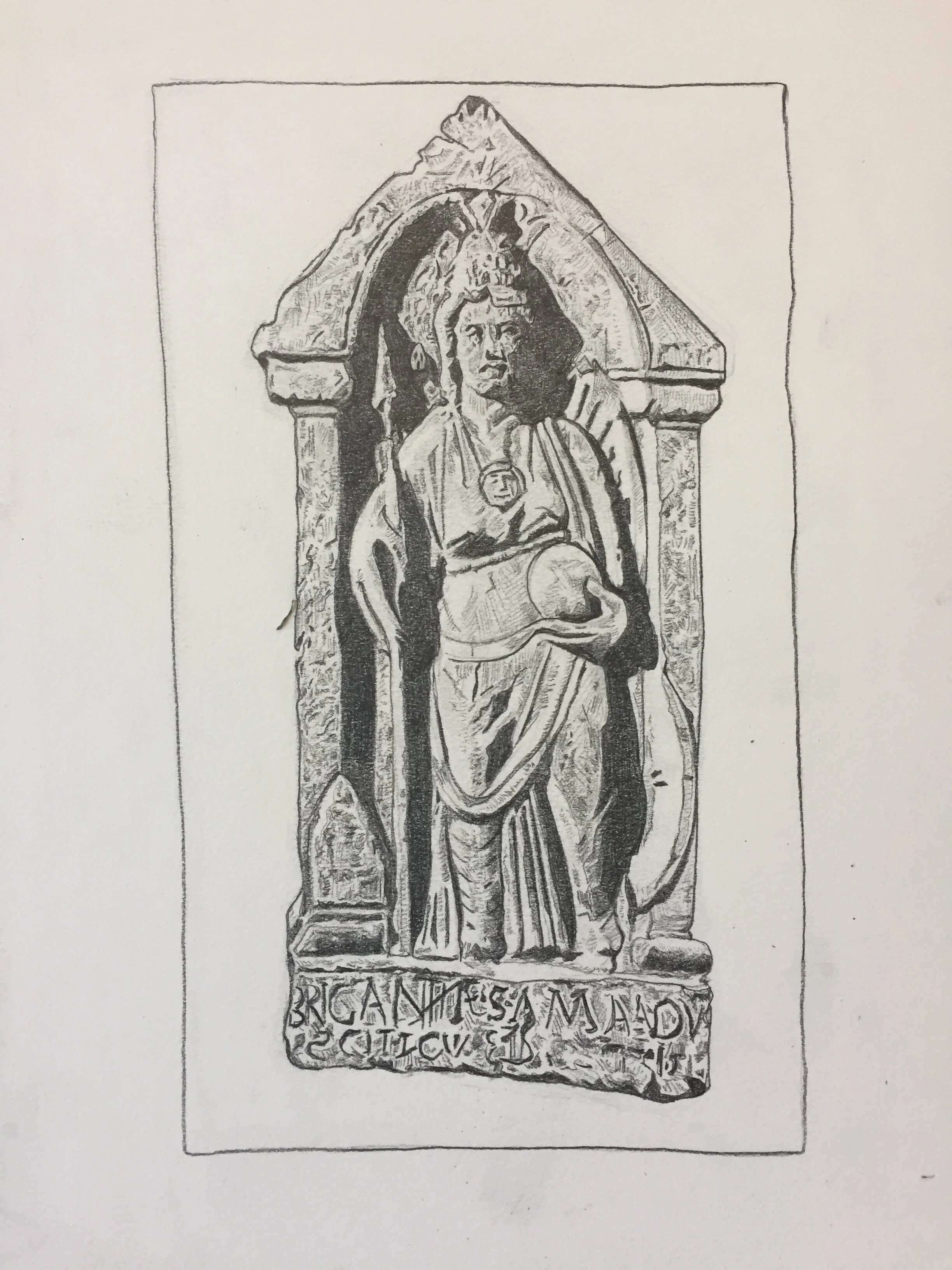
fig.2: Brigantia statue

fig.2: Brigantia statue

Starting a new project is always a massive comma. You’re ready to go, and excited, and then stumped. I mean – I’ve got an idea, a feeling of what I want to do, but actually starting, well that’s another matter. And this is where games, experiments, trying something completely different – all these things, come in. 
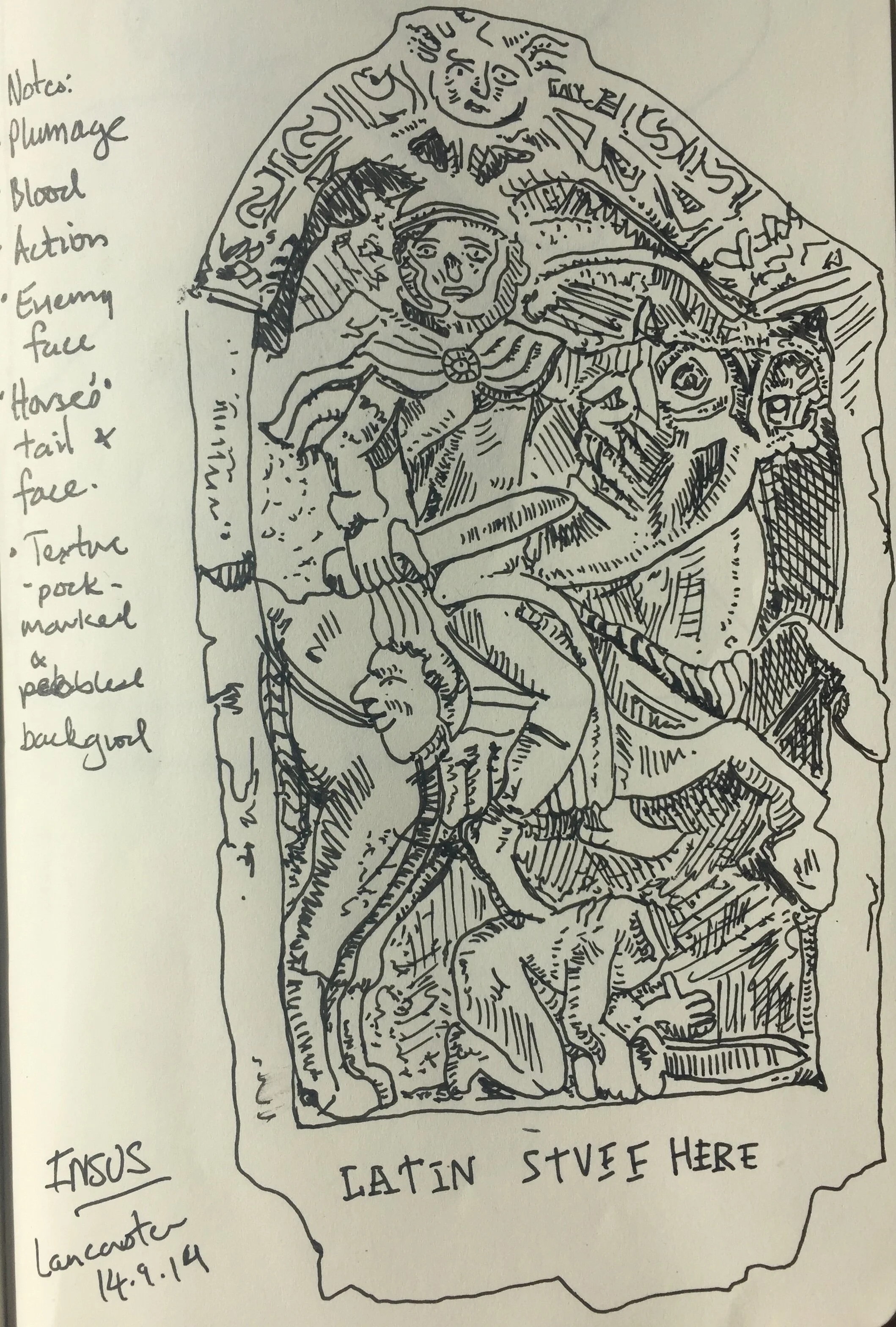
fig.2: Insus tombstone

fig.2: Insus tombstone

 My latest project is taking a scenario and creating a comic about The Romans. I’ve had the first meeting, talked over the scenario, the key bits of research that might be of use, and asked a load of stupid questions (I find asking as many of those is really useful to get a sense of what the brief is); but sitting down to start – nothing, flatline. 
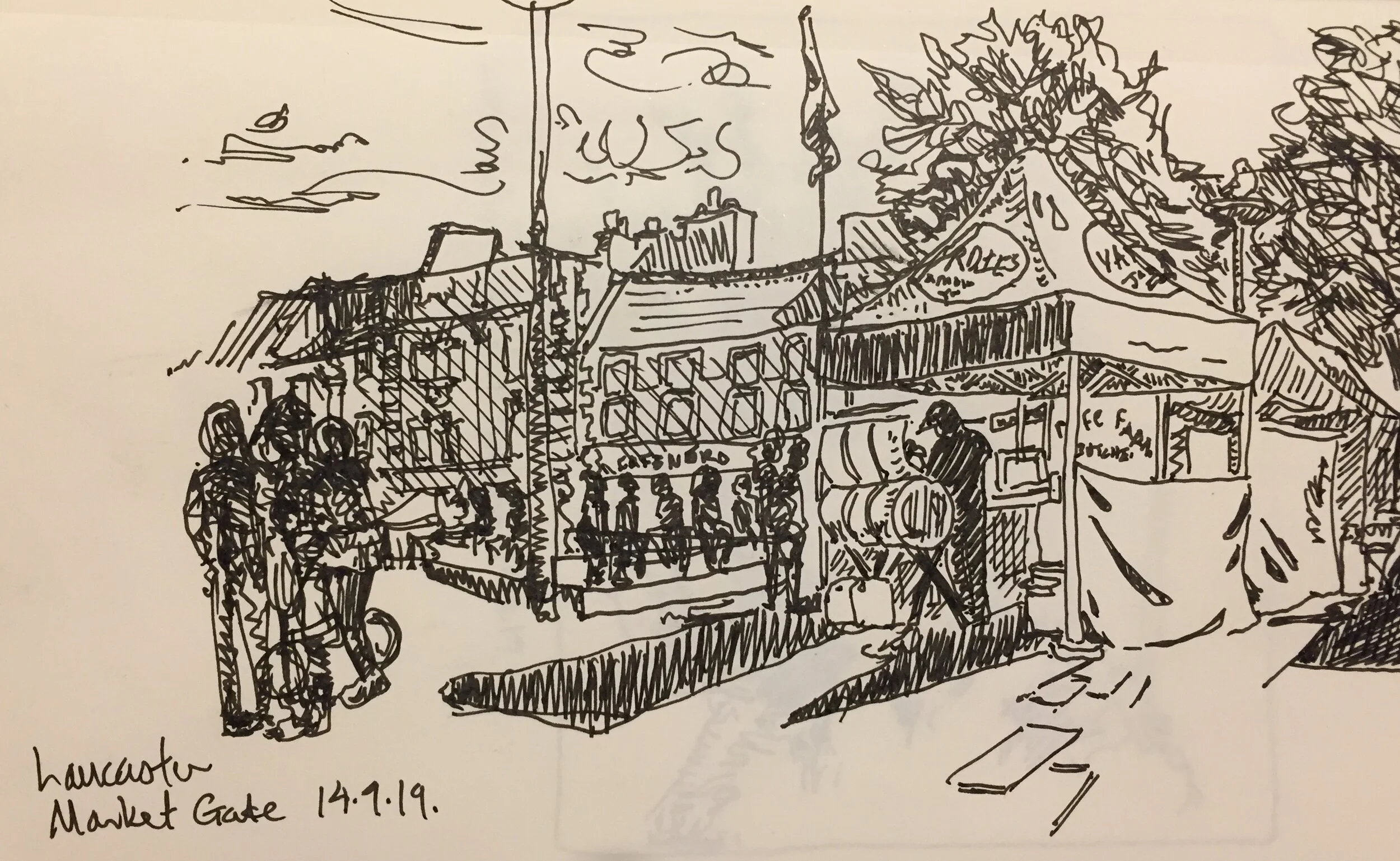
fig.3: Lancaster Market Square

fig.3: Lancaster Market Square

 At this point I generally get frustrated with myself. I stare, I think, I make coffee – and another; I pick up my pencil – then put it down and check some emails – catching myself I stop, have more coffee, then go for a walk. I mean I know I can write a script and plot a sequence of panels (what I call proto-thumbnails – loose compositional sketches to work out how the narrative will progress together with the images [fig.4]), but I can’t get past the white page that seems to be grinning at me. The danger is that the frustration can lead to giving up, or worse avoiding the issue – burying the project under a load of to-do lists sort-of-thing.
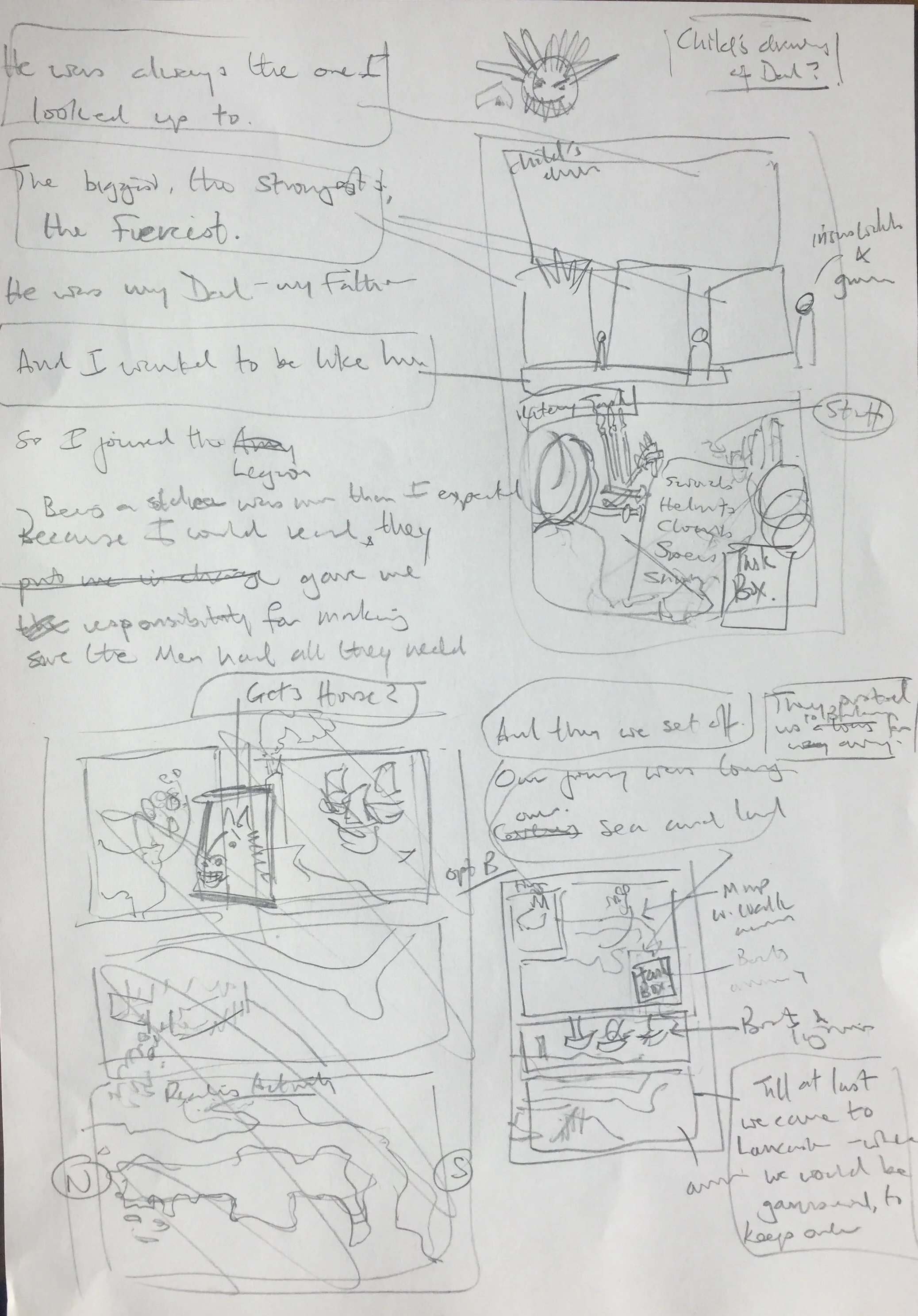
fig.4 Proto-thumbnails

fig.4 Proto-thumbnails

My way in, is often through drawing – quite detailed drawing. In this case the recreation of research images, which force me to look fully, to arrange my thoughts with discipline, and to imbibe a sense of form and shape that will inform the format of the comic itself [fig.1].

Add to that a physical visit – researching more artefacts, walking the space to get a sense of the landscape and place, aided and abetted by the endorphins of movement, and the dissonance of the different. All of which provokes more drawing [fig.2 & 3] - some is specific, but some is about letting my imagination explore the space around the topic. Now my notes suddenly seem to make sense; and the white page begins to reveal a pathway into plot and story.

So, before I know it, the first draft is completed – alongside a load of new questions that will be answered as I start to draw the thumbnails proper. 

The water of life.

fig.1: Tomatoes

fig.1: Tomatoes

I haven’t worked in watercolour for a while, but recently I’ve found myself going back to it a couple of times. It’s a medium that seems spontaneous, but I find it makes me re-think the way I normally draw and paint. I have to re-see light and shadow, and really consider where not to paint. Colour builds in layers, and shades through diluting the pigment. Acknowledging absence is fundamental to the process.

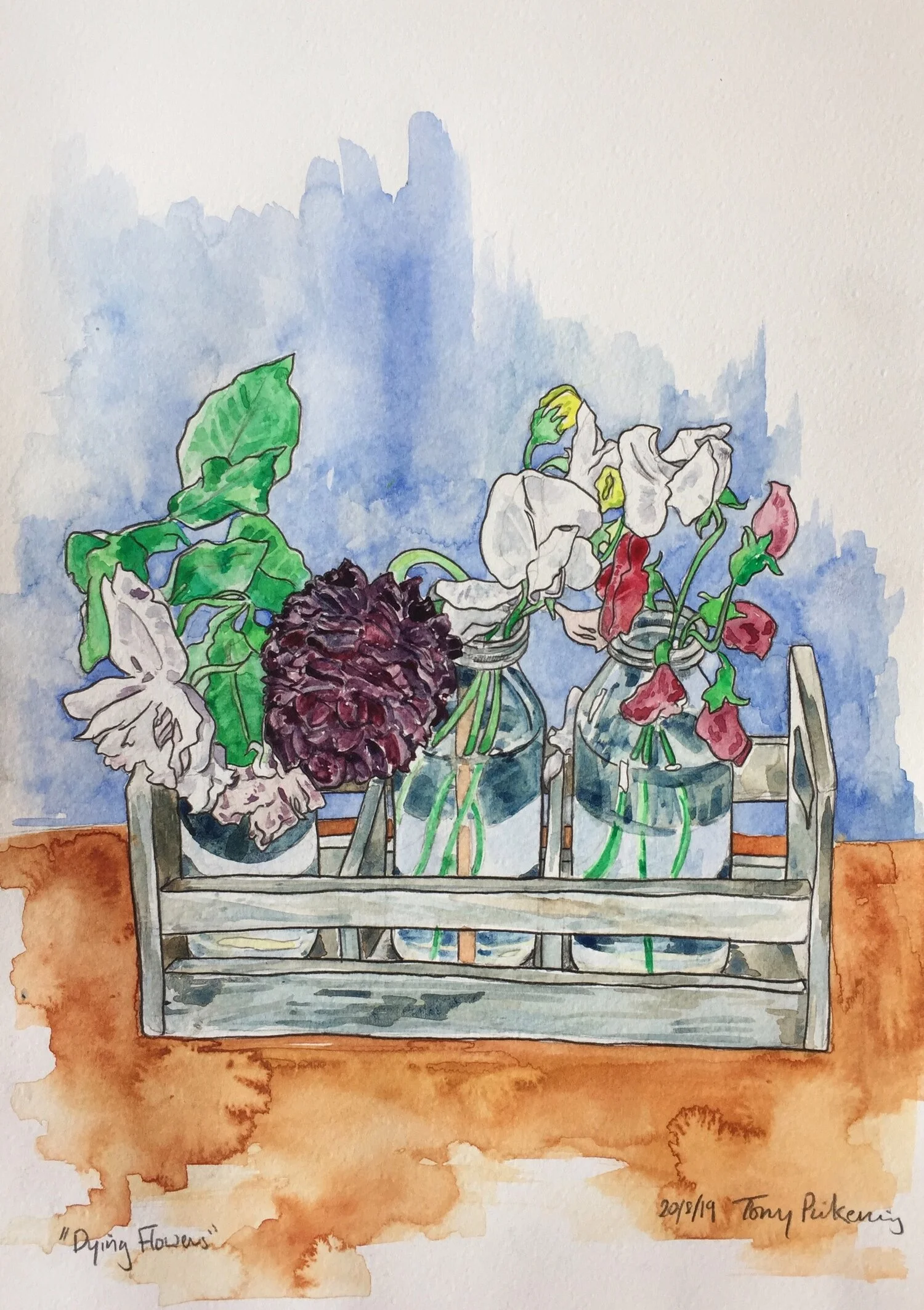
fig.2: Dying Flowers

fig.2: Dying Flowers

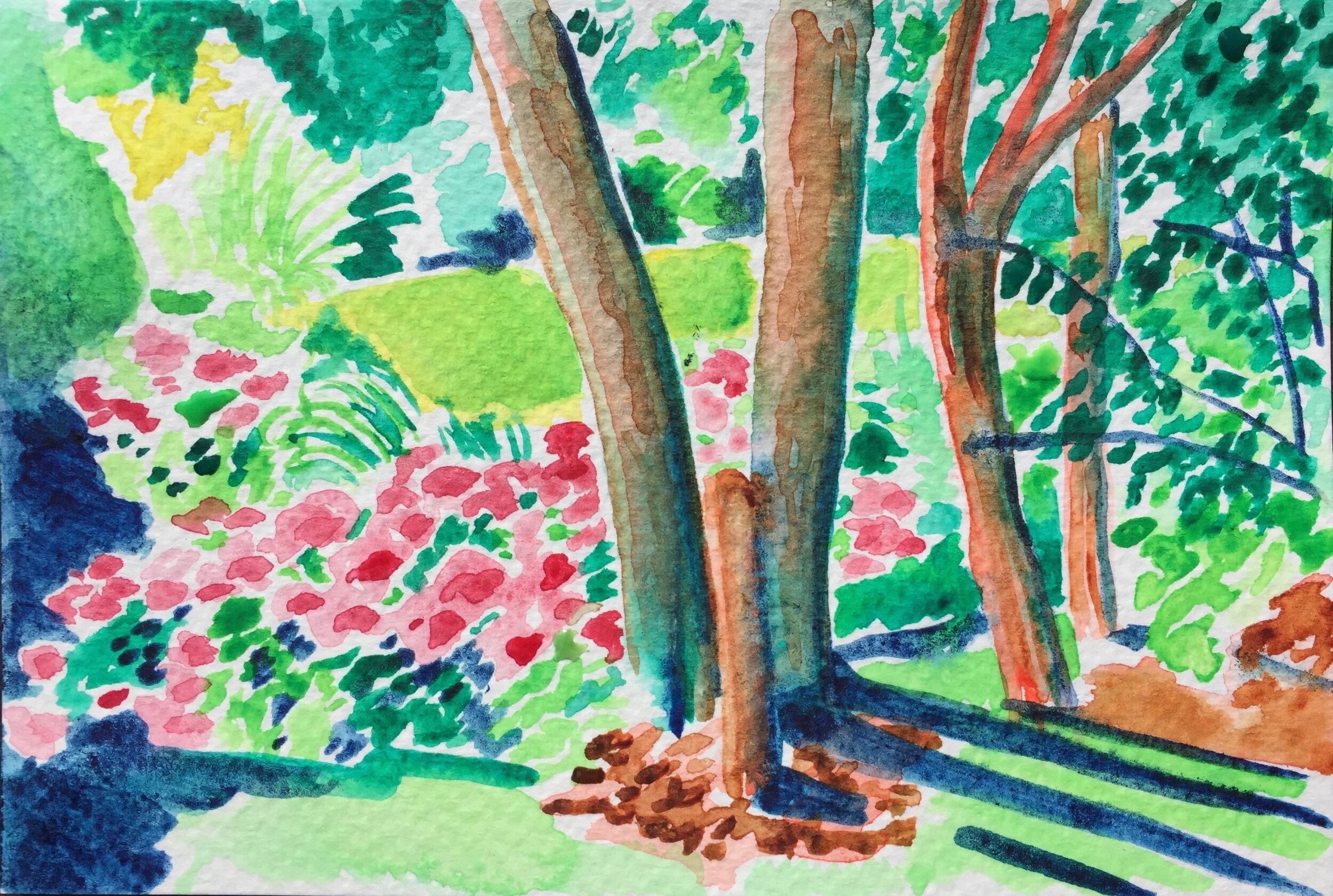
fig.3: Norfolk morning #1

fig.3: Norfolk morning #1

Maybe this is why I decided to use watercolours with my Dad [fig.1 & 2]. Re-thinking what I knew is part of my interaction with Dad and his dementia. Trying to understand him in the Now, whilst still holding him in my memories and who I am; using art to talk with him: something that doesn’t require context, doesn’t provoke distress, something that is present and visceral, that can be witnessed as a process, and be pleasurable in itself. 

I’ve touched on this in previous posts, and while it may seem egotistical, the moments when I look up and see him enjoying seeing me drawing or painting are moments when I see HIM for a second, and I feel he can see me – and not the person I have to become around him now. If I’m honest, drawing and painting allows me to process the situation too. My focus on an object or a scene, lets me put emotions that aren’t helpful into technical processes, and it turns out both of these paintings consider life, and the path of decay.

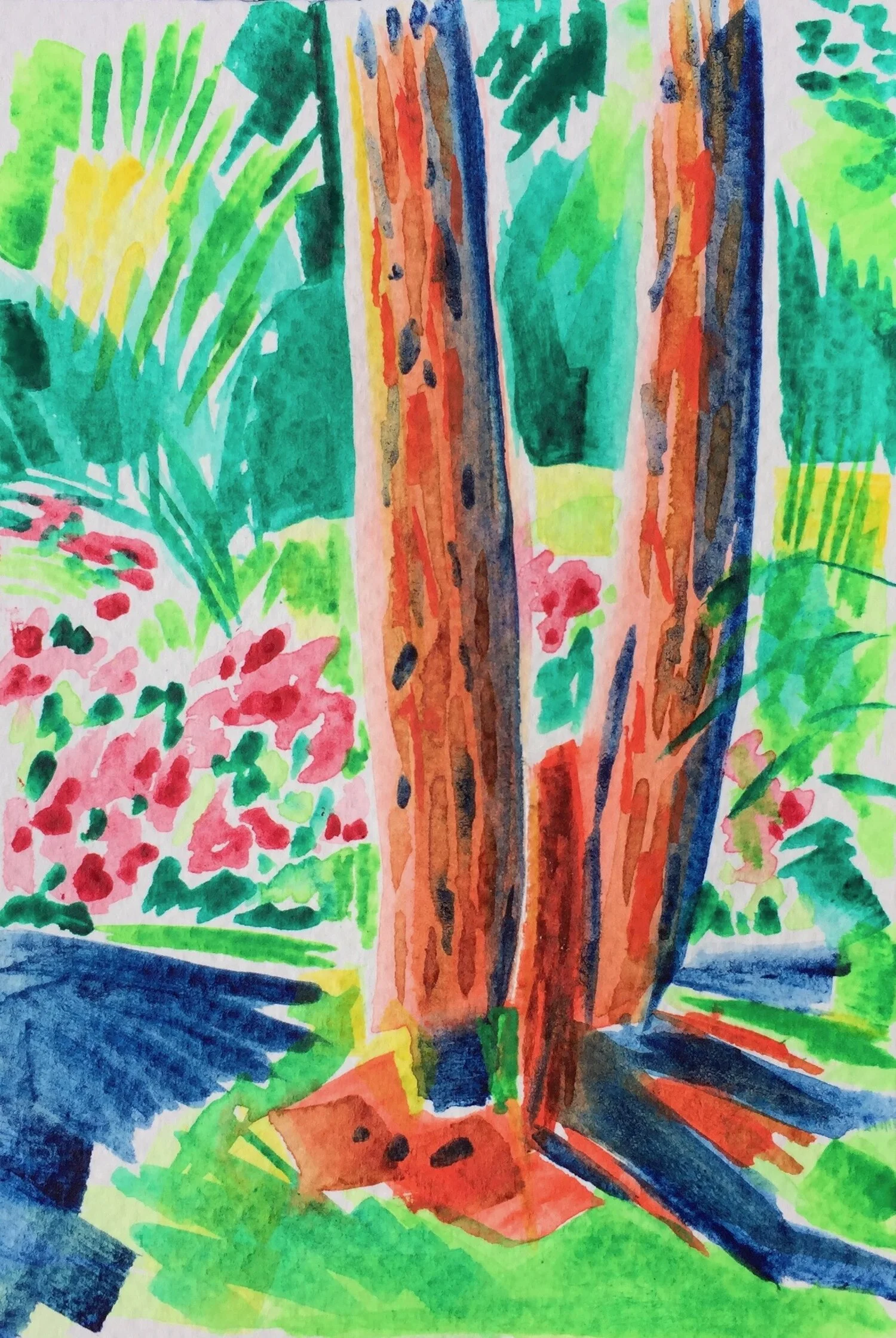
fig.4: Norfolk morning #2

fig.4: Norfolk morning #2

In contrast the other sketches [fig.3&4] consider pattern and line in blocks and try to catch the vibrance of holiday mornings, before people are up, before the tensions of the day begin. These are experiments with light and colour, about the beginning of the day, and the potential of life.

They are exercises about how to depict the world in new forms, with new limitations and solutions, and although a key part of describing line in the paintings is by filling the space around it, this absence is a positive statement, and together with blocks of colour, make Norfolk seem Mediterranean, which for a few moments, it was. 

Starting from very different places these images produce very different results. But each one impacts on my practice - provoking new ideas and pathways for approaching, and embracing projects in the future.

Stacking the Deck.

Right, I’m back, and the coffee has brewed, so let’s go. 

 After a bit of a break, and some time with my Dad, this week I want to reflect on some work I produced for a Card game – Carbon City Zero: “A deck-building card game where players race to create the first zero carbon city”, produced by Dr Sam Illingworth and Dr Paul Wake  at Manchester Metropolitan University and the charity 10:10 Climate Action.

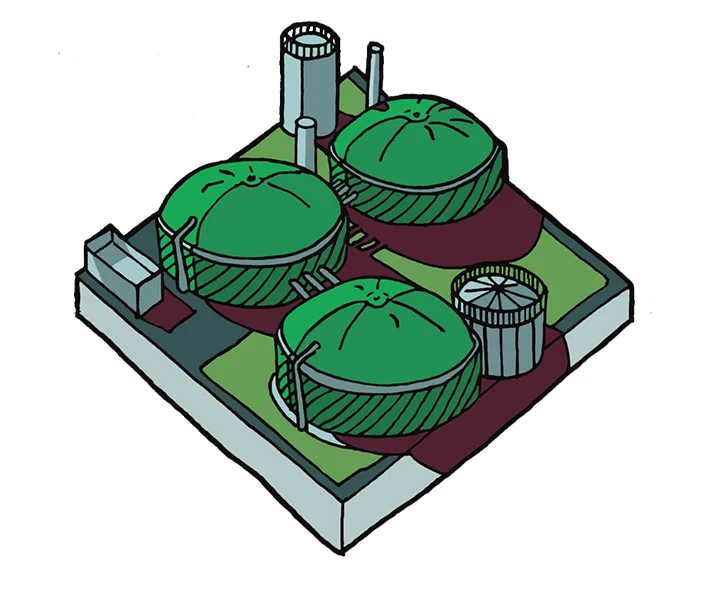
Fig.1: Biogas Plant

Fig.1: Biogas Plant

Fig.2: Lobby Ministers

Fig.2: Lobby Ministers

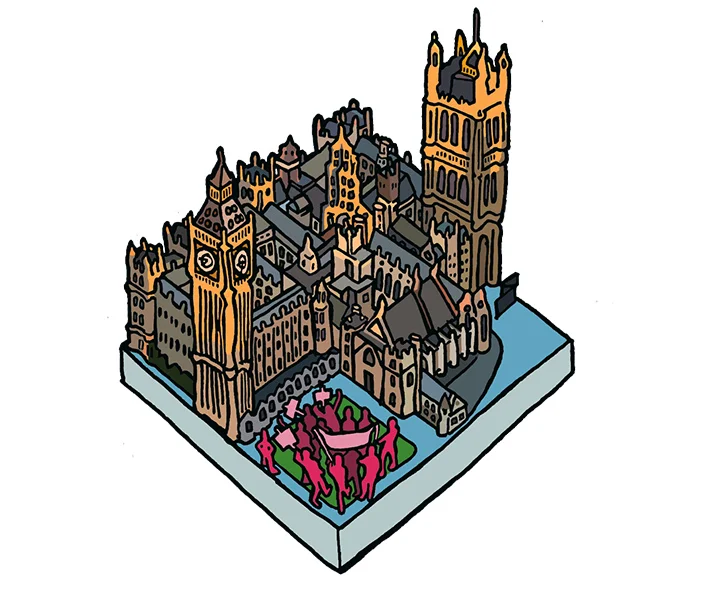
My brief was to produce illustrations for the cards – with three distinct sets of cards. The creators wanted the sense of building a city – so liked the idea of isometric tiles that felt as if they could fit together. They also liked the hand-drawn feel of the line in my Newcastle: City Tales sequence. The cards had to have the feel of a recognisable world, but also – given the aim of getting the players to make their city carbon neutral, as if the world was a place where good choices could be made [fig.1]. They also had to be objects that people wanted to engage with.

Right-ho then.

I researched isometric images, and realised the maths was going to be fun – especially as the images I came across often had a futuristic and computer-generated feel. Amazing as some of these images were, I quickly realised that my approach needed to be different. My solution was to cut a template – so I could repeat the maths quickly (a little trick I’ve picked up working out maths for food with my type 1 ;) ), this enabled me to work to a ratio, and perspective consistently - except where I wanted to cheat. 

Fig.3: Poor Housing Stock

Fig.3: Poor Housing Stock

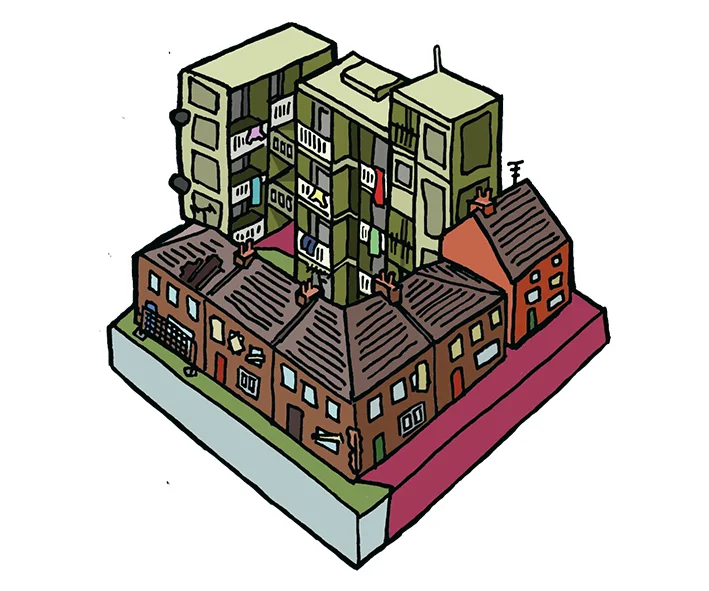
With the framework set up I could get into the nitty-gritty. I soon began to enjoy realising the detail of the urban landscape [fig.2]. The drawings moved from the futuristic to the decaying, from technology to the human figure, from the high-rise to the everyday – in short the nuance and complexity of a modern city.

Fig.4: Behavioural Change

Fig.4: Behavioural Change

My initial pencil drawings were tonal – playing with depth and the perspective of the isometric base. Windows, doors, nooks and crannies, these all became part of the texture of the drawings. To keep the hand-drawn feel I resisted the temptation to trace the line in Illustrator – instead inking the pencils, scanning in the inks, and cleaning up any pixel distortion in Photoshop (I know this can be done quicker – and when I get an i-Pad we’ll talk *sigh). I simplified the drawings as I moved from pencil to inking the outlines but decided when I chose to add colour digitally that I wanted to reflect some of the tonal quality, so used tone as well as light and shadow to build my colouring [fig.3]. 

Fig.5: Poor Communication

Fig.5: Poor Communication

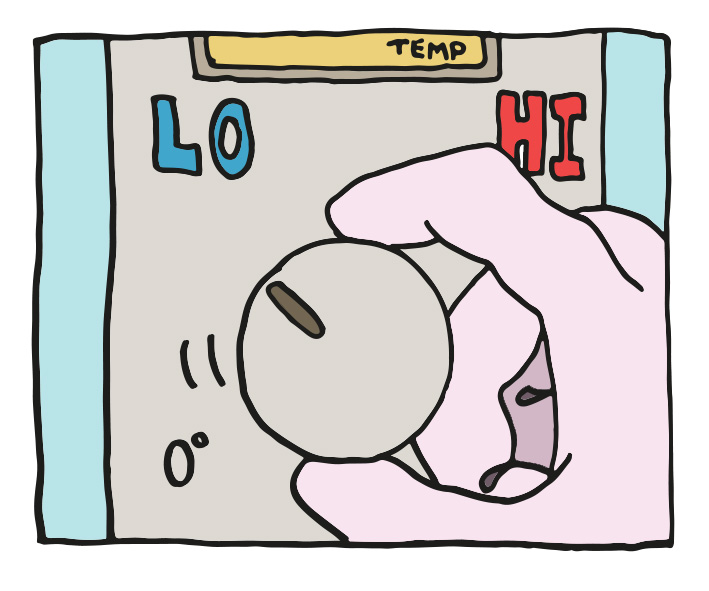
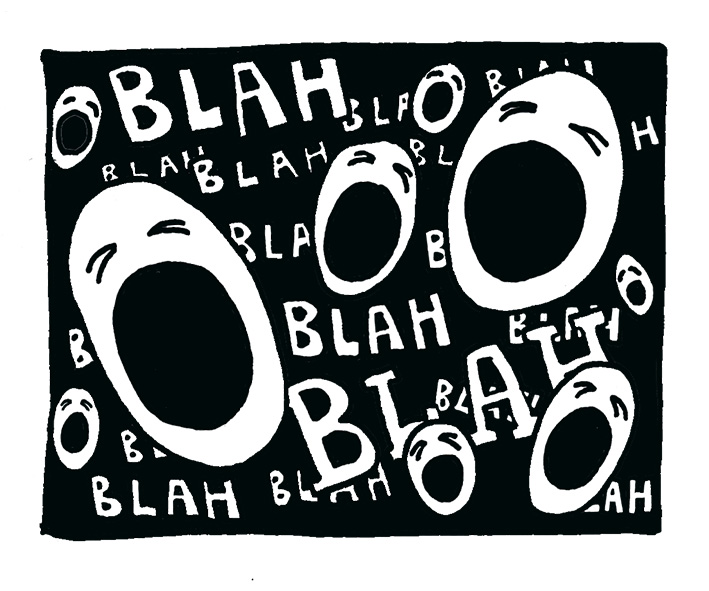
The other card sets had to have different qualities – some infographic, some bleaker, but they also had to feel a part of the game. These cards are more graphic [fig.4], and more cartoon [fig.5] – both deviations I enjoyed, playing with symbolic and satirical impulses, and the thought behind representing data and ideas. The link between the sets is in the line – or the tone of voice that speaks to the player, that starts the dialogue.

With 39 images, this was a large project, but one that was absorbing, challenging, rewarding, a project I’m proud to be a part of – Oh, and I quite like my drawings too ;) 

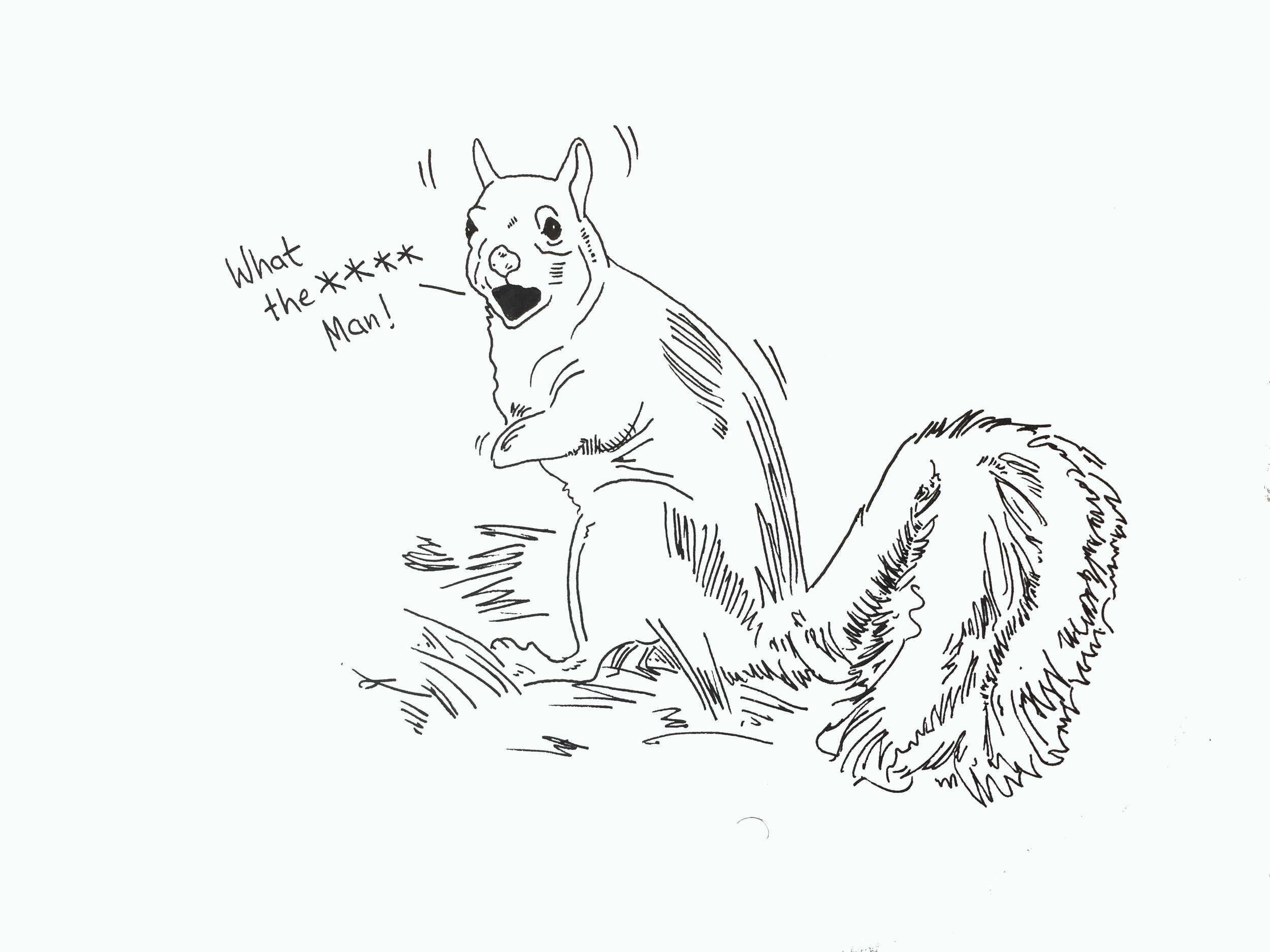
Surprised squirrel - work in progress.

Just a quick - and very late post this week. Partly cos’ I’ve been busy, partly cos’ I’m away next week (so no post). One of the things I’ve been working on is a graphic story about my need to exercise, y’know for health, and my complex relationship with exercise - which is both to do with type 1, and probably more to do with the psychology of competition.

fig.1: Surprised squirrel (at the sight of me running)

fig.1: Surprised squirrel (at the sight of me running)

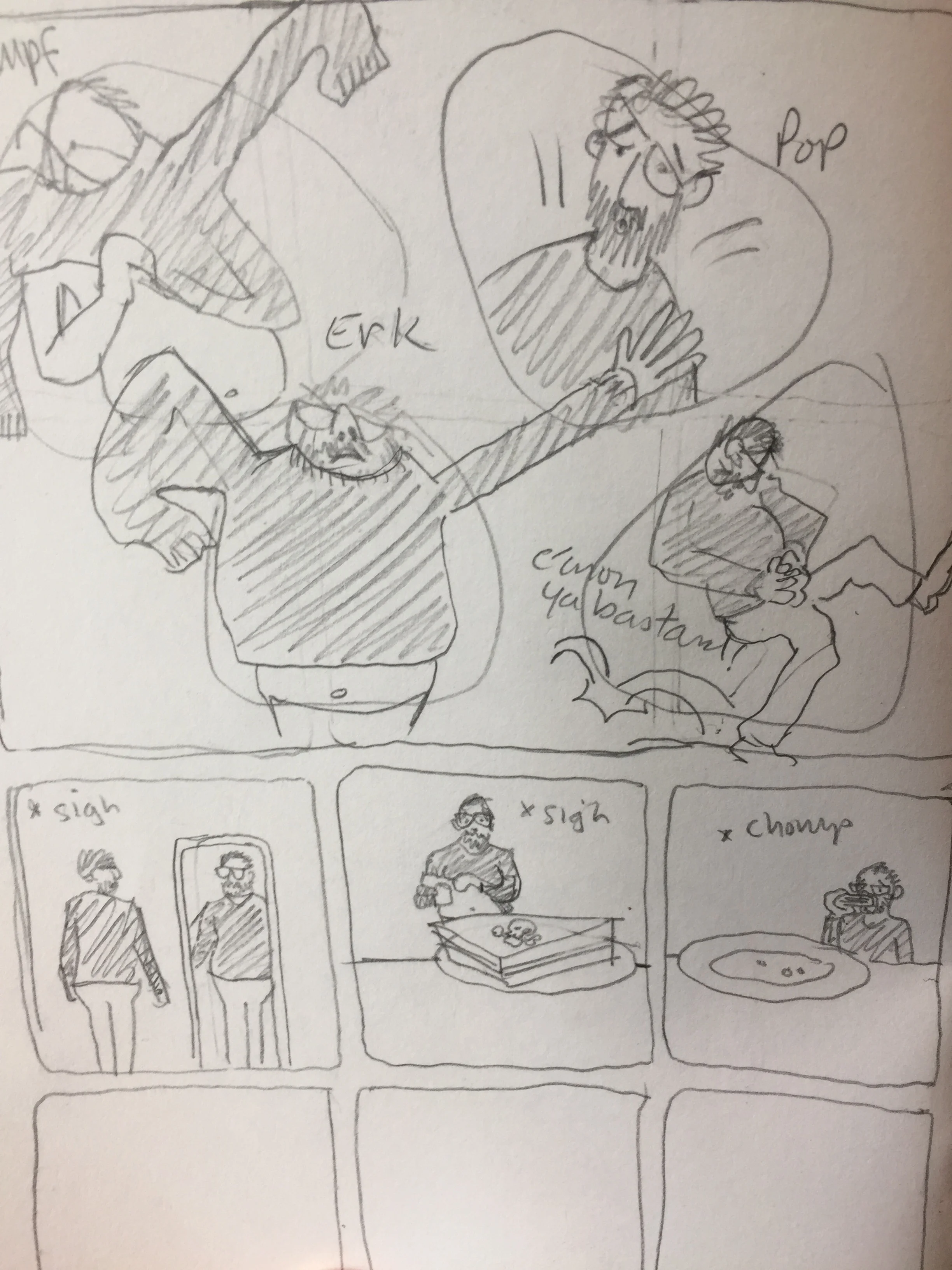
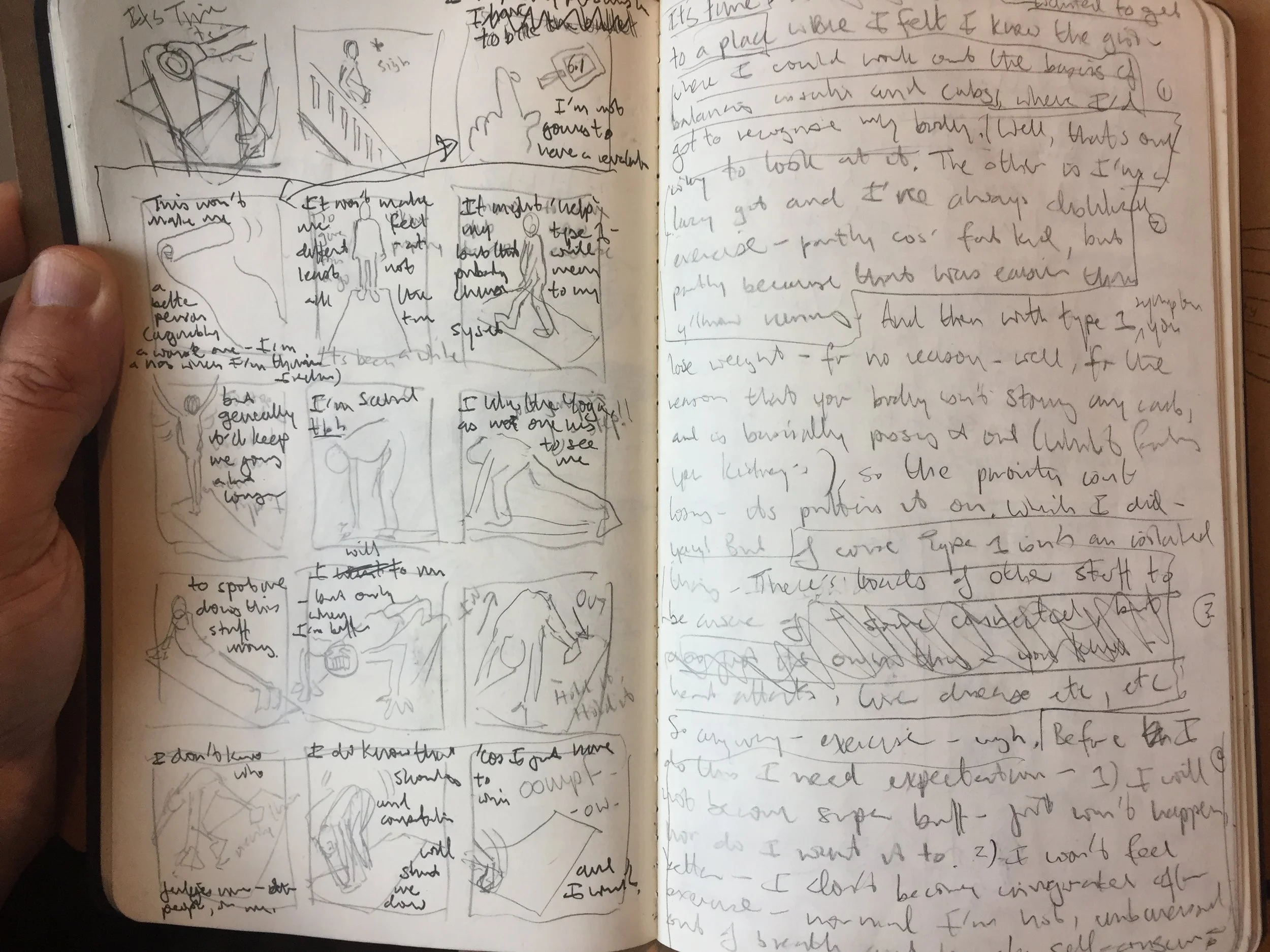
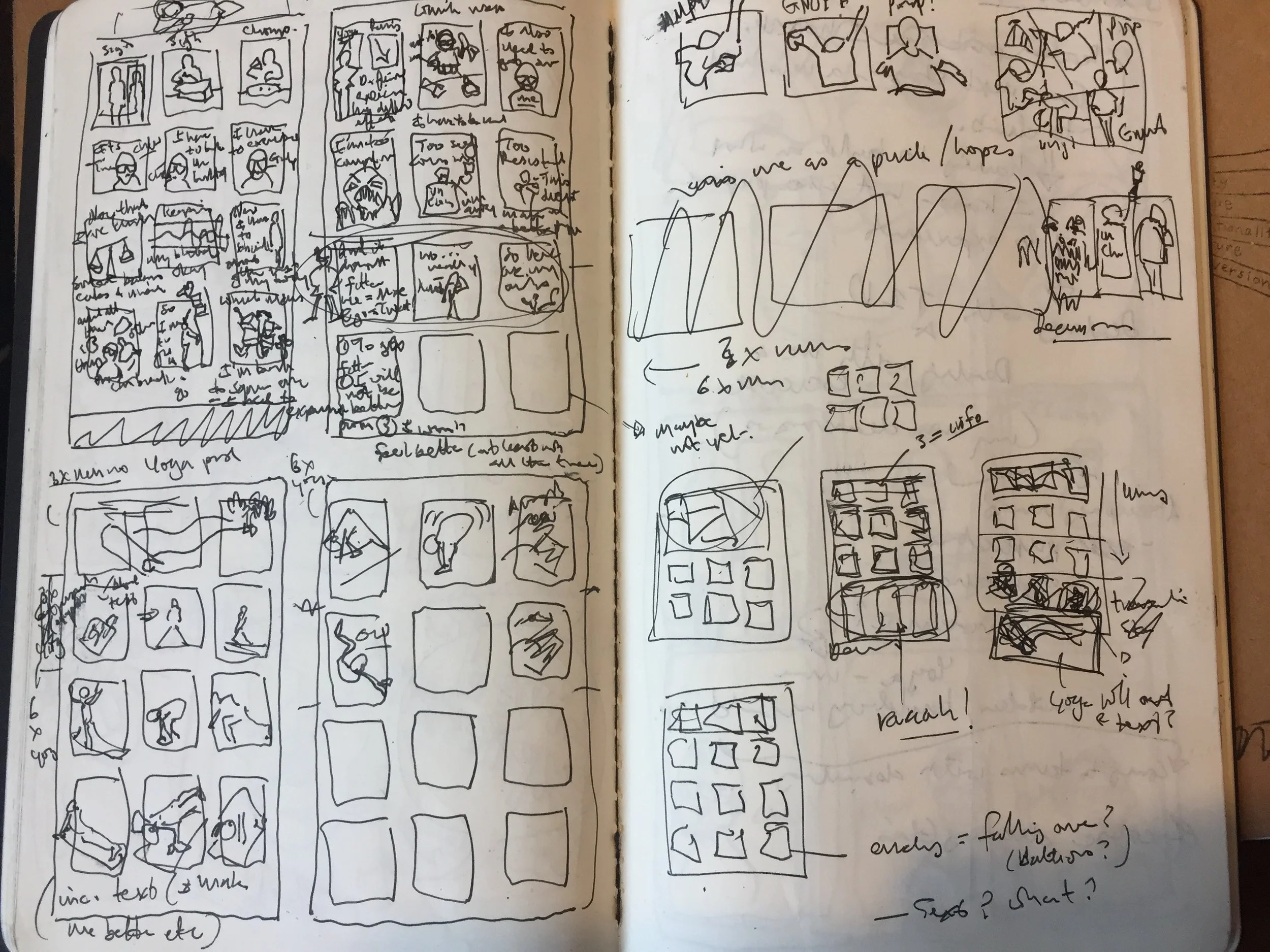
Anyway these are things I’m working out - which you can see below in some of my thumbnails and starting sketches [fig.2-4] - where I’m beginning to establish the relationship between image and text. In these rough sketches trying to establish a pattern of physicality and movement through line, shape and the frame.

fig.2: Draft sketches - opening sequence

fig.2: Draft sketches - opening sequence

But more importantly, whilst running this morning, the sight of me had this effect on a squirrel [fig.1], which will probably make it into the final piece… so there’s that.

fig.3: thumbnails and text

fig.3: thumbnails and text

fig.4: Sequencing plans

fig.4: Sequencing plans

Imaginative space

I guess this week’s post is a process piece, but I’m not sure I’d call it a systematic approach? I’ve got a few projects zooming round my head – some professional, some personal, and some domestic. The upshot being that the brain can get cluttered, creativity can seem a chore and motivation can dip - which is where these drawings come in... It also helped that I’ve managed to get out to a couple of gallery spaces this week. 

 These drawings are of work by other artists. They offer an imaginative space in which to play – a space which is constructed by logic other than my own so has a different pressure to work with and within. 

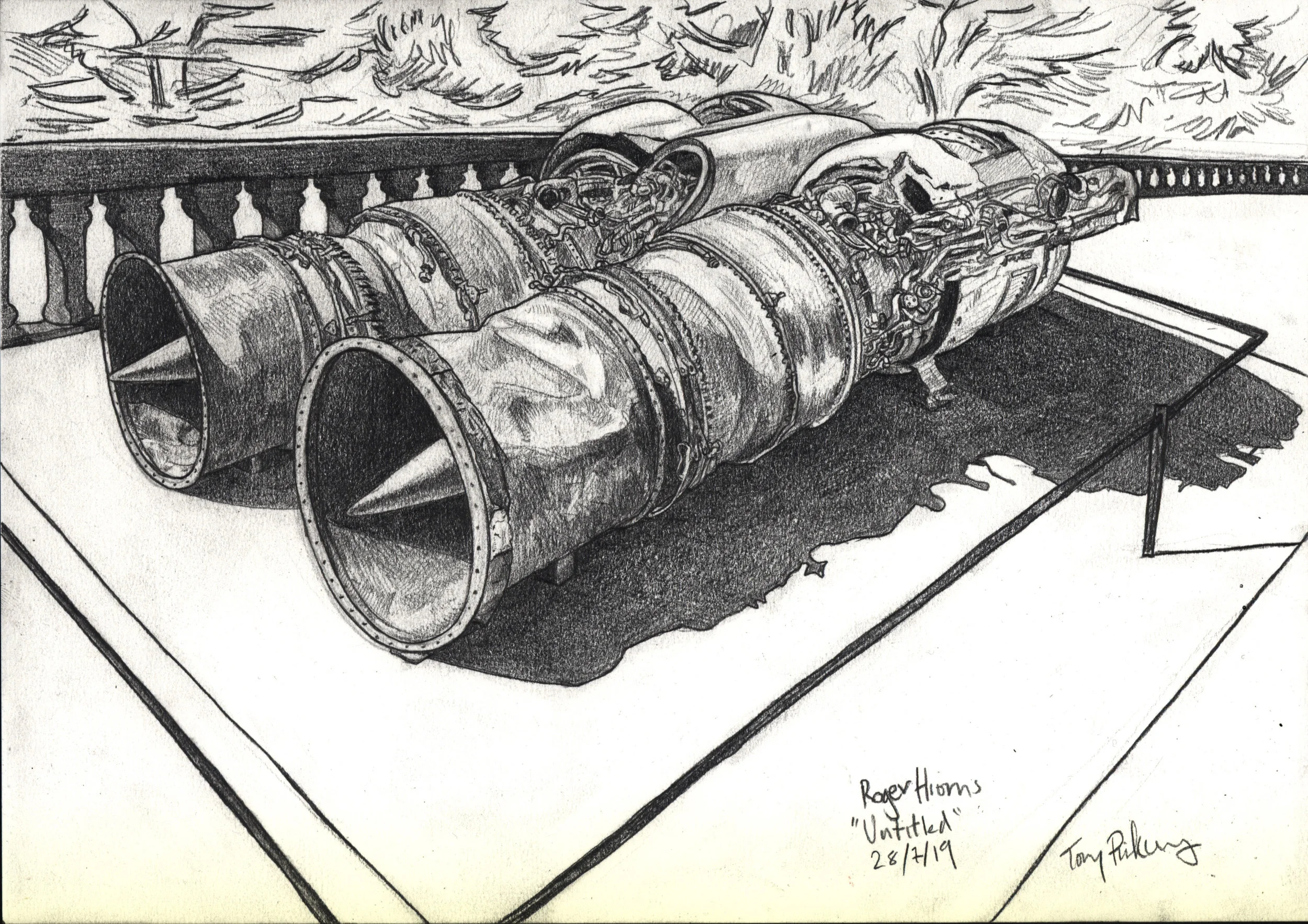
fig.1: Roger Hirons “Untitled”

fig.1: Roger Hirons “Untitled”

 Roger Hirons “Untitled” [fig.1] in The Yorkshire Sculpture Park takes the form of two decommissioned Boeing EC-153c aircraft engines and drew me in for many reasons: the sight of these very mechanical objects in the grounds of the park; the detail of the mechanics evident in the construction, as well as the effect of decay in tone and texture; the fact that the engines remind me of the pod racers in the Star Wars prequels (not gonna say much more about those – but the pod-racing was cool); and the play of light and shadow on the hottest day of the year made for a nice composition. 

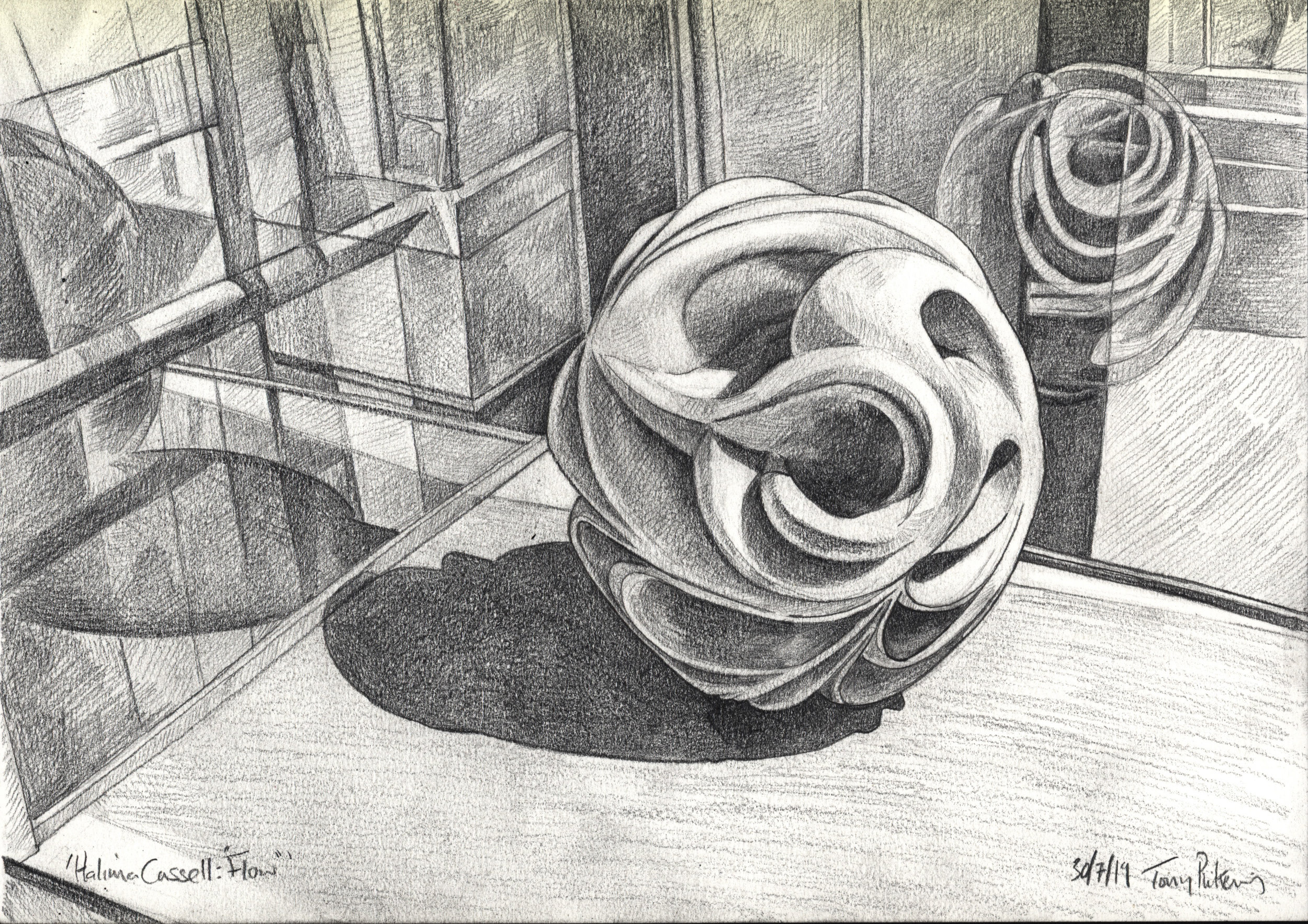
fig.2: Halima Cassell’s “Flow”

fig.2: Halima Cassell’s “Flow”

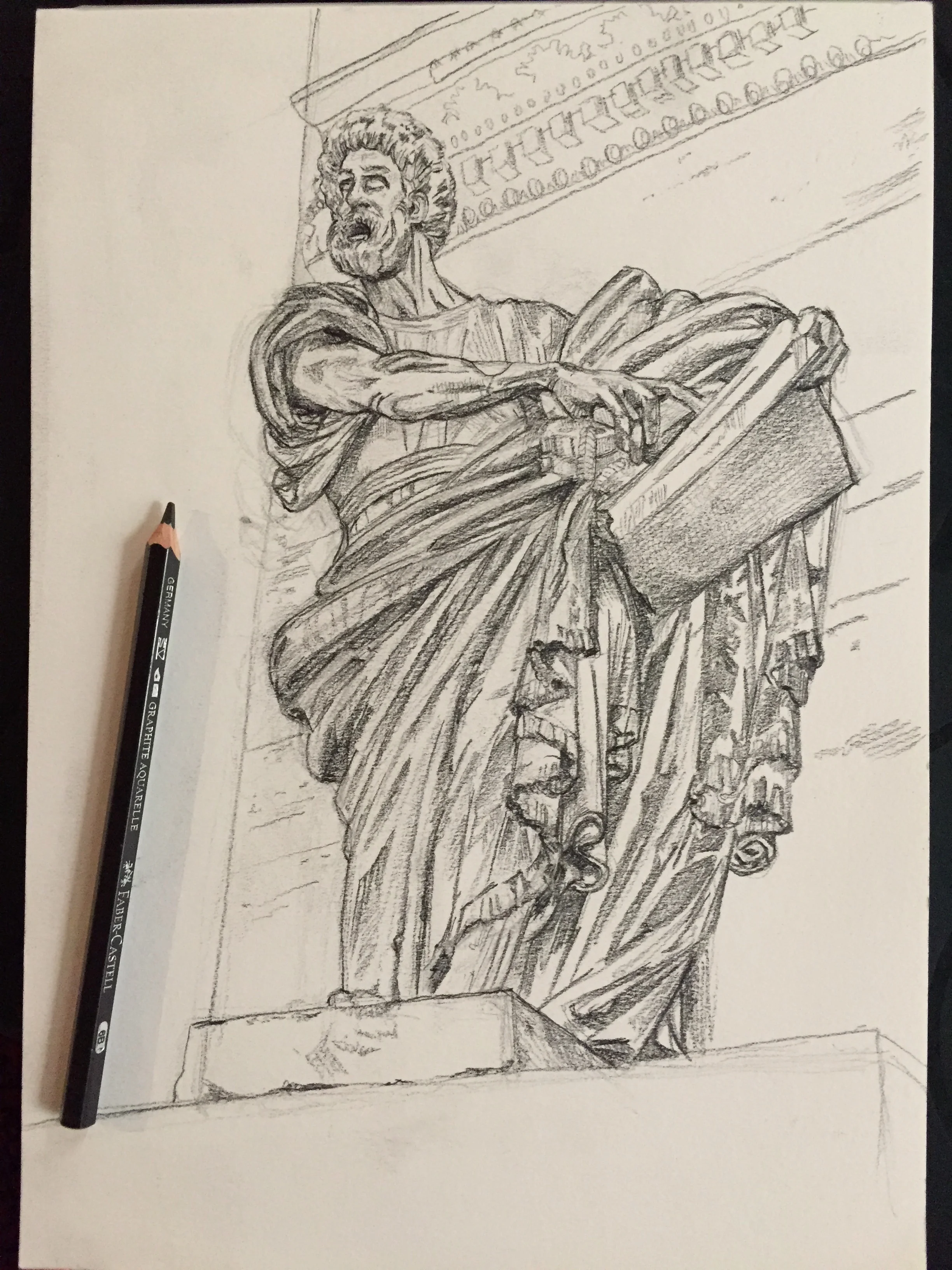
fig.3: “St Peter” by Mochi

fig.3: “St Peter” by Mochi

 Halima Cassell’s “Flow” [fig.2] in the Manchester Art Gallery is part of an exhibition I was returning to – having only had a brief chance to gawp the first time. Here the complexity of her sculptures and ceramics produces shapes I found myself mesmerised by; and the reflections in the case provoked ways to explore a shape that by definition seeks to hide from the viewer. 

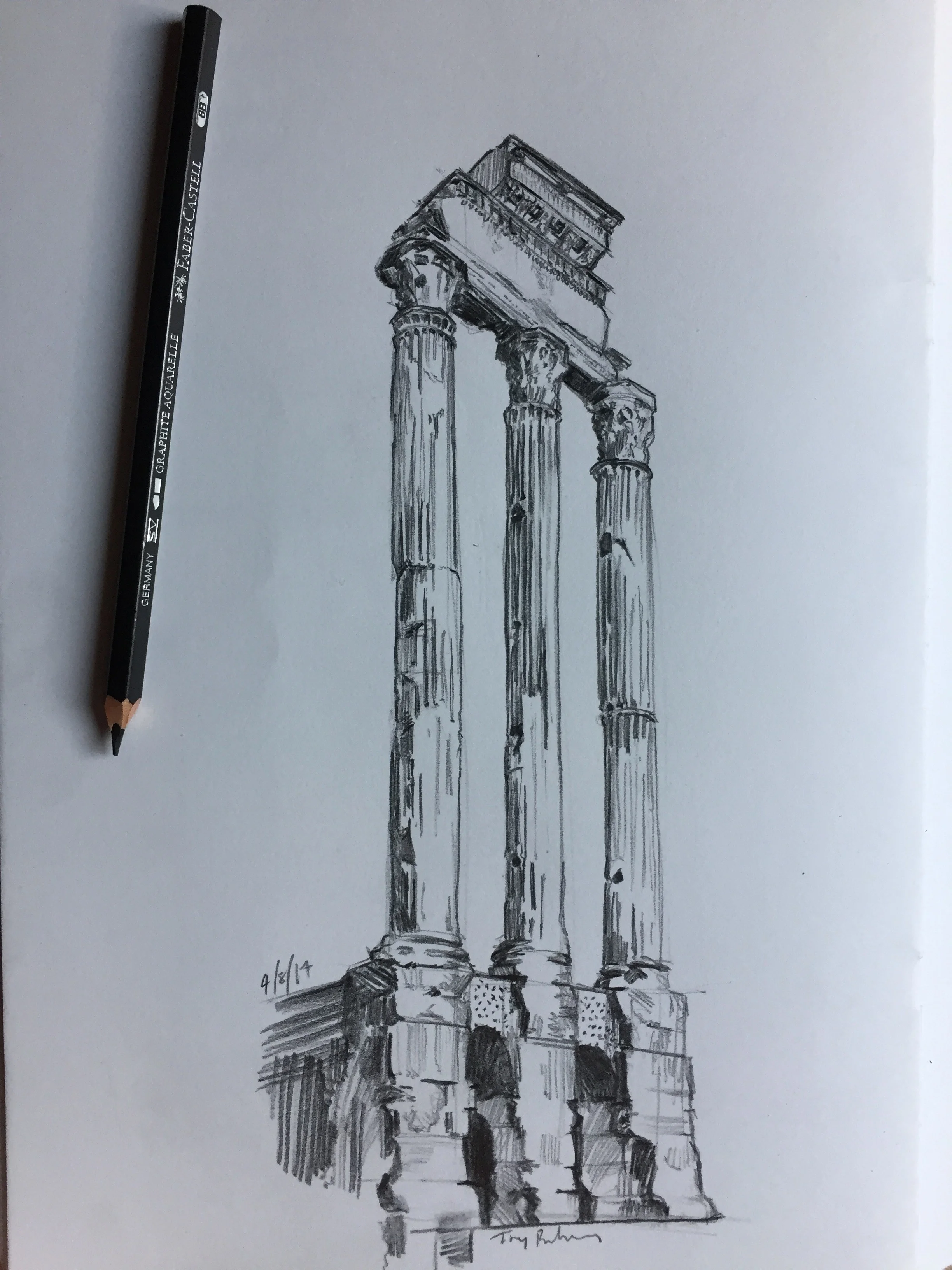
fig.3: “The Temple of Castor and Pollux”

fig.3: “The Temple of Castor and Pollux”

 Lastly are two drawings from a trip to Italy: “St Peter” by Mochi [fig.3] found guarding the Porto del Poppolo in Rome (full disclosure – I think that’s the right attribution, but I could be wrong) – I just loved the expression and characterisation; and “The Temple of Castor and Pollux” [fig.4] from the Forum for its drama and scale.

 Importantly these are drawings of sculptures (*ahem, mostly), bringing the three-dimensional challenges of form, shape, and depth to my drawings. Allowing me to play with shadow, tone, light and reflection and line. They are also detailed – drawings that prompt me to lose myself in the experience of drawing, in the tactile pleasure of blending and building up layers of graphite on paper. 

 The images are both challenging and zen – focusing my concentration on specific images, whilst simultaneously allowing latent ideas and plans to surface and unclench, letting them spread out from the ball which overthinking had wound them into.

Face values

Another quick blog I’m afraid. This week I have my graduation ceremony for my Illustration MFA (completed with distinction last October - yay! - but this week I get to wear the hat and robe 😉), so I’m writing between work bits n bobs, sorting all that and a bit of celebration.

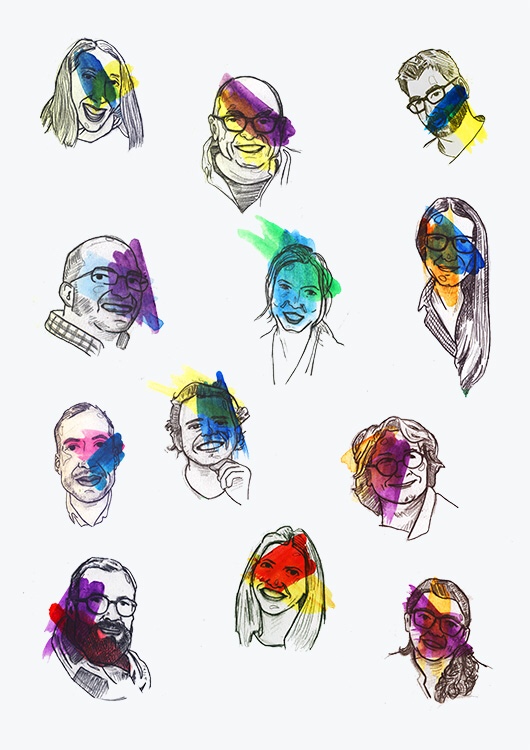
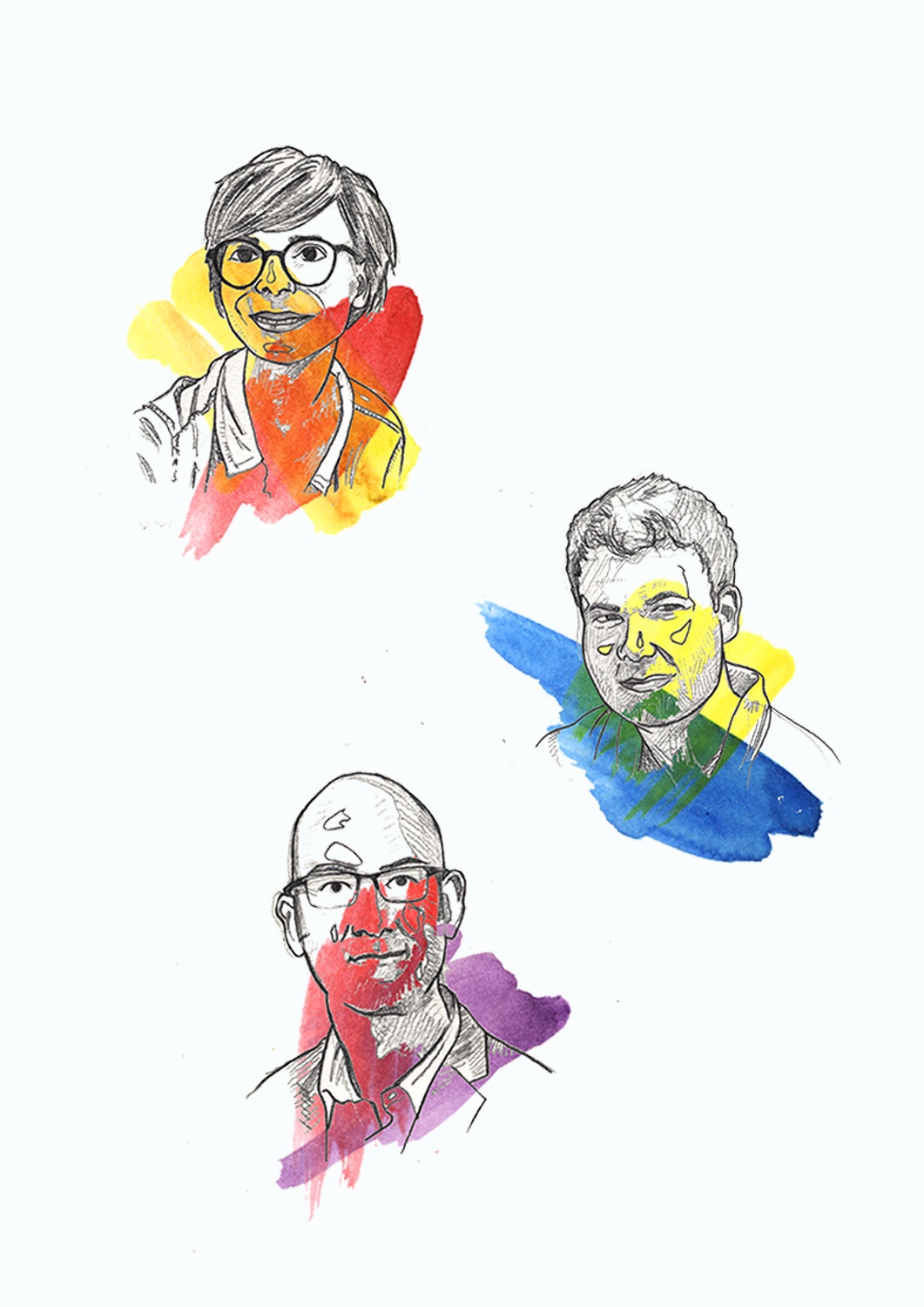
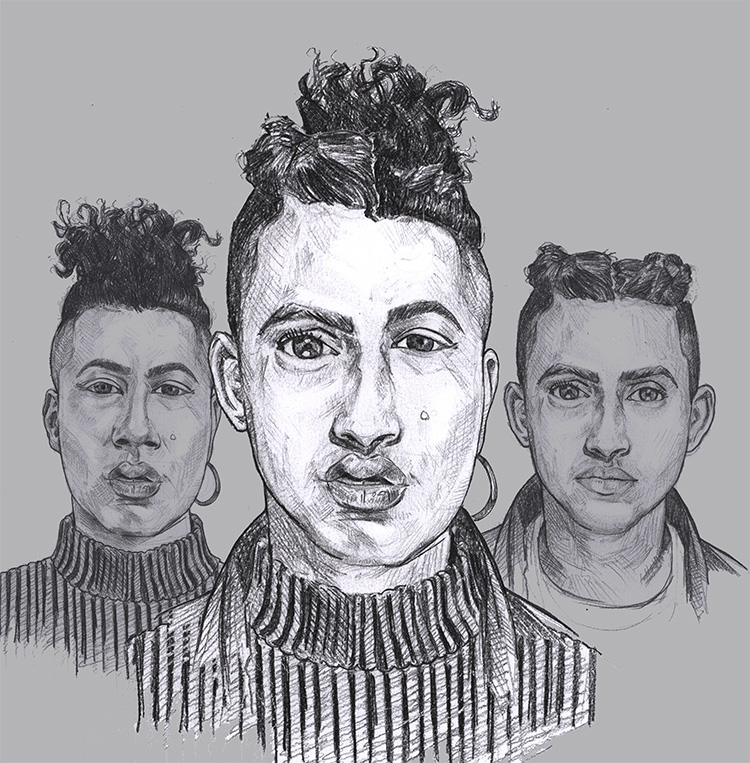
So this week I’m looking at some commissioned work - staff identities for a website, St Giles Medical (a medical communications company based in London and Berlin) [fig.1 & 2], which to me are celebratory.

Fig.1 “meet the team”

Fig.1 “meet the team”

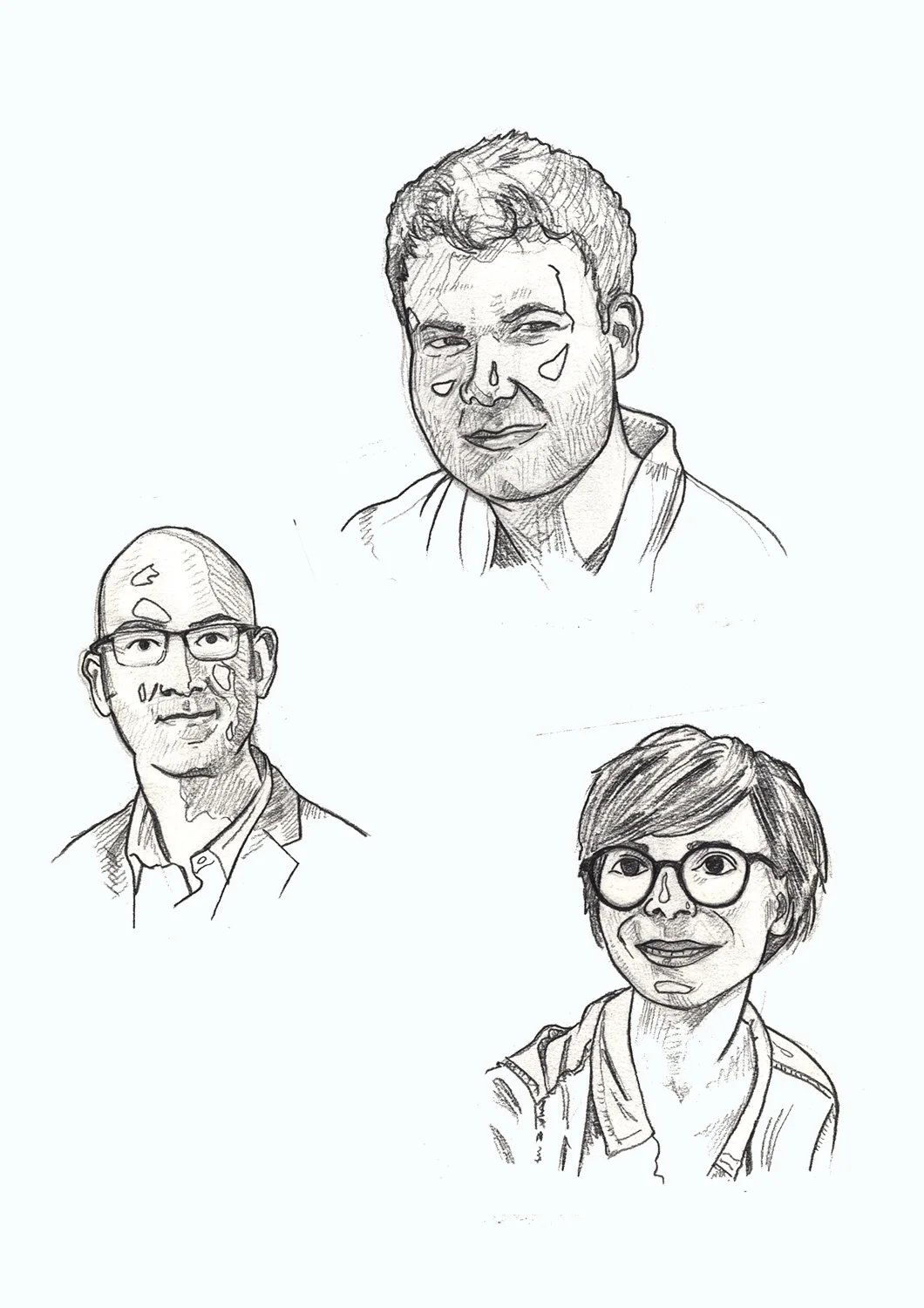
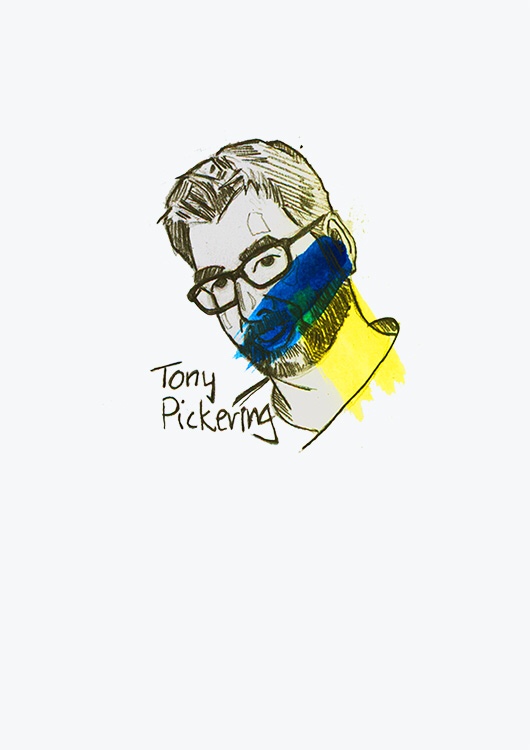
I loved doing these as they combine pencil drawings [fig.3], portraiture, cartooning and colour design (there’s also lettering which I’ve not included here - except fig.4), and each step has its own joy for me in the process.

Fig.2 “meet the team” (Additions)

Fig.2 “meet the team” (Additions)

These images have a nice tension for me - between realistic depiction and a stylised line that want more simplicity. There’s also something really cool about the way the pencil works with and against the colour - which is first gouache, then digitised as the drawing and image is refined.

Fig.3 “meet the team” Pencils

Fig.3 “meet the team” Pencils

At all stages there are challenges of depiction, of tone and colour and of composition - for the individual images, and how they can work together.

Fig.4 “meet the team” (individual and lettering)

Fig.4 “meet the team” (individual and lettering)

But ultimately, what I enjoy is the task of finding the personal in the professional and reminding myself how humanity is central to my illustrations and design.

Some welcome Graphic Medicine.

The sun had set, the moon luminescent in the sky – light flickering on the lapping waves. Heat and Summer stretched along the Brighton seafront – as back towards the centre Saturday night sprawled onto the shore.

Watching the dancing light, I felt a curious mixture of elation and exhaustion. The last three days of the Graphic Medicine 2019 conference had been an adventure: with so many people to see and speak to; new perspectives to consider and new work to appreciate – and wow to; as well as the small matter of my own presentation to prepare and deliver. After all that those dancing lights seemed to slip between inspiration and delirium. 

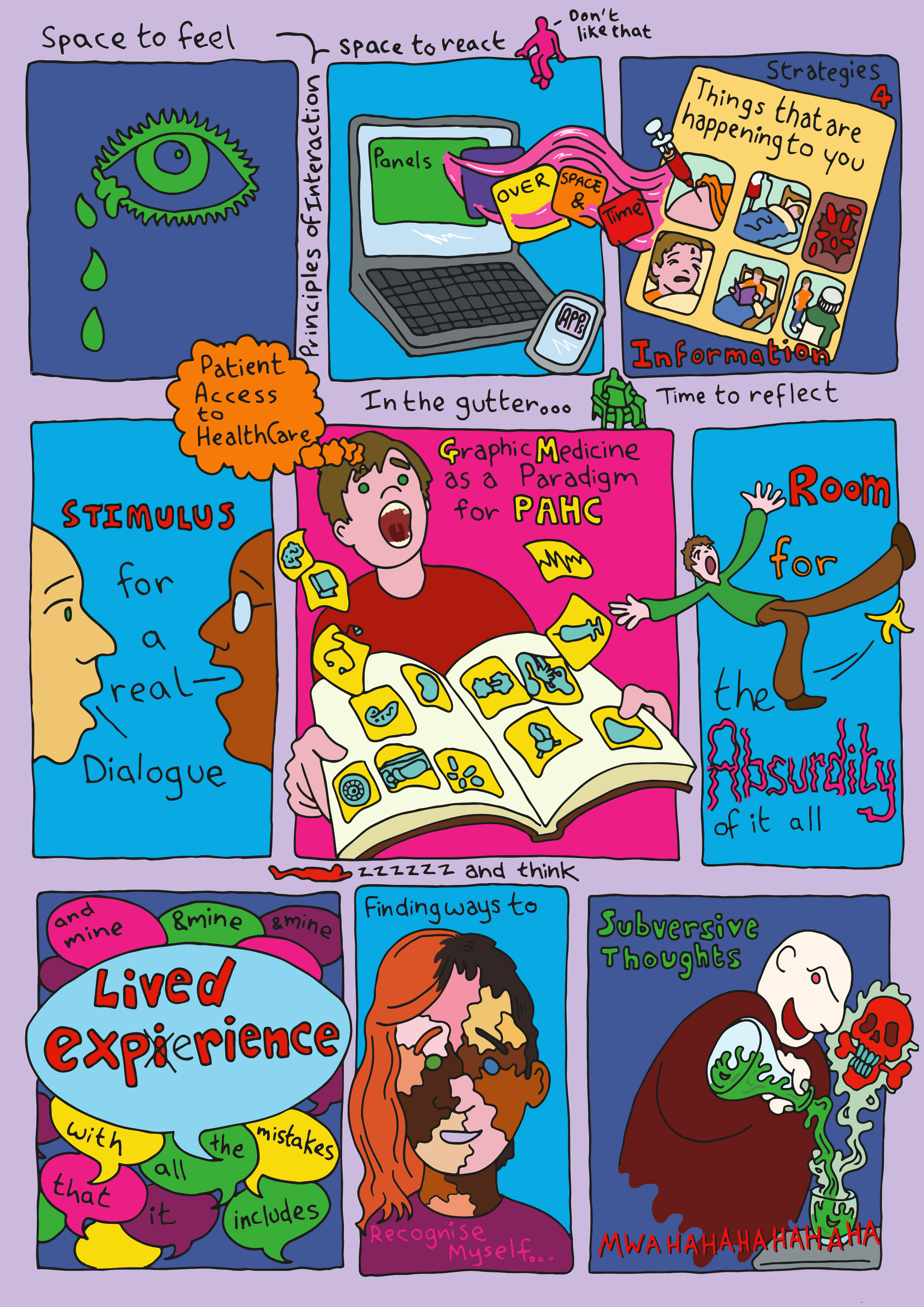
fig.2 Graphic Medicine as a paradigm for PAHC

fig.2 Graphic Medicine as a paradigm for PAHC

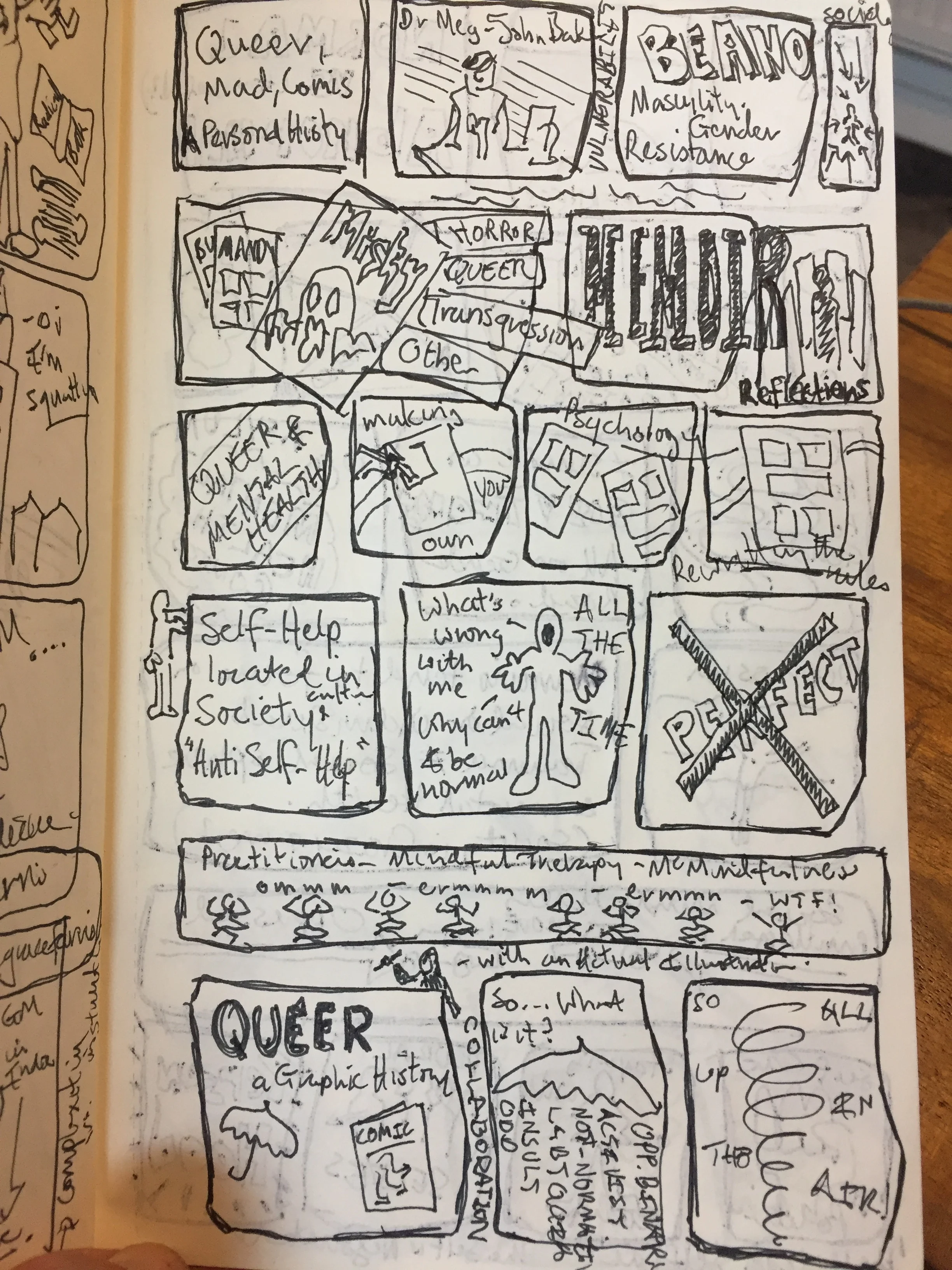
fig.1a: Meg-John Barker: Queer: A Graphic History (comics notes)

fig.1a: Meg-John Barker: Queer: A Graphic History (comics notes)

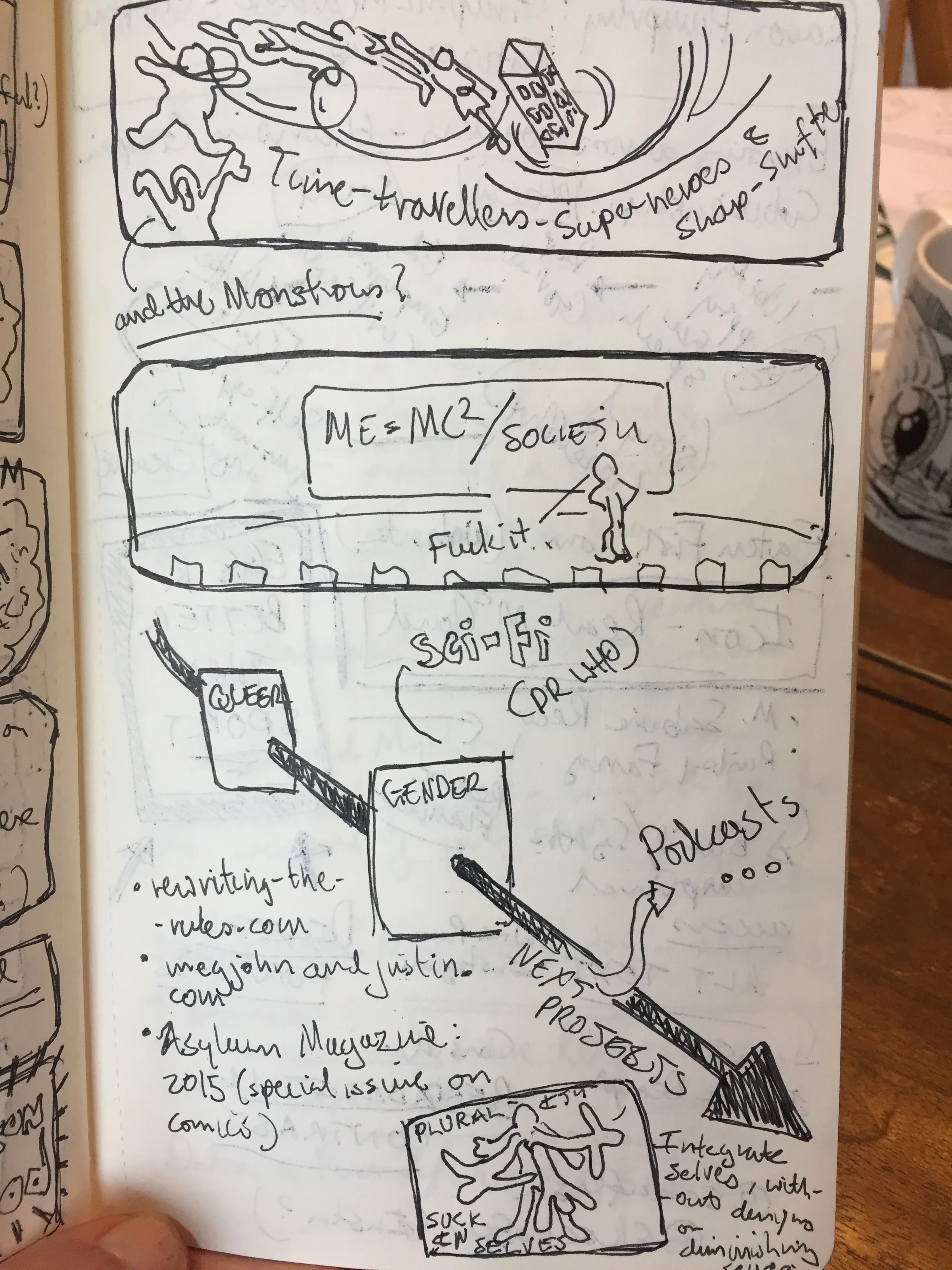
The theme of this year’s conference was Que[e]rying Graphic Medicineand kicked off with a keynote by Dr Meg-John Barker that looked at “queering” as a deconstruction of the simplicity of binary relationships in psychology and explored the notion of the many selves we are and act throughout our lives. Their speech spoke to my belief in the importance of communicating and engaging with complexity in the conversation between Healthcare Institutions, Professionals and People Accessing Healthcare; a belief that got me into graphic medicine in the first place [fig.2 are my comics notes of her keynote[1]].  

fig.1b: Meg-John Barker: Queer: A Graphic History (comics notes)

fig.1b: Meg-John Barker: Queer: A Graphic History (comics notes)

The breadth of the conferences took me from panel to workshop to conversation then further conversation over drinks. My snapshot covered comics that started conversations, that articulated multitudes of selves, that engaged with the lived experience of healthcare workers, carers and people living with illness[2]; presentations questioned our assumptions of form, value and benefit and sought to find ways to make plurality accessible – immediately and digitally[3]; workshops explored ways to allow access to aesthetic discovery and consider our models of healthcare[4], and all through this I saw comics that were beautiful, poignant, absurd – but mostly honest[5]. Presenters navigated the complexity of telling their own stories and how to express the stories of others[6], artists questioned and illuminated their own processes – and considered how the visual language of others could be re-purposed to allow themselves to say something they might otherwise keep hidden[7]. The final keynote was MK Czerwiec’s account of Coming Out as a Cartoonist, and the heartbreak and joy that fuels Taking Turns her memoir of the experience as a Nurse in Unit 371, an Aids unit at Illinois Masonic Medical Center in Chicago, that ran from 1984 to 2000. All of which was summed up by Matthew Noe – taking a break from live tweeting everything!

fig.1c: Meg-John Barker: Queer: A Graphic History (comics notes)

fig.1c: Meg-John Barker: Queer: A Graphic History (comics notes)

I couldn’t see all the panels, nor can I cover all I saw – so my apologies now to anyone I’ve missed out. For myself, the conference allowed me to speak on Diabetes: Year One – my impulses towards poetry and comics, and the articulation of comics as a research methodology. To discuss the process of discovery in the movement from being a person, then a patient, and then a person living with diabetes, and then, maybe in the future, a person who has diabetes. My talk led me to draw (a good sign I feel), to attempt to describe the way the comics has brought me to see comics as a paradigm for Person Access to HealthCare (PAHC – and yes the illustration was added last minute – hence my mistake of writing “patient” instead of ‘person’ in the orange bubble, go-on look, told you) – as a model for UX design, if you will [fig.1]. The idea is to realise that it is the person in the spaces between that gets to construct the meanings between the panels of information and experience, so instead of leaving the gutter as an after-thought, maybe design with the gutter space as the focal point?

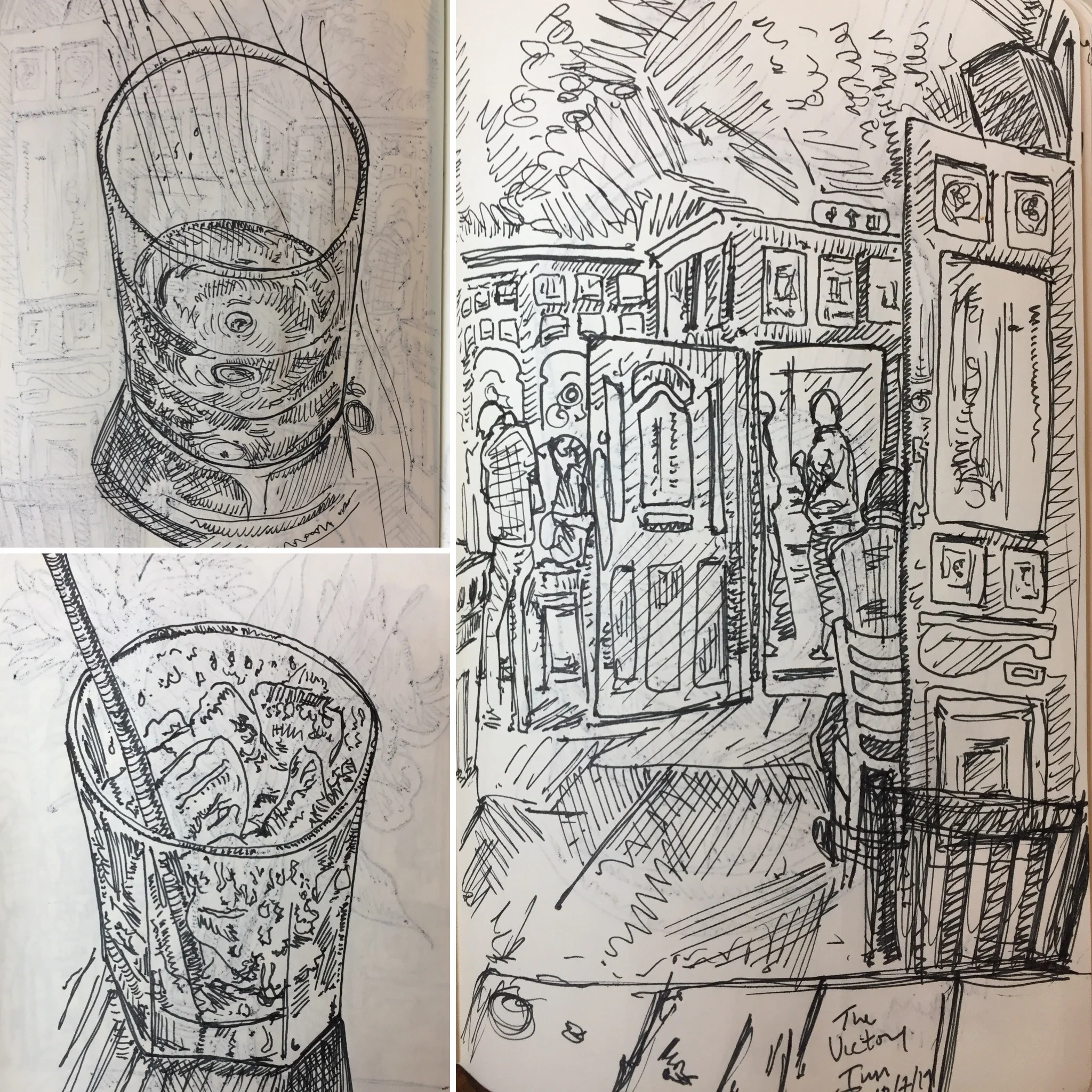
fig 3. Brighton: Pubs n Drinks

fig 3. Brighton: Pubs n Drinks

As well as all this, I got to talk out ideas for another comic project (no pics – the thumbnails are waaay to rough and over-written after getting too excited), drink way too much and explore some of Brighton’s pubs [fig.3]… and sights *coughs. Which might explain why the blog is late this week.

To conclude it was a phenomenal conference and a huge thanks needs to go to the organising committee: Bobbie Farsides, Ian Williams and Muna Al-Jawad, and I hope to make it again next year – in Toronto.


[1]Meg-John Barker: Queer: A Graphic History

[2]Wilkins, Caron, Grennan, Priego, Rana & Roper: On the Aesthetic Education of Caregivers: The Specificities of Form and Genre in Comics about Dementia Care; McNicol & Leamy: “He’s got a tongue, you know!”: Creating a comic with people with Dementia 

[3]Christina Maria Koch: Talking about Illness Experience in Graphic Medicine – Theory, Method, Politics; Alice Jaggers: Definitions without Borders: How to Define Graphic Medicine While Being Inclusive; Sam Schäfer: There is More to Comics and Blindness than Daredevil

[4]Councillor, Fox & Fryzelka: Drawing new paradigms of health and care

[5]Loads of these – but especially Zara Slattery: Coma Comic (work in progress – watch out for this!)

[6]Adam Bessie: It’s All In Our Head: Graphic Memoir in Collaboration; Viivi Rintanen: Comics about Madness – how to reduce the stigma of madness with a comics blog

[7]John Miers: Processing my own trauma through the voices of others.

Making a Scene...

I’m heading down to Brighton this week for Graphic Medicine 2019 Que[e]rying Graphic Medicine (#GM2019) this week, so today is all about finalising my presentation, and as I’ve just decided to add a sequence for it - mainly that. I figure next week’s post will be all about what happens, and what I get up to, which means today’s post is another chance to reflect on some past work.

fig.1: Sam & Tee

fig.1: Sam & Tee

This time I thought I’d think about figures and faces, characters and relations, so I thought I’d flag up some illustrations I produced as the online identity for The Family Tree - a “magical realist podcast drama about family, belonging, change and identity” created by @jadamthwaite and @goosefat101.

fig.2: Clara & Jackie

fig.2: Clara & Jackie

The illustrations all begin as pencil drawings, with some then augmented in photoshop [fig.1 & 2]. These two images had very specific roles in the development of the series, and were both fun and a challenge, as in order to get them turned around the most efficient way was to combine drawings, but to do so in such a way to keep the feel of the series. This was an opportunity to play with the digitisation of pencil, which happily creates textured effects I like - phew!

fig.3: Nathan

fig.3: Nathan

The show has a sense of intrigue and mystery about it (so worth starting at the beginning if you fancy a listen). These illustration all depict characters (and in some cases actors) from the show in situations from and around the episodes.

fig.4: Ellie

fig.4: Ellie

The creator briefs were fun - at times including show specific stuff that seemed random, until the episode aired, at times suggesting an allusion, or sub-text they’d like me to include, and alongside all that I was free to embellish and add in my own touches (such as the books in fig.6).

fig.5: Violita

fig.5: Violita

All of which meant that composing the image started to feel very much like a photograph - or film scene. Most of the images are square - to fit social media, which is an unusual angle for me, but one that began to open out space around the character, and negotiate new relationships between the character and scene. Often the angle is heightened - whether as a selfie [fig.4] (also why not a square), or an up or down shot [fig.2 & 6]. The sense of mystery comes from these compositions, but is accentuated by the tonal pencil, and the theme of shadow [fig.4 & 5 - but all of ‘em really] or echo that is built up in these images. The effect is to create a noir feeling in (mostly) ordinary spaces. I also like that you feel that, as well as you - the viewer, someone else is watching these scenes - probably just out of the corner of your eye, so you never quite catch them at it.

fig.6: Shahjahn

fig.6: Shahjahn

I really enjoyed the composition and sculpting of these illustrations - building snapshots of these characters lives. The drawings play on my love of drawing people and faces, but ask me to situate them in ways that are meaningful - the backgrounds are never neutral here. And whilst the show isn’t about medicine, which is more my normal manor - its dealing with issues of identity definitely speaks to my work on how we accept, define or resist medicine as part of our own personhood.

Oh, one final thing, the outline on the images gives a sense of sculpted reality - realistic, but also defined. The show’s magic realist tone seeks to do the same, reality with a twist - perhaps - I don’t wanna say too much, but y’know… listen…

http://thefamilytreepodcast.co.uk
https://podcasts.apple.com/gb/podcast/the-family-tree-episode-1-the-mystery/id1113714688?i=1000375761351

(P.S. - I hope these link works, I tried to embed ‘em - if not, that is the website, so do the cut and past, or manual, thing - ta)

Places and spaces.

Places and spaces. The world we exist in, and the way in which we experience that world. One of the first things I did when I began my practice consciously was to start sketching the world around me. To find buildings and places that I could really look at - to break into shapes, lines, tones and colours, to understand them better, to make them into spaces.

fig.1: The Wasteland [pencil on paper]

fig.1: The Wasteland [pencil on paper]

This started as a sketching project, but has increasingly become a dialogue with my drawing. The one looser and energetic, the other formalised and tonal. But the sketching has made me embrace idiosyncrasy and love movement, whilst the drawing has prompted clarity of vision, so that there is more economy of line, and thought in composition. One result of this has been more forgiveness of the wobbly line - a tendency of mine from teenage has been the pursuit of the perfect swish and swoop, or worst, a straight line.

fig.2: YHA Boggle Hole [ink on paper]

fig.2: YHA Boggle Hole [ink on paper]

The images today represent many of these features in various media - I have two considered drawings that evoke a setting. The Wasteland [fig.1] is a pencil study for a possible setting, playing with depth and detail, evoking a place in time - a space for characters to inhabit, and the emotional response, the tone, of that space. Whilst YHA Boggle Hole [fig.2] was a commission of a place as a present, a process that involves considering presenting that place, and making it a space as object. Drawn in ink, with a dipping pen I was able to create a degree of texture in building up layers of shading, but I also wanted to use this idea of place presented, to use and disrupt perspective and framing as a part of the conversation.

fig.4: Kendal Castle [pen on paper]

fig.4: Kendal Castle [pen on paper]

fig.3: Shaftesbury Theatre [pen on paper]

fig.3: Shaftesbury Theatre [pen on paper]

The others are sketches - of buildings and landscape. The buildings are sketched whilst drinking coffee, the landscape whilst taking a break from talking. Shaftesbury Theatre [fig.3] and Kendal Castle [fig.4] are pen sketches. I find using a thicker pen gives less allowance for fiddly detail, which in turn means you have to breath before making marks, to give yourself time to see where the pen will go, rather than my normal approach, which is to get marks on the paper and tame them to what I want. This was a choice that came from drawing, where I could take the time to refine line direction and thickness. You can see this approach more in the pencil drawing of Sixty-Sixty Sounds in Denmark Street [fig.5]. It’s not the best photo, but you can see how the think-as-you-draw nature of my mark making is refined to bring edges to a line, and to build up the tonal range.

fig.5: Sixty-Sixty Sounds [blue pencil on paper]

fig.5: Sixty-Sixty Sounds [blue pencil on paper]

I like both approaches, but there’s something rewarding about the pen sketches purely because it’s so much easier to overwork them. Pencil is seductive, and I could easily spend the day in a sketch that becomes a drawing, so in some ways I never feel finished (though, of course, I have to); whilst with pen your time and paper is finite, so the experience (and this might be a lot to do with sketching from coffee shops) is more of a rush - clear observation, decisive lines, and the capacity to adapt to mistakes, or to quickly abandon it and start again.

fig.6: Spring Cottage [pen on paper]

fig.6: Spring Cottage [pen on paper]

I have talked before about drawing as a way to respond to the world - hinting at its meditative qualities, and about the ‘mindfulness’ of focus - the close observation of the immediate and the ‘now’. In many ways this idea of space-making in drawing (or in art and design in general) is about the reflection on relationships that exist within and around places, that define space.

Earlier I mentioned that my practice was part of a dialogue, so I think that my last image should be a sketch that is a conversation - a way of communicating with my father who has dementia, who likes to watch me sketch - an act that is present, that is connected to the place around him, that may help to give it meaning (albeit briefly), that creates a space. It’s unfinished - next time I’ll make sure to take a cushion out for Dad, but after the first few lines, as I could relax into the perspective and proportion of the building, I could look and watch as his eyes followed my hand, measuring watch I was producing on the paper against watch he could see in front of him. As it happens, I think this drawing balances on the fault-line between the styles I’ve discussed today...

This was supposed to be another quick post - though I seem to have got carried away… maybe it’s the yoga? - but that’s for another post…

I'm laughing, you're laughing?... I'm... oh...

It’s Monday, and the last of the solstice light comes crashing through the window, as work looms up to mock my bleary eyes.

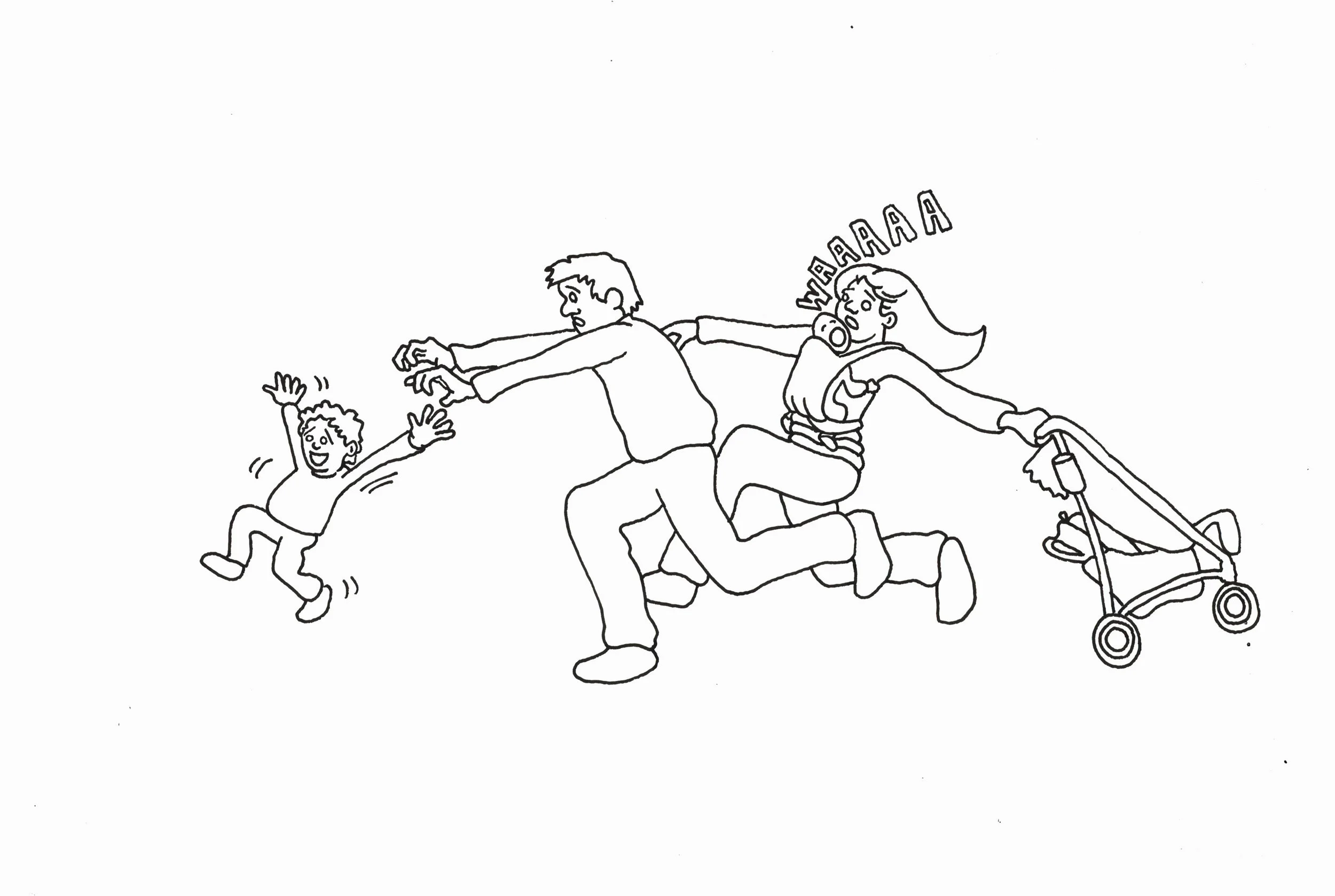
I’m determined not to be so tardy this week, so this post is a few pieces from my random art file. The pieces are ink based, and focused on my sense of humour - dark [fig.1] and slapstick [fig.2, 3 & 4] (and arguably not that funny - although I’m laughing).

fig.1 Trick or Treat (Inktober 2018)

fig.1 Trick or Treat (Inktober 2018)

This sequence was inspired by last years Inktober prompts, which I was running late on - but fortunately seemed to naturally fall into a suitably gruesome narrative. It gave me a chance to develop characters, but also to go heavy with the ink for a Noir feel. I like the detail in the style, the use of perspective, the dancing of the story, and the twist in the last panel. And the gunk… I like the gunk.

fig.2 Madcap DayOut

fig.2 Madcap DayOut

This image was an unused idea for a commissioned piece - aiming for more family friendly in audience. I still wanted to add a sense of the chaos I remember from family days out, and the sheer effort of the experience I have since encountered looking after nieces and nephews. Again I like the energy and movement, as well as the conflicting experiences of all involved. As befits the ‘zany' approach the final version was coloured an tweaked using photoshop (see bel… erm, here…

fig.3 Madcap Day Out (colour version)

fig.3 Madcap Day Out (colour version)

The disconnected shadow does add energy (and the dad’s shoe is uncoloured, as it was behind an object - (honest!).

I find humour is a great way to explore ideas and thoughts visually - it gives you the space to both articulate, and critique your thoughts, and hopefully find ways to connect ideas, feelings and experiences in a way that makes them accessible in real life. Saying that I’m not sure what ‘Trick or Treat’ says for my relationship with pumpkins? And humour can also feel very vulnerable - after all, the image can be great, but if it’s not funny… well, that’s it.

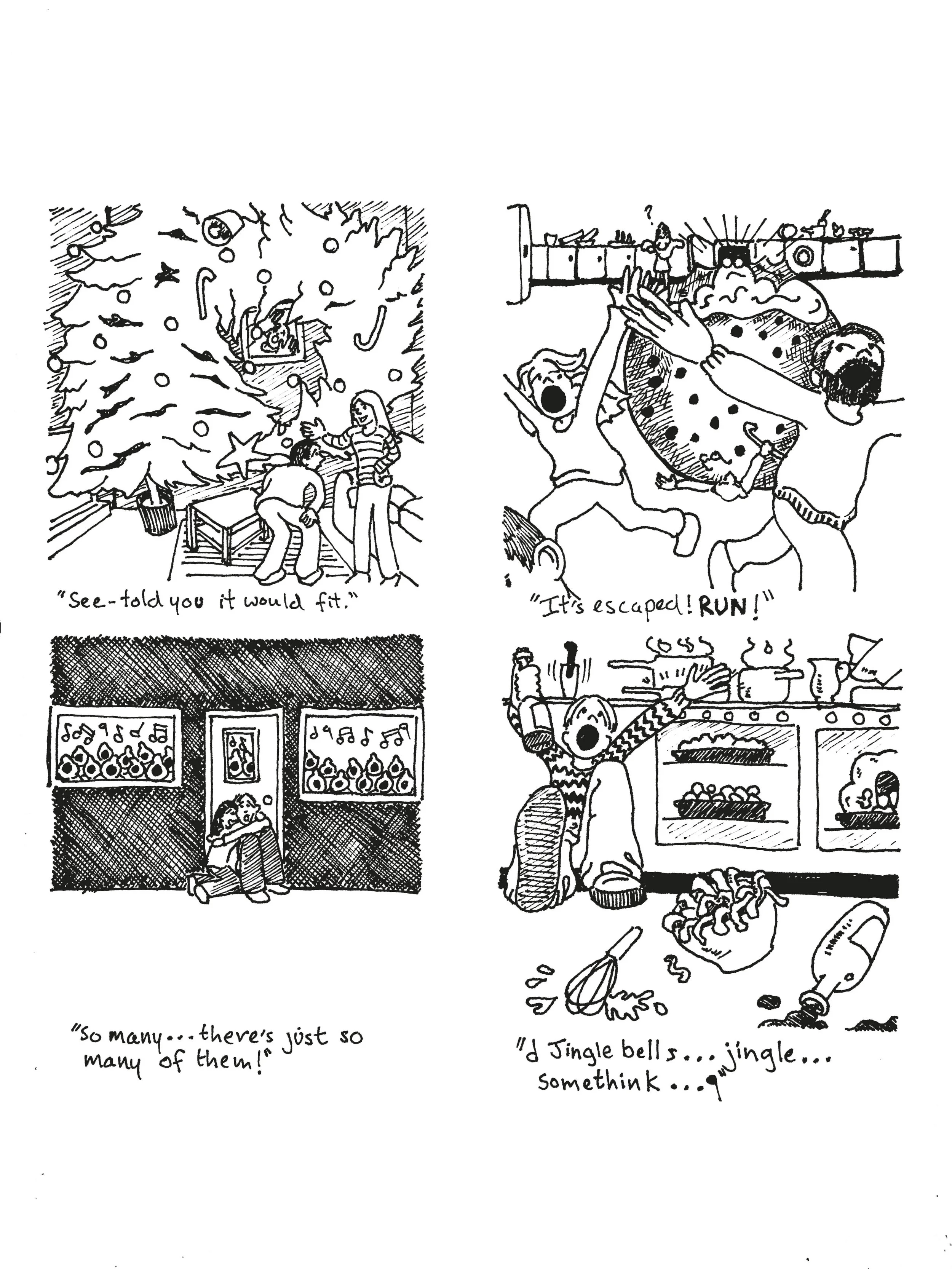
Still - I must have a big enough ego, as this next lot [fig.4] were my xmas cards last year, and while I’d refine the line a bit (it was a last minute ideas, so I ran up against the print deadline), the main thing was would the idea work? I especially like the carol singers - the image is economical, and the caption tells a strong story; though the tree and drunk-in-the-kitchen relate to my experiences of Christmas. The feedback was good thought, so this year… hmmmm.

fig.4 Xmas Chaos

fig.4 Xmas Chaos

Again, gotta rush. Next week I suspect will be also rushed (hopefully then back to normal), so I’m going to focus on places and spaces I’ve explored in drawings before.